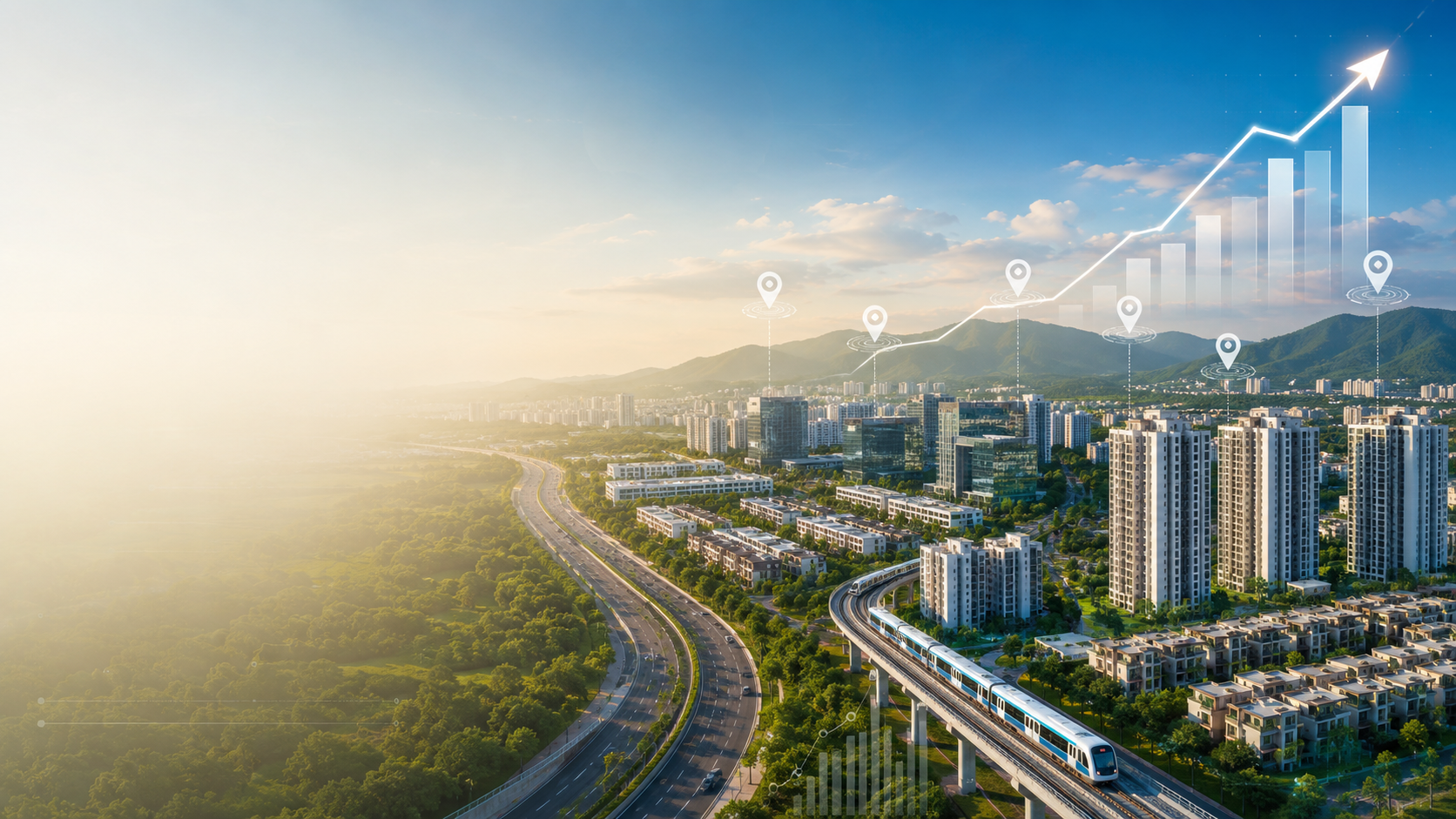
Pune Property Price Trends (2015–2026): Area-wise Analysis & Future Predictions
Pune has evolved into one of India’s most attractive residential real estate markets over the past decade. Once known primarily as an educational and manufacturing hub, the city has transformed into a thriving technology and business destination, attracting professionals, entrepreneurs, students, and investors from across the country and abroad. This steady influx of population has significantly increased housing demand, leading to consistent appreciation in property prices across several micro-markets.
Unlike many cities that experienced volatile price movements, Pune’s residential market has largely been driven by end-user demand rather than speculation. Major employment hubs in Hinjawadi, Baner, Kharadi, Magarpatta, and Pimpri-Chinchwad have continued to create thousands of new jobs each year, supporting sustainable growth in the housing sector.
Infrastructure has also played a defining role in reshaping Pune’s property landscape. The expansion of the Metro network, the proposed Ring Road, improvements to the Mumbai–Pune Expressway, new flyovers, the upcoming international airport at Purandar, and the growth of IT parks have made previously peripheral locations increasingly attractive to homebuyers and investors.
As a result, areas such as Baner, Balewadi, Hinjawadi, Wakad, Punawale, Tathawade, Bavdhan, Bhukum, and Kharadi have witnessed significant appreciation between 2015 and 2026. While premium locations continue to command higher prices, emerging corridors still offer excellent opportunities for long-term wealth creation.
Whether you are a first-time homebuyer, an investor looking for strong capital appreciation, or an NRI planning to invest in Pune, understanding historical price trends is essential for making informed decisions.
In this guide, you will discover how Pune property prices have evolved between 2015 and 2026, which locations have delivered the strongest returns, the infrastructure projects influencing future growth, and where the best investment opportunities may lie over the coming years.
Pune Real Estate Market Overview
Why Pune Continues to Outperform
Pune property prices in 2026 average ₹9,600 per sq.ft. across the city, up from ₹5,100 per sq.ft. in 2015 — an appreciation of 88% over 11 years. This makes Pune one of the most consistent residential real estate markets in India, outperforming many larger cities on a risk-adjusted basis.
Pune consistently ranks among India’s strongest residential property markets because it combines employment growth, quality infrastructure, educational institutions, and comparatively affordable housing compared to cities like Mumbai, Bengaluru, and Hyderabad.
Several long-term factors continue to support demand:
– Large IT and ITES workforce across Hinjawadi, Baner, and Kharadi
– Strong automobile and manufacturing industries in Chakan, Pimpri, and Talegaon
– Presence of top universities and educational institutes
– Continuous migration from across India
– Healthy rental demand driven by working professionals
– Stable end-user driven market with low speculative activity
– Expanding Metro and road infrastructure network
Unlike speculative markets, Pune has historically shown steady and sustainable appreciation, making it attractive for both homebuyers and long-term investors.
Key Growth Drivers
Employment Hubs
The city’s employment ecosystem includes:
– Hinjawadi IT Park — Phase 1, 2, and 3
– Baner–Balewadi Commercial Belt
– Kharadi EON IT Park
– Talawade IT Park
– Pimpri Industrial Zone
– Chakan Manufacturing Hub
These employment centres continue to generate strong residential demand in surrounding locations.
Infrastructure
Major infrastructure developments shaping Pune’s property market include:
– Pune Metro — Line 1 and Line 2 operational, Line 3 (Hinjawadi corridor) under progress
– PMRDA Ring Road — connecting peripheral areas and opening new development corridors
– Mumbai–Pune Expressway expansion and missing link project
– Pune Airport upgrades for increased capacity
– Proposed Purandar International Airport
– New flyovers and highway widening across the city
Each project improves connectivity and typically contributes to higher property values in nearby locations over time.
Pune Property Price Timeline (2015–2026)
The table below tracks how Pune’s average residential property price has moved year on year, along with the market events that shaped each period.
| Year | Average Price (₹/sq.ft.) | Major Market Event | Approx. Growth |
|——|————————–|——————-|—————-|
| 2015 | ₹5,100 | Stable Market | 4% |
| 2016 | ₹5,300 | RERA Introduced | 4% |
| 2017 | ₹5,500 | GST Implementation | 3% |
| 2018 | ₹5,800 | Metro Construction Begins | 5% |
| 2019 | ₹6,100 | IT Expansion | 5% |
| 2020 | ₹6,000 | COVID Slowdown | -2% |
| 2021 | ₹6,350 | Low Home Loan Rates | 6% |
| 2022 | ₹6,900 | Demand Recovery | 8% |
| 2023 | ₹7,500 | Infrastructure Boost | 9% |
| 2024 | ₹8,150 | Strong Sales Momentum | 9% |
| 2025 | ₹8,900 | Premium Project Launches | 9% |
| 2026 | ₹9,600 | Metro Expansion & Ring Road Progress | 8% |
*Indicative citywide averages. Prices vary significantly by micro-market, project quality, builder reputation, and property type.*
Key observations from this data:
– The only year of negative growth was 2020, when COVID-19 disrupted the market briefly
– Recovery was swift — 2021 saw 6% growth driven by record-low home loan rates
– The strongest sustained growth phase ran from 2022 to 2025, averaging 8–9% annually
– 2026 growth of 8% reflects continued Metro expansion and Ring Road progress
Area-wise Property Price Analysis (2015–2026)
The table below compares property prices across Pune’s key residential micro-markets from 2015 to 2026, with CAGR and investment scores.
| Location | 2015 | 2020 | 2026 | Approx. CAGR | Investment Score |
|———-|——|——|——|————–|—————–|
| Baner | ₹6,500 | ₹8,200 | ₹12,500 | 6.1% | 9.5/10 |
| Balewadi | ₹5,900 | ₹7,400 | ₹11,300 | 6.3% | 9.3/10 |
| Hinjawadi | ₹4,700 | ₹5,900 | ₹9,500 | 6.7% | 9.6/10 |
| Wakad | ₹5,000 | ₹6,300 | ₹9,200 | 6.2% | 9.2/10 |
| Punawale | ₹4,100 | ₹5,500 | ₹8,400 | 6.8% | 9.4/10 |
| Tathawade | ₹4,400 | ₹5,900 | ₹8,900 | 6.6% | 9.3/10 |
| Bavdhan | ₹5,600 | ₹7,000 | ₹10,500 | 5.9% | 9.0/10 |
| Bhukum | ₹3,900 | ₹5,000 | ₹7,700 | 6.5% | 8.9/10 |
| Kharadi | ₹6,300 | ₹8,700 | ₹13,500 | 7.2% | 9.8/10 |
| Wagholi | ₹4,200 | ₹5,300 | ₹7,600 | 5.7% | 8.6/10 |
| Pimpri | ₹5,000 | ₹6,600 | ₹9,700 | 5.8% | 8.8/10 |
| PCMC Prime Areas | ₹5,400 | ₹7,000 | ₹10,400 | 6.0% | 9.0/10 |
—
Kharadi Property Prices (2015–2026)
Kharadi property prices in 2026 average ₹13,500 per sq.ft., up from ₹6,300 per sq.ft. in 2015 — a CAGR of 7.2%, the strongest appreciation of any Pune micro-market, with an investment score of 9.8 out of 10.
Kharadi’s rise is directly tied to the growth of EON IT Park, which houses major global and Indian IT companies. The area benefits from proximity to Pune Airport, easy access to the Pune–Mumbai Expressway, and a well-developed social infrastructure including schools, hospitals, malls, and restaurants.
Why Kharadi commands premium prices:**
– Home to EON IT Park — one of Pune’s largest IT employment hubs
– Excellent airport connectivity — under 10 minutes to Pune Airport
– Well-established social and retail infrastructure
– Strong rental demand from IT professionals
– Premium and luxury project launches by top developers
Kharadi remains the top-ranked investment location in Pune for 2026–2030.
Baner Property Prices (2015–2026)
Baner property prices in 2026 average ₹12,500 per sq.ft., up from ₹6,500 per sq.ft. in 2015, reflecting a CAGR of 6.1% driven by its established commercial belt and premium residential demand.
Baner is one of Pune’s most established premium residential locations, anchored by its thriving commercial belt along Baner Road and Balewadi High Street. Its proximity to Hinjawadi IT Park, excellent dining and entertainment options, and consistently high-quality project launches have made it a top choice for working professionals and investors alike.
Why Baner commands premium prices:
– Walking distance or short commute to Hinjawadi IT Park
– Mature social infrastructure — restaurants, cafes, schools, hospitals
– Premium and mid-premium residential supply from reputed developers
– Strong resale market with consistent buyer interest
– High rental yields driven by IT and corporate workforce
Hinjawadi Property Prices (2015–2026)
Hinjawadi property prices in 2026 average ₹9,500 per sq.ft., up from ₹4,700 per sq.ft. in 2015 — a CAGR of 6.7%, supported by IT Park employment and the upcoming Metro corridor.
Hinjawadi is Pune’s largest and most prominent IT destination, home to the Rajiv Gandhi Infotech Park spread across three phases. With hundreds of IT and ITES companies operating here, the area generates enormous residential demand for nearby locations.
The upcoming Hinjawadi–Shivajinagar Metro corridor is expected to significantly improve connectivity and add a further price tailwind to the area.
Why Hinjawadi is a top investment destination:
– Largest IT employment hub in Pune — over 3 lakh IT professionals
– Upcoming Metro corridor improving connectivity
– Strong rental demand with yields of 3–4%
– Multiple new project launches by top developers
– Significant infrastructure improvements in recent years
Wakad Property Prices (2015–2026)
Wakad property prices in 2026 average ₹9,200 per sq.ft., up from ₹5,000 per sq.ft. in 2015, with strong rental demand making it one of Pune’s most liquid residential micro-markets.
Wakad occupies a strategic location between Hinjawadi IT Park and the Baner–Balewadi corridor, making it attractive for buyers who want proximity to employment while keeping costs slightly lower than Baner. The area has seen rapid infrastructure development over the past decade, with improved roads, flyovers, and social amenities.
Punawale Property Prices (2015–2026)
Punawale property prices in 2026 average ₹8,400 per sq.ft., up from ₹4,100 per sq.ft. in 2015 — a CAGR of 6.8%, offering the best affordability-to-appreciation ratio in West Pune.
Punawale has emerged as one of the most compelling value propositions in Pune’s residential market. Situated adjacent to Wakad and Hinjawadi, it offers buyers easy access to IT employment while prices remain more affordable than its more established neighbours. Its CAGR of 6.8% is among the highest in Pune, reflecting strong underlying demand.
Tathawade Property Prices (2015–2026)
Tathawade property prices in 2026 average ₹8,900 per sq.ft., up from ₹4,400 per sq.ft. in 2015, with a CAGR of 6.6% backed by proximity to IT hubs and growing educational institutions.
Tathawade is an established residential destination in North-West Pune, benefiting from its location between Hinjawadi IT Park and Pimpri-Chinchwad. The presence of several engineering colleges and educational institutions, combined with easy access to employment hubs, has created consistent demand.
Bavdhan Property Prices (2015–2026)
Bavdhan property prices in 2026 average ₹10,500 per sq.ft., up from ₹5,600 per sq.ft. in 2015, combining natural surroundings with premium residential developments and strong connectivity.
Bavdhan is a sought-after residential destination for buyers who prioritise green surroundings, quieter living, and proximity to both Baner and the Mumbai–Pune Expressway. The area has seen an influx of premium and luxury residential projects over the past five years.
Balewadi Property Prices (2015–2026)
Balewadi property prices in 2026 average ₹11,300 per sq.ft., up from ₹5,900 per sq.ft. in 2015, with a CAGR of 6.3% driven by excellent infrastructure, sports facilities, and lifestyle developments.
Balewadi has transformed from a peripheral location into one of Pune’s most aspirational residential addresses, anchored by Balewadi High Street and proximity to the Shree Shiv Chhatrapati Sports Complex. Its location between Baner and Hinjawadi makes it highly attractive for working professionals.
Bhukum Property Prices (2015–2026)
Bhukum property prices in 2026 average ₹7,700 per sq.ft., up from ₹3,900 per sq.ft. in 2015 — a CAGR of 6.5% — making it one of Pune’s most promising emerging investment corridors.
Bhukum remains one of West Pune’s most affordable residential options while offering strong appreciation potential. Its location between Bavdhan and Pirangut, combined with improving road infrastructure, is drawing increasing interest from first-time buyers and investors looking for value.
Wagholi Property Prices (2015–2026)
Wagholi property prices in 2026 average ₹7,600 per sq.ft., up from ₹4,200 per sq.ft. in 2015, offering an affordable entry point in East Pune with growing connectivity to Kharadi and the IT corridor.
Wagholi serves as an affordable gateway to East Pune’s IT employment corridor. While infrastructure has historically been a challenge, significant improvements to road connectivity and social infrastructure over the past three years have strengthened buyer confidence.
What Is Driving Property Prices in Pune?
1. Pune Metro
The Pune Metro has significantly improved connectivity between residential and commercial zones, making metro-connected neighbourhoods increasingly attractive for both homeowners and investors. Areas within walking distance of Metro stations are seeing 10–15% price premiums compared to similar properties further away.
2. PMRDA Ring Road
The proposed PMRDA Ring Road is expected to reduce travel times, unlock new development corridors, and improve accessibility across western, northern, and eastern Pune. Locations along the Ring Road alignment — including Punawale, Bhukum, and emerging areas in North Pune — stand to benefit significantly from this project.
3. IT Sector Expansion
The continuous expansion of IT companies across Hinjawadi, Baner, Balewadi, and Kharadi has created sustained demand for residential housing close to employment centres. New data centres, global capability centres (GCCs), and technology campuses are adding further employment density to these corridors.
4. Manufacturing Growth
Industrial clusters in Chakan, Talegaon, Pimpri, and Talawade continue to attract a large workforce, supporting housing demand across nearby suburbs including PCMC, Pimpri, and North Pune.
5. Educational Institutions
Pune’s reputation as an education hub attracts thousands of students and professionals every year, contributing to both rental demand and long-term residential growth across the city.
Best Investment Locations in Pune (2026–2030)
| Rank | Location | Why Invest? |
|——|———-|————-|
| 1 | Kharadi | IT hub, premium growth, strong rentals |
| 2 | Hinjawadi | Metro connectivity, IT employment |
| 3 | Baner | Established premium residential market |
| 4 | Punawale | Affordable with strong appreciation potential |
| 5 | Balewadi | Excellent infrastructure and lifestyle |
| 6 | Tathawade | Growing educational and residential hub |
| 7 | Bavdhan | Nature, connectivity, premium developments |
| 8 | Bhukum | Emerging investment corridor |
| 9 | Wakad | Excellent rental demand |
| 10 | PCMC | Industrial and infrastructure-led growth |
Pune Property Price Forecast (2026–2030)
While future prices depend on macroeconomic conditions, infrastructure progress, and interest rates, Pune’s long-term fundamentals remain positive. Here are the three scenarios to consider when planning an investment.
Optimistic Scenario — 8–10% Annual Appreciation
This scenario assumes:
– Strong IT and GCC hiring across Hinjawadi, Baner, and Kharadi
– Faster-than-expected Metro completion including the Hinjawadi corridor
– Ring Road execution on schedule
– Stable or declining home loan interest rates
Base Scenario — 6–8% Annual Appreciation (Most Likely)
This scenario assumes:
– Balanced supply and demand across key micro-markets
– Continued infrastructure development with some delays
– Moderate economic growth of 6–7% GDP
– Interest rates stabilising around current levels
Conservative Scenario — 4–6% Annual Appreciation
This scenario assumes:
– Slower infrastructure execution and funding delays
– Higher borrowing costs reducing buyer purchasing power
– Increased housing supply from new project launches
– Slower job creation in the IT and manufacturing sectors
These projections are indicative and should not be interpreted as guaranteed returns. Real estate investments carry inherent risks and buyers should seek professional advice before making decisions.
Tips for Property Buyers in Pune
Before you buy:
– Choose locations close to existing or upcoming employment hubs
– Verify RERA registration at maharera.mahaonline.gov.in before booking
– Compare at least 3–4 builders and projects in your chosen location
– Plan your home loan EMI at no more than 35–40% of your net monthly income
– Consider future infrastructure plans, not just current prices and connectivity
– Evaluate rental demand if purchasing for investment — ask for average yields in the area
– Keep an emergency fund equivalent to 6 months of EMI beyond the down payment
– Review maintenance costs, parking charges, and society corpus fund carefully
Common Mistakes to Avoid
1. Buying solely because a property appears inexpensive — low price in a poorly connected area often means poor appreciation and weak rental demand
2. Ignoring future infrastructure plans — upcoming Metro stops and Ring Road corridors are significant price tailwinds
3. Not checking legal documentation— always verify title, encumbrance certificate, and occupancy certificate
4. Choosing a builder without assessing delivery history — past project handover timelines are the most reliable predictor of future delays
5. Overstretching monthly EMI commitments— buffer for interest rate fluctuations and unexpected expenses
6. Ignoring resale potential— some micro-markets have limited buyer pools, making exit difficult
7. Not comparing nearby projects— pricing varies significantly within the same area depending on builder reputation and amenities
8. Underestimating maintenance expenses — factor in society charges, property tax, and periodic maintenance costs
9. Focusing only on amenities rather than location — a gym fades in importance; a long daily commute does not
10. Making decisions based on speculation instead of market research — end-user demand, not sentiment, drives sustainable appreciation in Pune
Expert Outlook
Pune’s residential market has demonstrated remarkable resilience over the past decade. It navigated demonetisation in 2016, GST implementation in 2017, the IL&FS liquidity crisis in 2018–19, and the COVID-19 disruption in 2020 — and in each case recovered strongly within 12–18 months.
Continued employment growth across IT, GCC, manufacturing, and education sectors, combined with infrastructure investments in the Metro and Ring Road, and a healthy pipeline of end-user demand provides a solid foundation for long-term appreciation. While short-term fluctuations are always possible, buyers who prioritise quality projects, established developers, and well-connected locations are generally better positioned for sustainable value creation.
The window for buying in emerging corridors like Punawale, Bhukum, and Tathawade at relatively accessible prices is narrowing as infrastructure improves and buyer interest intensifies.
Conclusion
From 2015 to 2026, Pune has emerged as one of India’s most dynamic and consistent residential real estate markets. Locations such as Kharadi, Baner, Hinjawadi, Balewadi, Wakad, Punawale, and Tathawade have recorded strong appreciation, supported by expanding infrastructure, employment opportunities, and consistent housing demand.
For investors, the city continues to offer opportunities across both established and emerging micro-markets. For end-users, purchasing a home in a well-connected location with strong long-term fundamentals can provide both lifestyle benefits and meaningful capital appreciation over a 5–10 year horizon.
If you are planning to buy property in Pune, compare locations carefully, evaluate infrastructure developments in the pipeline, and seek professional guidance before making a decision.
Need expert advice?Explore our location guides, compare new launch and ready-to-move projects across West and East Pune, and connect with the VJ Real Estate team for personalised assistance in finding the right property for your goals.
Leave a Reply
You must be logged in to post a comment.