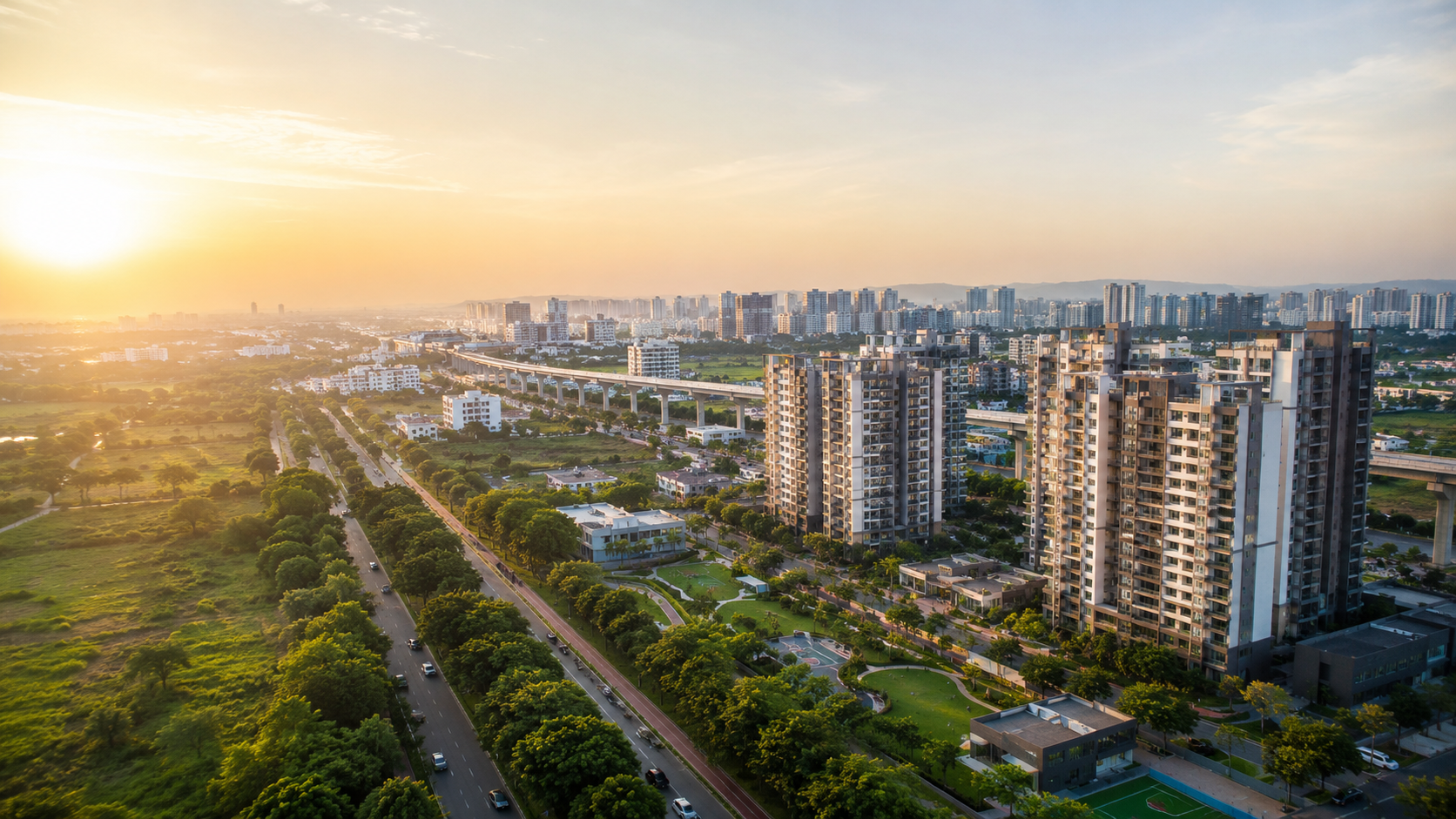
Punawale 2026: The Complete Real Estate Guide — Prices, Metro Connectivity, Investment Outlook & Liveability
Quick answer: Punawale (Pincode 411033), a West Pune locality between Wakad and Tathawade, has average property rates of roughly ₹7,600–₹10,500 per sq ft in 2026, up about 5% in the last year and nearly 40% over five years. It sits 10–15 minutes from Hinjewadi IT Park, gets indirect metro access via the upcoming Hinjewadi–Shivajinagar Metro Line 3 corridor, and offers rental yields of 3.7–4.3% — making it one of West Pune’s better value-for-money entry points for IT-linked buyers and investors.
If you’re deciding whether to buy, rent, or invest in Punawale this year, here’s everything the data says.
Where Is Punawale and Why Does It Matter in 2026?
Punawale is a rapidly urbanized locality in the Pimpri-Chinchwad Municipal Corporation (PCMC) belt of West Pune, wedged between Wakad, Tathawade, and Ravet, and just a short drive from the Hinjewadi Rajiv Gandhi Infotech Park — home to over 1,500 companies including Infosys, TCS, Wipro, Cognizant, IBM, and Accenture. What used to be farmland through the late 1990s is now one of Pune’s most-watched residential micro-markets, driven almost entirely by IT-sector housing demand spilling over from pricier neighboring areas.
Key location facts:
Pincode: 411033
Distance to Hinjewadi IT Park: ~10–15 minutes by road
Connectivity: Mumbai–Pune Expressway, NH-48, and the Katraj–Dehu Road Bypass
Travel time to Pune Junction Railway Station: under 35 minutes
Nearest existing metro access: PCMC Bhavan station (Purple Line), ~9.1 km away
Punawale Property Prices in 2026: What Buyers Are Actually Paying
Real estate portals report slightly different averages depending on methodology (asking prices vs. actual government-registered transactions), so here’s a consolidated picture:
| Price Metric | | Rate (per sq ft) |
| ————— | | —————— |
| Average asking rate (listings) | | ₹7,400 – ₹10,450 |
| Average government transaction rate | | ₹9,549 – ₹9,600 |
| Independent house/villa rate | | ₹11,386 |
| Premium projects (e.g., 7 Plumeria Drive) | | ₹10,600 |
| 1 BHK price range | | ₹39 lakh – ₹55 lakh |
| 2 BHK price range | | ₹65 lakh – ₹85 lakh |
| Monthly rent (1–3 BHK) | | ₹15,000 – ₹43,000 |
| Average rental yield | | 3.7% – 4.3% |
Price appreciation trend:
1 year: ~5%
3 years: ~32%
5 years: ~39–40%
This positions Punawale as a steady compounder rather than a boom-and-bust micro-market — appreciation has been consistent rather than speculative, largely because demand is driven by genuine end-users (IT employees) rather than short-term investors.
How Punawale Compares to Nearby Localities
| Locality | | Avg. Rate (₹/sq ft) | | 1-Yr Growth |
|———-| |———————-| |————–|
| Punawale | | 7,600 – 10,500 | | ~5% |
| Marunje | | 5,300 – 8,600 | | – |
| Wakad | | ~10,000+ | | ~18% |
| Tathawade | | 7,000 – 9,000 | | – |
| Baner | | 10,000 – 12,000+ | | – |
| Hinjewadi | | 8,000 – 14,000 | | – |
The takeaway: buyers get the same access to the Hinjewadi job corridor as Wakad or Baner residents, but at roughly 25–40% lower entry cost — which is the core reason Punawale keeps absorbing overflow demand from its pricier neighbors.
Metro Connectivity: What’s Actually Changing in 2026
This is the single biggest swing factor for Punawale’s medium-term value, so it’s worth being precise about what is confirmed versus what is still in progress.
Pune Metro Line 3 (Pink Line / Hinjewadi–Shivajinagar corridor):
23.2 km, elevated, 23 stations, connecting Hinjewadi to Shivajinagar’s Civil Court
As of early 2026, physical construction progress stood at roughly 94.6%, with financial progress near 97.4%
Passenger services on this line have been targeted for around March 2026, though the project has already seen multiple deadline extensions since its original 2023 target
Built on a PPP (DBFOT) model by a Tata Realty–Siemens joint venture, operated by Keolis
What this means for Punawale specifically: Punawale itself is not directly on the Line 3 route — the nearest stations run through Hinjewadi, Wakad, and Balewadi. Residents will rely on feeder buses, autos, or a short drive to reach the closest stations once operational, while the nearest currently-operating metro access remains PCMC Bhavan on the Purple Line, about 9 km away.
Why it still matters for property values: Pune data shows homes within roughly 500 meters of an operating metro station have appreciated 15–20% over two years, versus 8–10% just a few kilometers out. Punawale won’t capture the direct “walk-to-metro” premium, but as a close-by feeder locality to Hinjewadi and Wakad stations, it typically sees a secondary appreciation ripple once a line goes live — the pattern seen consistently in Pune’s other near-metro corridors.
Liveability: Schools, Healthcare, and Daily Convenience
Punawale scores well on the practical, everyday metrics that matter to families and working professionals relocating for IT jobs:
Connectivity rating: ~4.1/5
Education & healthcare rating: ~3.7/5
Overall livability/lifestyle rating: ~4.0/5
Key institutions: Lotus Business School and nearby DY Patil engineering and management colleges
Healthcare: Ojas Multispeciality Hospital and other clinics/hospitals along the Wakad–Tathawade stretch
Daily needs: Local markets, supermarkets, and retail are still expanding compared to fully mature localities like Wakad, but improving each year alongside new residential launches
Housing supply: Punawale currently has 500+ apartments, 10+ builder floors, and a handful of plots listed for sale, with over 1,200 registered government transactions in the past year worth roughly ₹850 crore — a sign of healthy, active turnover rather than a stagnant or oversupplied market.
Investment Outlook for 2026 and Beyond
Three structural drivers underpin Punawale’s investment case:
IT-sector office leasing is accelerating. Pune recorded about 9.9 million sq ft of office space leased in 2025, much of it driven by Global Capability Centres (GCCs) expanding around Hinjewadi — directly translating into more housing demand in feeder localities like Punawale.
Affordability arbitrage versus Wakad and Baner. With Wakad prices rising ~18% in a single year and pushing many IT professionals out of budget, Punawale and neighboring Marunje have become the default landing zone for that displaced demand — a trend that accelerated through 2024–2025 and is expected to continue in 2026.
Rental demand from a steady professional tenant base. With rental yields around 3.7–4.3% and monthly rents typically between ₹15,000–₹43,000, Punawale offers reasonably dependable rental income for owners not planning to occupy immediately, though yields remain a notch below what pure IT-hub addresses like Hinjewadi Phase 2/3 can command.
Realistic expectations, not hype: Broader Pune data suggests city-wide capital values are growing 5–10% annually, and industry commentary flags PCMC-belt areas like Punawale, Ravet, and Chikhali for potential 10–15% annual gains tied to expressway access and the Chakan–Talegaon industrial corridor. Treat these as directional estimates rather than guarantees — property appreciation is never linear, and metro timelines in particular have slipped before.
Who Should (and Shouldn’t) Consider Punawale
Punawale is a strong fit if you:
Work in or near Hinjewadi and want a shorter commute without Wakad/Baner pricing
Are a first-time buyer or mid-career upgrader with a ₹40 lakh–₹85 lakh budget
Want steady, low-volatility appreciation over a 5+ year horizon
Are comfortable with metro access being a short feeder-ride away rather than a direct walk
Think twice if you:
Need immediate, high-density social infrastructure (large malls, top-tier hospitals) — some of this is still catching up compared to Wakad or Baner
Are chasing the highest rental yields — Hinjewadi Phase 2/3 addresses currently edge out Punawale here
Need metro on your doorstep today — Line 3 isn’t live yet, and Punawale sits off the direct route
Frequently Asked Questions
What is the average property price in Punawale, Pune in 2026?
Average rates range from about ₹7,600 to ₹10,500 per sq ft depending on the source (asking price vs. registered transaction price), with premium projects touching ₹10,600 per sq ft.
Is Punawale connected to the Pune Metro?
Not directly. Punawale sits near, but not on, the Hinjewadi–Shivajinagar Metro Line 3 corridor. The nearest operating metro station is PCMC Bhavan on the Purple Line, about 9 km away; Line 3 itself was targeted to begin passenger service around March 2026.
Is Punawale a good investment in 2026?
Yes, for buyers prioritizing affordability and steady appreciation over immediate metro access. It has appreciated roughly 40% over five years, offers 3.7–4.3% rental yields, and benefits from continued IT-sector demand spillover from Wakad and Baner.
How far is Punawale from Hinjewadi IT Park?
Approximately 10–15 minutes by road under normal traffic conditions, depending on the specific IT Park phase.
What is the rental yield in Punawale?
Around 3.7% to 4.3% for residential apartments, roughly in line with comparable West Pune localities like Wakad-Tathawade.
How does Punawale compare to Wakad for buyers?
Punawale offers similar access to the Hinjewadi job corridor at roughly 25–40% lower prices than Wakad, though Wakad currently has more mature social infrastructure and slightly better metro proximity.
Leave a Reply
You must be logged in to post a comment.