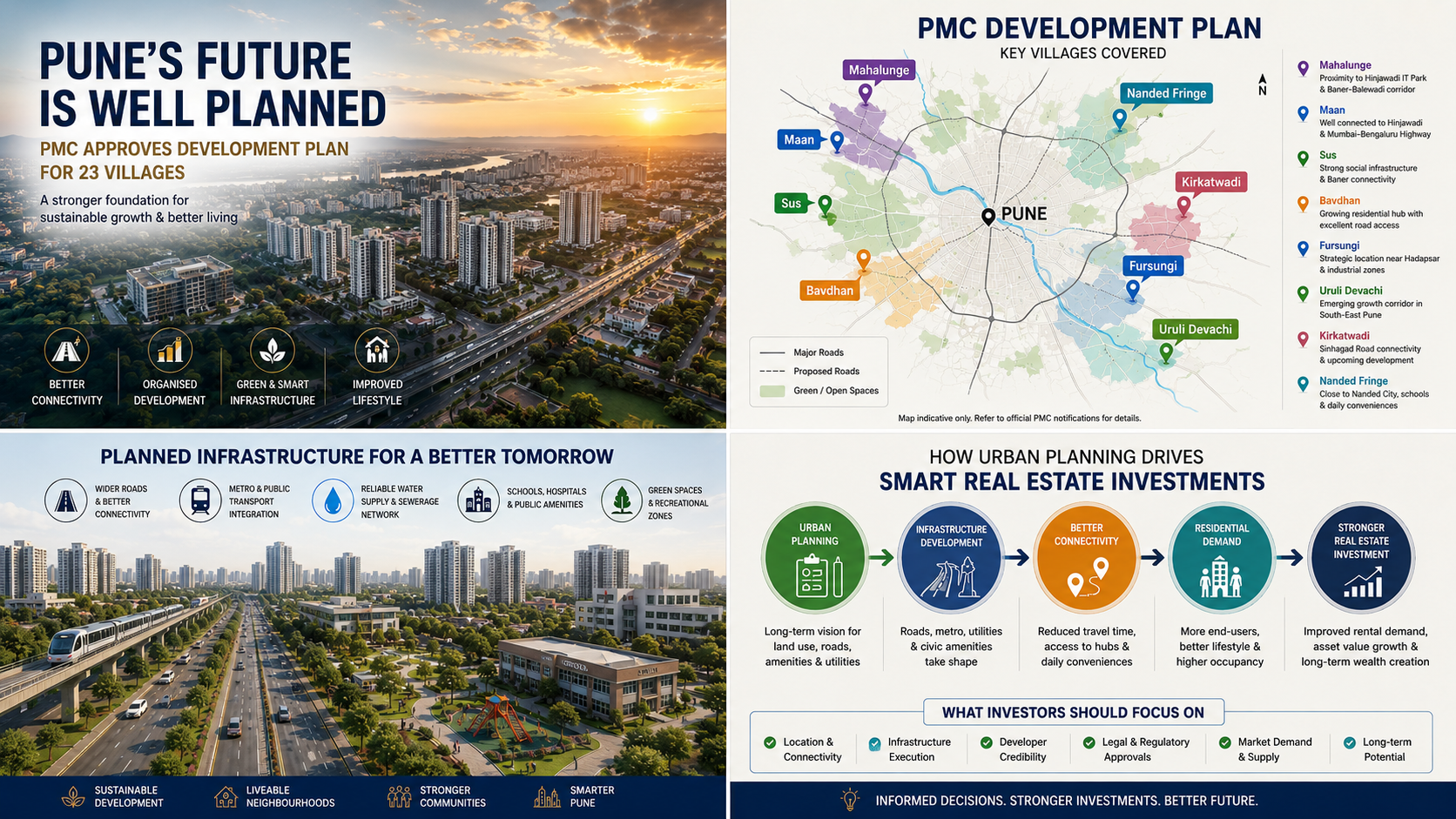
PMC Approves Development Plan (DP) for 23 Villages: What It Means for Pune Real Estate Investors in 2026
Pune has long been one of India’s fastest-growing real estate markets, driven by a strong IT sector, educational institutions, manufacturing industries, and continuous infrastructure development. As the city expands beyond its traditional boundaries, urban planning has become increasingly important to ensure sustainable growth.
One of the most significant planning developments in 2026 is the approval of the Development Plan (DP) for 23 villages under the Pune Municipal Corporation (PMC). This approval marks an important milestone in the city’s long-term urban planning strategy and provides a structured framework for future residential, commercial, and public infrastructure development.
For homebuyers, property investors, NRIs, developers, and landowners, the announcement has generated considerable interest. While a Development Plan does not automatically result in immediate infrastructure construction or property price increases, it establishes a legal and planning framework that guides how these areas are expected to develop over the coming years.
Several of the villages included in the approved Development Plan—such as Mahalunge, Maan, Sus, Bavdhan, Fursungi, Uruli Devachi, Kirkatwadi, and the Nanded fringe—are already witnessing growing residential demand due to their proximity to employment hubs, educational institutions, and major transportation corridors.
In this article, we explain what the PMC Development Plan is, why its approval is significant, how it may influence Pune’s emerging real estate markets, and what buyers and investors should consider before making property decisions.
What Is the PMC Development Plan?
A Development Plan (DP) is a statutory planning document prepared under the Maharashtra Regional and Town Planning (MRTP) Act, 1966. It serves as a long-term blueprint for the planned development of urban areas and guides how land should be used over the next two decades or more.
Rather than focusing on individual real estate projects, the Development Plan establishes an overall vision for city growth by identifying residential zones, commercial districts, transportation networks, public amenities, utility corridors, green spaces, and environmentally sensitive areas.
Its primary objective is to ensure that urban expansion takes place in an organized, sustainable, and well-connected manner.
Key Objectives of the Development Plan
Planned Land Use
The Development Plan allocates land for different purposes, including residential, commercial, industrial, institutional, recreational, and public uses. Proper zoning helps prevent unplanned growth and supports balanced urban development.
Road and Transportation Planning
Transportation is a core component of every Development Plan. The approved DP identifies proposed road alignments, road widening, arterial roads, collector roads, junction improvements, and future transport corridors that can improve connectivity between growing neighbourhoods.
Public Amenities
To support expanding communities, the Development Plan reserves land for essential civic infrastructure, including:
Government schools
Hospitals and healthcare centres
Parks and gardens
Playgrounds
Community halls
Fire stations
Police stations
Public parking
Bus terminals
These reservations are intended to improve the quality of life for future residents.
Water Supply and Utility Infrastructure
Urban growth depends on adequate civic utilities. The Development Plan supports long-term planning for:
Water supply networks
Sewerage systems
Stormwater drainage
Utility corridors
Waste management infrastructure
Such planning helps municipalities accommodate increasing population and development over time.
Environmental Protection
Modern urban planning also considers environmental sustainability. The DP includes provisions for preserving hills, water bodies, green belts, river buffers, open spaces, and other environmentally sensitive areas wherever applicable.
Why the Approval of the Development Plan Matters
The approval of the Development Plan is a significant planning milestone because it provides greater clarity regarding the future direction of urban growth. It offers a framework that government agencies, developers, infrastructure authorities, and investors can use when planning future projects.
However, it is important to understand what this approval means—and what it does not.
An approved Development Plan does not guarantee immediate construction of roads, metro lines, or civic infrastructure. Individual projects still require separate technical approvals, budget allocations, land acquisition (where applicable), and implementation by the relevant authorities.
Nevertheless, the approved plan provides greater confidence regarding long-term urban planning.
Better Road Connectivity
Many of the villages included in the Development Plan have experienced rapid residential growth over the past decade. Planned road widening, improved internal roads, and better connections to major highways can enhance accessibility and support future development.
Improved Civic Infrastructure
As residential populations grow, demand for reliable civic services increases. The Development Plan enables authorities to plan for future water supply, sewage systems, drainage, public transport, parks, educational institutions, and healthcare facilities.
Greater Planning Certainty
For developers, landowners, and homebuyers, an approved Development Plan offers greater visibility into future land use and infrastructure priorities. This information can help stakeholders make more informed long-term decisions.
Encouraging Organised Development
Well-defined planning frameworks reduce uncertainty and encourage coordinated development. This can help create neighbourhoods with better road networks, public spaces, and civic amenities compared to unplanned urban expansion.
Increased Interest from Homebuyers and Investors
Infrastructure planning often attracts attention from both end-users and investors. Locations with improving connectivity, employment access, and planned civic amenities may experience stronger housing demand over time. However, buyers should evaluate each project individually and avoid assuming that all areas will perform similarly.
Villages Included in the Approved Development Plan
Several of the villages covered under the approved Development Plan are already established or emerging residential destinations within Pune. Their proximity to IT parks, industrial zones, educational institutions, and transportation corridors has contributed to increasing interest from both developers and homebuyers.
Village Key Growth Drivers Residential Outlook
Mahalunge Baner proximity, IT hubs, proposed infrastructure Strong demand from professionals and families
Maan Hinjawadi employment hub, road connectivity Growing residential and mixed-use development
Sus Access to Baner, schools, hospitals Mature residential locality with premium housing
Bavdhan Mumbai–Bengaluru Highway, educational institutions Well-established residential corridor
Fursungi Hadapsar connectivity, industrial access Emerging mixed-use development
Uruli Devachi Urban expansion towards South-East Pune Long-term growth potential
Kirkatwadi Sinhagad Road connectivity Developing suburban residential market
Nanded Fringe Township ecosystem, educational facilities Stable demand from end-users
Note: Buyers and investors should refer to the latest official PMC notifications to verify the complete list of villages covered under the approved Development Plan and understand any location-specific planning provisions.
What’s Next?
The approval of the PMC Development Plan establishes a roadmap for Pune’s future urban growth. While infrastructure implementation will occur in phases and remain subject to separate approvals and funding, the plan provides a clearer vision for how these emerging areas are expected to evolve.
For homebuyers and investors, understanding this framework is an important first step. Equally important is evaluating project quality, legal approvals, developer credibility, and location-specific infrastructure before making any purchase decision.
Infrastructure Impact: How the Development Plan Could Shape Pune’s Growth Corridors
The approval of the PMC Development Plan provides a framework for future infrastructure planning across the notified villages. While individual projects will still require separate approvals, funding, and execution, the DP helps establish the direction of long-term urban development.
For homebuyers and investors, infrastructure is one of the most important factors influencing a location’s livability and long-term attractiveness.
1. Road Network Improvements
Road connectivity is a key focus of the Development Plan. As residential development expands, existing roads often require widening, new links, and junction improvements to accommodate higher traffic volumes.
Potential long-term benefits include:
Better connectivity between residential neighborhoods
Reduced travel time to employment hubs
Improved access to schools, hospitals, and commercial centres
Enhanced public transport accessibility
More efficient traffic movement
Locations such as Mahalunge, Maan, Sus, and Bavdhan already benefit from connectivity to Baner, Hinjawadi, and the Mumbai–Bengaluru Highway. Future road improvements could further strengthen these links.
Similarly, Fursungi, Uruli Devachi, Kirkatwadi, and the Nanded fringe are expected to benefit from continued urban expansion and planned transportation upgrades over time.
Metro Connectivity
Although not every DP village will receive direct metro access, Pune’s expanding metro network has the potential to improve regional connectivity across multiple growth corridors.
Areas located near existing or future metro corridors may benefit from:
* Reduced commuting time
* Improved accessibility to commercial districts
* Greater public transport options
* Lower dependence on private vehicles
Buyers should note that metro expansion depends on separate planning, approvals, and construction schedules. Proximity to a proposed corridor should not be interpreted as confirmation of future station locations or completion timelines.
Ring Road and Regional Connectivity
Regional infrastructure projects such as the Pune Ring Road are expected to influence travel patterns by improving connectivity between different parts of the metropolitan region.
For several western and southern growth corridors, improved regional road infrastructure may provide:
* Faster inter-city travel
* Better freight movement
* Improved access to industrial areas
* Enhanced connectivity between residential and commercial hubs
The exact impact will vary depending on a property’s location relative to completed infrastructure.
Airport Connectivity
Pune’s existing airport and the proposed international airport developments in the metropolitan region are expected to strengthen regional accessibility over the long term.
Improved airport connectivity is particularly important for:
* Business professionals
* NRIs
* Corporate relocations
* International investors
* Technology companies
Areas with convenient access to major transportation corridors often attract sustained residential demand, although many other market factors also influence property performance.
Water Supply and Sewerage Infrastructure
Reliable civic infrastructure is essential for any growing city.
The Development Plan supports long-term planning for:
* Water distribution networks
* Sewerage systems
* Stormwater drainage
* Utility corridors
* Public sanitation infrastructure
Improved utility planning contributes to healthier, more sustainable urban communities and supports future residential growth.
Social Infrastructure
Real estate growth is driven not only by roads but also by access to essential services.
Many of the villages included in the Development Plan are already located near:
Educational Institutions
* International schools
* CBSE and ICSE schools
* Colleges
* Universities
* Coaching centres
Healthcare Facilities
* Multi-specialty hospitals
* Diagnostic centres
* Emergency healthcare
* Specialty clinics
Retail and Entertainment
* Shopping malls
* Restaurants
* Supermarkets
* Multiplexes
* Lifestyle destinations
A strong social infrastructure ecosystem enhances both quality of life and long-term residential appeal.
Commercial Development
Commercial growth typically follows residential expansion.
As infrastructure improves, developers may introduce:
* Office spaces
* High-street retail
* Business parks
* Co-working hubs
* Hospitality developments
Employment generation and commercial activity often support sustained housing demand by reducing commuting distances and creating integrated urban environments.
Investment Perspective
Infrastructure announcements often attract investor attention because they provide insight into the long-term planning direction of a city.
However, prudent investors evaluate far more than planning approvals alone.
Why Investors Track Development Plans
An approved Development Plan helps investors understand:
* Future land use
* Infrastructure priorities
* Urban expansion patterns
* Potential residential growth corridors
* Public amenity planning
This information forms one part of a broader investment analysis.
Factors to Evaluate Before Investing
Before purchasing property, investors should assess:
Developer Reputation
Choose developers with a proven record of delivering projects on time and maintaining construction quality.
Legal Compliance
Verify:
* MahaRERA registration
* Approved building plans
* Title documents
* Required permissions
Connectivity
Evaluate access to:
* Employment hubs
* Schools
* Hospitals
* Public transport
* Daily conveniences
Market Demand
Strong end-user demand generally contributes to healthier long-term market stability than speculation alone.
Infrastructure Execution
A Development Plan outlines future planning, but actual implementation depends on multiple factors, including budgets, approvals, and construction timelines.
Understanding Property Appreciation
Many buyers ask whether DP approval guarantees higher property prices.
The answer is no.
Property values are influenced by several interconnected factors, including:
* Infrastructure execution
* Employment growth
* Housing supply
* Buyer demand
* Interest rates
* Economic conditions
* Developer activity
* Government policy
While planned infrastructure can improve a location’s attractiveness over time, appreciation is never guaranteed.
Homebuyer Perspective
For end-users, the Development Plan is primarily about improving long-term livability rather than short-term investment returns.
Better Planned Communities
Future residents may benefit from:
* Wider roads
* Public parks
* Community facilities
* Better traffic management
* Improved public services
—
Enhanced Daily Convenience
Access to schools, hospitals, shopping centres, workplaces, and recreational facilities can significantly improve quality of life.
Many of the western Pune locations covered by the Development Plan already offer a mature ecosystem of social infrastructure.
Greater Confidence
An approved planning framework provides homebuyers with better visibility into how surrounding areas are intended to develop over time.
This can support more informed purchasing decisions alongside legal and financial due diligence.
Expert Market Analysis
The approval of the Development Plan reinforces several broader trends already shaping Pune’s residential market.
Western Pune Continues to Lead
Areas such as:
* Mahalunge
* Maan
* Sus
* Bavdhan
continue to attract demand due to their proximity to:
* Hinjawadi IT Park
* Baner
* Balewadi
* Educational institutions
* Healthcare facilities
* Retail destinations
These micro-markets have evolved from suburban locations into established residential destinations.
Southern and Eastern Corridors
Locations including:
* Fursungi
* Uruli Devachi
* Kirkatwadi
represent expanding urban corridors where infrastructure planning could support future residential development as the city continues to grow.
These markets may appeal to buyers seeking relatively affordable options compared to more mature western micro-markets, although each location should be evaluated independently.
Supply and Demand Outlook
Pune continues to experience demand driven by:
* IT and technology employment
* Manufacturing industries
* Educational institutions
* Population growth
* Lifestyle migration
* NRI interest
Developers are increasingly focusing on integrated townships and amenity-rich residential communities that cater to modern homebuyers.
At the same time, buyers have become more selective, prioritizing developer credibility, project quality, connectivity, and legal transparency over speculative investment themes.
Key Takeaways
The approval of the PMC Development Plan for 23 villages provides a structured vision for Pune’s long-term urban expansion. It strengthens planning certainty, supports future infrastructure development, and offers valuable insights into emerging growth corridors.
For investors, the DP should be viewed as one component of a comprehensive investment decision—not as a guarantee of future returns.
For homebuyers, it highlights the importance of choosing locations with strong connectivity, quality social infrastructure, reputable developers, and clear legal approvals.
Ultimately, successful real estate decisions are built on thorough research, location analysis, and long-term planning rather than short-term market expectations.
Leave a Reply
You must be logged in to post a comment.