Introduction
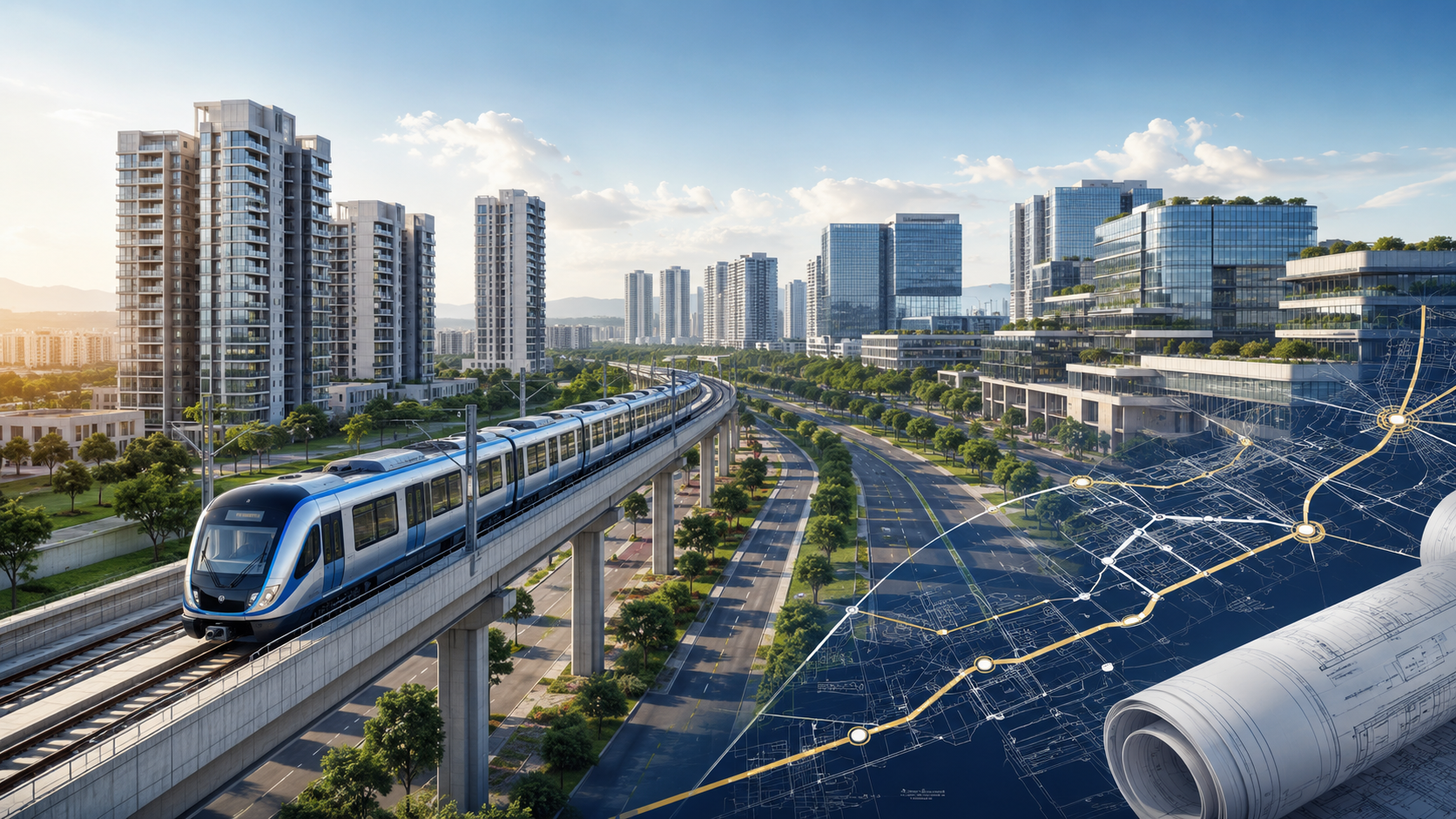
Infrastructure decisions rarely make headlines beyond the day they are announced. Yet, every once in a while, a planning decision has the potential to influence how an entire city grows for decades. The recent direction from the Mayor of the Pimpri Chinchwad Municipal Corporation (PCMC) asking Maha Metro to revise the Detailed Project Reports (DPRs) for proposed metro corridors is one such development.
Unlike announcements focused on new stations, construction milestones, or funding approvals, this move shifts attention to something more fundamental: planning for the future rather than simply solving today’s transportation challenges.
The Mayor has emphasized that metro corridors should not be designed solely around current travel demand. Instead, the revised DPRs should account for long-term population growth, expanding industrial zones, future residential development, and changing mobility patterns across Pimpri-Chinchwad. This forward-looking approach reflects a broader understanding that metro infrastructure built today will continue serving the city for the next 30 to 50 years.
For homebuyers, investors, developers, and businesses, this is more than an infrastructure update. Metro alignments influence where people choose to live, where companies establish offices, how retail districts emerge, and how property values evolve over time.
Cities that have successfully integrated transportation planning with urban development—such as Delhi, Hyderabad, Bengaluru, and several international metropolitan regions—demonstrate that well-planned metro systems can become catalysts for sustainable economic growth. Pune now has an opportunity to adopt similar long-term planning principles.
In this article, we examine what the proposed DPR revision means, why it matters, and how it could shape the future of Pune’s real estate landscape.
Key Takeaways
Quick Summary
PCMC has requested Maha Metro to revise metro DPRs with future urban growth in mind.
The objective is to prevent capacity constraints decades after project completion.
Metro planning now considers future population, employment hubs, and urban expansion rather than current demand alone.
Better infrastructure planning often creates stronger long-term real estate fundamentals.
Homebuyers should evaluate infrastructure alongside factors such as developer quality, legal approvals, employment growth, and neighborhood livability.
Understanding the Bigger Picture
Most public discussions around metro projects focus on construction progress, station announcements, or project costs. However, transportation planning begins many years before the first pillar is erected.
Every metro corridor is expected to operate for several decades. Decisions made during the planning stage determine:
Route alignment
Number of stations
Train capacity
Passenger demand
Land acquisition
Future expansion possibilities
Integration with roads, buses, railways, and other transport systems
Once construction begins, modifying these decisions becomes significantly more expensive and technically challenging.
That is why revisiting DPRs before final approvals can be one of the most valuable exercises in infrastructure planning.
What Is a DPR?
A Detailed Project Report (DPR) is the master planning document that forms the technical, financial, engineering, and operational blueprint for a large infrastructure project.
Think of it as the complete business and engineering plan for an entire metro corridor.
Without an approved DPR, large-scale public infrastructure projects cannot move forward through funding approvals and execution.
What Does a Metro DPR Include?
A comprehensive metro DPR typically covers multiple aspects of project planning.
| Component | Purpose |
| ———————— | ————————————————- |
| Route Alignment | Determines where the metro line will run |
| Station Planning | Identifies station locations and spacing |
| Ridership Forecast | Estimates future passenger numbers |
| Engineering Design | Covers viaducts, tunnels, depots, and structures |
| Cost Estimates | Calculates project expenditure |
| Financial Analysis | Assesses long-term financial viability |
| Environmental Assessment | Evaluates environmental impact and mitigation |
| Traffic Studies | Analyzes current and future travel demand |
| Land Acquisition | Identifies required land parcels |
| Utility Relocation | Plans shifting of pipelines, cables, and services |
| Construction Methodology | Defines execution strategy |
| Implementation Timeline | Provides project schedule and milestones |
A DPR is therefore much more than a technical document—it determines how efficiently a metro system will function for decades.
Why Revising a DPR Can Save Billions
Large cities evolve rapidly. Population patterns, employment centers, and residential demand often change significantly within a decade.
If metro infrastructure is designed only for today’s requirements, authorities may later face challenges such as:
Overcrowded stations
Insufficient train frequency
Limited interchange capacity
Inadequate parking
Poor integration with future transport systems
Costly expansion projects
Retrofitting existing infrastructure is usually far more expensive than incorporating future requirements during the planning stage.
For example, widening stations, adding new platforms, acquiring additional land after development, or redesigning interchanges can involve substantial costs and years of disruption.
By revisiting DPRs before construction, planners have an opportunity to build flexibility into the system from the outset.
What Did the PCMC Mayor Announce?
The Mayor of PCMC has urged Maha Metro to revise the DPRs for proposed metro corridors with a stronger focus on long-term urban growth.
Rather than limiting planning to existing traffic volumes and today’s commuter patterns, the revised studies are expected to consider broader development trends, including:
Future population growth
Expansion of residential townships
Emerging industrial clusters
Growth of IT and manufacturing employment
Changing commuting patterns
Future mobility demand
Integration with upcoming regional infrastructure
The emphasis is on creating a metro network that remains effective not just upon completion but throughout the coming decades.
This reflects a shift from reactive infrastructure planning to proactive city development.
Why This Decision Is Different from Routine Metro Announcements
Infrastructure news often revolves around construction updates, new tenders, or inauguration dates.
The current decision is different because it addresses the planning assumptions that shape the entire project.
Instead of asking:
“How quickly can we build?”
The discussion becomes:
“What kind of city will Pune become over the next 30 years, and how should today’s metro network support that future?”
This distinction is significant because transportation infrastructure influences:
Urban density
Housing supply
Commercial investment
Employment distribution
Environmental sustainability
Public transport adoption
Long-term economic productivity
Planning for future demand can reduce the likelihood of infrastructure becoming obsolete or inadequate within a relatively short period.
Why This Matters for Pune
Pune has experienced rapid urbanization over the past two decades, driven by a combination of industrial growth, a thriving IT sector, educational institutions, and improved regional connectivity.
The city continues to attract professionals, entrepreneurs, students, and businesses from across India.
Several factors are expected to shape Pune’s future:
Population Growth
Pimpri-Chinchwad and the Pune Metropolitan Region continue to expand outward, with new residential developments emerging in peripheral areas.
As urban populations increase, demand for efficient public transport also rises.
Expansion of IT Employment
Technology parks around Hinjawadi, Talawade, Baner, Balewadi, and other employment hubs continue to attract skilled professionals.
Improved metro connectivity can reduce travel times and improve workforce mobility.
Manufacturing Growth
The Pimpri-Chinchwad region remains one of India’s important manufacturing centers.
Industrial activity around Chakan, Bhosari, Talegaon, and surrounding areas generates significant commuter movement that future metro planning may need to accommodate.
Housing Demand
As land availability becomes constrained in established neighborhoods, residential growth increasingly shifts toward emerging suburbs.
Well-planned metro connectivity can support these expanding communities while reducing dependence on private vehicles.
Traffic Congestion
Road infrastructure alone cannot indefinitely absorb rising traffic volumes.
Metro systems provide high-capacity public transportation that can improve travel efficiency and reduce congestion on major corridors.
Environmental Sustainability
Public transportation contributes to reduced vehicle emissions and supports broader climate objectives by encouraging a shift away from private vehicle usage.
Understanding Future Metro Planning
One of the most important principles in transportation planning is distinguishing between current demand and future demand.
Cities rarely remain static.
A locality with moderate commuter volumes today may become a major employment center within a decade due to industrial investment or residential expansion.
Consequently, metro planners rely on sophisticated forecasting techniques rather than present-day observations alone.
Ridership Forecasting
Ridership forecasting estimates how many passengers are expected to use a metro corridor over its operational lifespan.
These forecasts consider:
Population growth
Employment projections
Residential development
Commercial expansion
Travel behavior
Vehicle ownership trends
Economic growth
Land-use planning
Accurate forecasting helps determine train frequency, station size, platform length, and operational requirements.
Station Spacing
Station placement balances accessibility with travel efficiency.
Stations located too close together may slow operations, while excessive spacing can reduce convenience for commuters.
Planners analyze surrounding land use, population density, employment centers, and future development potential before finalizing station locations.
Interchanges
Modern metro systems increasingly function as integrated transportation networks rather than isolated corridors.
Effective interchanges allow passengers to transfer seamlessly between:
Metro lines
Suburban rail
Bus networks
Airport transport
Regional transit
Such integration significantly enhances overall network efficiency.
Capacity Planning
Metro infrastructure must accommodate projected passenger growth over several decades.
Capacity planning influences:
Train lengths
Platform dimensions
Depot facilities
Signaling systems
Operational frequency
Building for future demand helps avoid expensive upgrades later.
Transit-Oriented Development (TOD)
Transit-Oriented Development (TOD) is an urban planning strategy that encourages mixed-use, high-density development within walking distance of public transit stations.
A well-executed TOD approach can:
Increase public transport usage
Reduce traffic congestion
Encourage walkable neighborhoods
Support local businesses
Improve land utilization
Create vibrant urban communities
Many global cities have successfully used TOD to maximize the economic and social benefits of metro investments.
Integrated Urban Mobility
Future-ready metro planning extends beyond trains.
An integrated mobility system includes:
Bus connectivity
Cycle tracks
Pedestrian infrastructure
Parking facilities
Ride-sharing integration
Last-mile connectivity solutions
The goal is to create a seamless travel experience from origin to destination.
How Metro Infrastructure Shapes Real Estate Markets
Transport infrastructure has historically been one of the strongest catalysts for urban development. Whether it is a metro system, an expressway, or a new airport, improved accessibility changes how people choose where to live, work, and invest.
However, infrastructure alone does not guarantee appreciation. The strongest-performing locations typically combine multiple growth drivers, including employment hubs, quality housing, educational institutions, healthcare facilities, retail ecosystems, and reliable civic infrastructure.
The proposed PCMC Metro DPR Revision is important because it seeks to align metro planning with these broader urban development trends rather than focusing only on today’s commuter demand.
How Metro Connectivity Can Influence Property Values
While appreciation varies by location and market conditions, improved metro connectivity can contribute to:
Better accessibility to employment centers
Reduced daily commute times
Increased residential demand
Higher rental demand
Greater interest from commercial occupiers
Retail and hospitality growth
Improved long-term market confidence
More organized urban development through Transit-Oriented Development (TOD)
Historically, many Indian cities have seen neighborhoods around operational metro stations outperform comparable areas without mass transit, although the magnitude depends on execution, local supply, and overall economic conditions.
Metro Impact Across the Property Lifecycle
| Stage | Typical Market Impact |
| —————- | —————————————————— |
| Announcement | Initial buyer and investor interest increases |
| DPR & Planning | Long-term investment evaluation begins |
| Construction | Infrastructure-led demand gradually rises |
| Near Completion | End-user purchases accelerate |
| Operations Begin | Rental demand and commercial activity strengthen |
| Mature Network | Stable appreciation supported by improved connectivity |
Area-Wise Real Estate Analysis
Moshi
Current Market
Moshi has evolved from an affordable suburban market into one of the fastest-growing residential destinations in the Pimpri-Chinchwad region. Large integrated townships, improving road infrastructure, and proximity to industrial employment centers continue to attract first-time buyers and investors.
Demand is driven by:
Affordable and mid-segment housing
Young working professionals
Industrial workforce
Families upgrading from older neighborhoods
Potential Metro Influence
Future metro connectivity could significantly improve accessibility between Moshi and established commercial centers.
Potential benefits include:
Reduced travel times
Higher attractiveness for end users
Better rental demand
Increased mixed-use development
Stronger retail ecosystem
Investment Outlook
Long-Term Rating: ★★★★★
Moshi remains one of the stronger long-term residential growth markets, provided infrastructure projects progress as planned.
Chakan
Current Market
Chakan is among Maharashtra’s most significant manufacturing hubs.
It hosts automobile, engineering, logistics, and industrial facilities with continuous employment generation.
Residential demand has historically been supported by industrial workers, engineers, and professionals.
Metro Influence
Although industrial corridors differ from residential corridors, improved public transport could enhance workforce mobility and support future mixed-use development.
Potential impacts include:
Better employee commuting
Increased demand for workforce housing
Improved commercial opportunities
Enhanced logistics ecosystem
Investment Outlook
Chakan offers stronger potential for investors with a long-term horizon rather than those seeking immediate appreciation.
Talawade
Talawade occupies a strategic position between the industrial belt and emerging IT ecosystem.
Growth drivers include:
IT parks
Educational institutions
Manufacturing activity
Residential townships
Future metro connectivity may strengthen its role as a residential destination for professionals employed across both industrial and technology sectors.
Market Strengths
Competitive pricing
Growing employment
Expanding civic infrastructure
Increasing developer interest
Nigdi
Nigdi is one of PCMC’s well-established residential localities.
Unlike emerging suburbs, Nigdi benefits from mature infrastructure, schools, hospitals, shopping centers, and established communities.
Metro Impact
For developed neighborhoods, metro connectivity often improves convenience rather than creating entirely new demand.
Benefits may include:
Improved public transport
Higher rental demand
Better commercial footfall
Improved connectivity for senior citizens and students
Nigdi is likely to remain attractive for end users seeking stability rather than speculative appreciation.
Bhosari
Bhosari has long been recognized as one of Pune’s major industrial centers.
Thousands of employees commute daily to industrial estates located here.
Metro Benefits
Improved public transport could:
Reduce dependence on private vehicles
Improve worker mobility
Support redevelopment
Encourage commercial investment
Over time, better transport accessibility could also enhance residential demand in surrounding areas.
Ravet
Ravet has become one of West Pune’s fastest-growing residential micro-markets.
Its location provides access to:
Mumbai–Pune Expressway
Old Mumbai Highway
Hinjawadi
Pimpri-Chinchwad
Pune city
Why Buyers Prefer Ravet
Modern residential projects
Good educational institutions
Strong road connectivity
Improving social infrastructure
Metro Outlook
If future metro corridors strengthen connectivity toward employment centers, Ravet could experience:
Higher end-user demand
Better rental occupancy
Increased commercial activity
Long-term capital appreciation
Kiwale
Kiwale continues benefiting from spillover demand from Ravet and Punawale.
Compared with established markets, Kiwale still offers relatively affordable entry points.
Growth Drivers
Expressway connectivity
Educational institutions
Residential townships
Improving civic infrastructure
Metro integration could make Kiwale more attractive to IT professionals seeking larger homes outside central Pune.
Akurdi
Akurdi enjoys the advantage of being an established employment and educational hub.
Major institutions, industries, and transportation infrastructure already support consistent demand.
Metro Influence
Metro connectivity could:
Increase office demand
Improve student mobility
Support mixed-use redevelopment
Strengthen rental housing demand
Pimpri
Pimpri functions as one of Pune Metropolitan Region’s primary commercial and administrative centers.
Existing strengths include:
Hospitals
Government offices
Retail centers
Employment hubs
Manufacturing ecosystem
Future metro planning could reinforce Pimpri’s position as a regional business district.
Commercial real estate may particularly benefit from improved commuter accessibility.
Chinchwad
Chinchwad combines residential neighborhoods, industrial activity, education, and retail into a balanced urban ecosystem.
Metro expansion could improve regional integration while supporting redevelopment opportunities in selected pockets.
As urban density increases, public transportation becomes increasingly important for sustaining quality of life.
Area Comparison Table
| Area | Current Growth | Metro Potential | Residential Demand | Investment Outlook |
| ——— | ————– | ————— | —————— | ——————- |
| Moshi | High | Very High | High | Excellent |
| Chakan | High | Moderate-High | Moderate | Strong Long-Term |
| Talawade | High | High | High | Excellent |
| Nigdi | Stable | Moderate | High | Stable Appreciation |
| Bhosari | Moderate | High | Moderate | Positive |
| Ravet | Very High | Very High | Very High | Excellent |
| Kiwale | High | High | Growing | Excellent |
| Akurdi | Stable | High | High | Strong |
| Pimpri | High | Very High | High | Excellent |
| Chinchwad | Stable | High | High | Strong |
Infrastructure Projects That Could Work Together
Metro projects rarely operate in isolation. Their impact often increases when combined with other strategic infrastructure investments.
Pune Ring Road
The proposed Ring Road aims to improve regional connectivity while reducing congestion within the urban core.
Combined with metro connectivity, it could support decentralized residential and commercial growth.
Mumbai–Pune Missing Link
The Missing Link project is expected to reduce travel time between Mumbai and Pune.
Improved regional accessibility may increase interest from:
Businesses
Second-home buyers
Investors
Logistics companies
Mumbai–Pune Expressway Upgrades
Continuous upgrades to India’s busiest expressway continue strengthening Pune’s connectivity with Mumbai.
This supports both residential and commercial investment.
Hinjawadi Metro Corridor
The Hinjawadi Metro corridor remains one of Pune’s most significant public transport projects due to its connection with the city’s largest IT employment cluster.
Improved access could benefit residential markets across western Pune.
Airport Connectivity
Future integration between metro services and Pune Airport has the potential to improve mobility for:
Business travelers
IT professionals
Corporate offices
Hospitality sector
PMRDA Infrastructure
Regional planning initiatives by PMRDA continue supporting:
Urban expansion
New townships
Road improvements
Public utilities
Regional transportation
Industrial Corridors
Industrial growth remains one of PCMC’s strongest economic drivers.
Improved transportation infrastructure supports:
Workforce mobility
Business expansion
Logistics efficiency
Housing demand
Why Infrastructure Drives Property Appreciation
Infrastructure creates value because it reduces friction.
When travel becomes easier:
Businesses gain access to larger talent pools.
Employees spend less time commuting.
Retail businesses receive higher footfall.
Developers gain confidence to launch new projects.
Families gain better access to education and healthcare.
These improvements strengthen the overall attractiveness of a location.
However, appreciation is typically strongest when infrastructure is accompanied by sustained employment growth and sound urban planning.
Lessons from Other Indian Cities
Delhi Metro
Delhi Metro transformed accessibility across the National Capital Region and influenced residential as well as commercial development around many stations. Areas with strong multimodal integration generally witnessed sustained long-term demand.
Key Lesson
A comprehensive network creates more value than isolated corridors.
Hyderabad Metro
Hyderabad demonstrated how metro connectivity can complement an expanding IT sector.
Employment growth and metro infrastructure reinforced each other, benefiting markets such as HITEC City and surrounding residential areas.
Key Lesson
Metro investments perform best when aligned with major employment hubs.
Bengaluru
Despite traffic challenges, Bengaluru illustrates the importance of expanding metro capacity alongside rapid urban growth.
Key Lesson
Planning must anticipate future demand rather than reacting after congestion becomes severe.
Mumbai Metro
Mumbai’s expanding metro network highlights how improved connectivity can reshape commuting patterns across multiple business districts.
Key Lesson
Integrated transport networks often have a greater long-term impact than standalone infrastructure projects.
Expert Perspective
The request to revise metro DPRs reflects an understanding that infrastructure should be designed for the city Pune expects to become—not only the city that exists today.
If revised plans successfully incorporate projected population growth, employment expansion, multimodal integration, and Transit-Oriented Development principles, they could contribute to a more resilient and efficient urban transport network over the coming decades.
At the same time, property buyers and investors should distinguish between confirmed infrastructure plans and future projections. While improved connectivity can enhance long-term real estate fundamentals, investment decisions should always consider factors such as developer credibility, legal due diligence, social infrastructure, and the overall economic strength of the locality.
Risks Investors Should Understand Before Buying Near a Proposed Metro Corridor
Metro projects are among the most influential infrastructure investments in urban development, but they should never be the sole basis for a property purchase. Experienced investors evaluate the broader fundamentals of a location before making a decision.
1. Project Timelines Can Change
Metro projects often involve multiple stages, including DPR approval, funding, land acquisition, environmental clearances, tendering, and construction. Delays at any stage can affect the expected completion timeline.
Investor Tip: Verify whether the corridor is proposed, approved, under construction, or operational before factoring it into your investment decision.
2. Land Acquisition Challenges
Acquiring land in densely populated urban areas can be complex. Changes to alignments or station locations may occur during the planning process.
Investor Tip: Avoid assuming that a proposed station will remain in the exact location shown in preliminary plans.
3. Price Speculation
Real estate prices sometimes rise quickly following major infrastructure announcements, even before construction begins. In certain markets, this can lead to short-term speculative pricing.
Investor Tip: Compare prevailing prices with historical trends, nearby localities, and the area’s long-term demand drivers.
4. Connectivity Is Only One Factor
A metro station improves accessibility, but it does not automatically compensate for weak civic infrastructure, poor project quality, or lack of employment opportunities.
Evaluate:
Developer reputation
Construction quality
Legal approvals
Water and power infrastructure
Schools and hospitals
Employment accessibility
Long-term neighborhood development
5. Rental Demand Depends on Occupiers
Metro connectivity can improve rental demand, but rental performance also depends on the profile of local tenants.
Areas near:
IT parks
Industrial zones
Educational institutions
Commercial business districts
typically generate stronger rental demand than locations with limited employment activity.
Investment Scorecard
| Factor | Importance | Weight |
| ——————— | ———- | —–: |
| Metro Connectivity | High | 20% |
| Employment Growth | Very High | 25% |
| Social Infrastructure | High | 15% |
| Developer Reputation | Very High | 15% |
| Legal Due Diligence | Essential | 15% |
| Future Infrastructure | Moderate | 10% |
Key Insight: Metro connectivity should be viewed as an important advantage—not the only investment criterion.
Connectivity Comparison
| Area | IT Connectivity | Industrial Connectivity | Metro Potential | Long-Term Outlook |
| ——— | ————— | ———————– | ————— | —————– |
| Moshi | Good | Excellent | High | Excellent |
| Chakan | Moderate | Excellent | Moderate–High | Strong |
| Talawade | Excellent | Good | High | Excellent |
| Ravet | Excellent | Moderate | High | Excellent |
| Kiwale | Good | Moderate | High | Strong |
| Pimpri | Good | Excellent | Very High | Excellent |
| Chinchwad | Good | Excellent | High | Strong |
| Nigdi | Moderate | Good | Moderate | Stable |
| Bhosari | Moderate | Excellent | High | Positive |
| Akurdi | Good | Excellent | High | Strong |
Indicative Infrastructure Timeline
| Project Stage | Likely Outcome for the Market |
| ——————- | ————————————————————————- |
| DPR Revision | Planning refinement and technical reassessment |
| Government Review | Administrative approvals and funding discussions |
| Tendering | Contractor selection |
| Construction Begins | Improved buyer confidence |
| Major Civil Works | Growing residential and commercial interest |
| Metro Operations | Enhanced connectivity, stronger rental demand, and improved accessibility |
Note: Actual timelines depend on government approvals, funding, land acquisition, and execution progress.
Metro Impact on Property Values
| Distance from Metro | Typical Buyer Appeal | Potential Long-Term Effect* |
| ——————- | ——————– | ——————————————— |
| Within 500 m | Highest | Strong accessibility premium |
| 500 m–1 km | High | Good balance of convenience and livability |
| 1–2 km | Moderate | Benefits from feeder connectivity |
| Beyond 2 km | Variable | Depends on road network and employment access |
*Property performance varies based on market conditions, project quality, supply, and demand. Metro proximity alone does not guarantee appreciation.
Who Should Consider Investing?
First-Time Homebuyers
A metro-connected locality can reduce commuting time and improve long-term convenience, especially for professionals working in Pune’s IT and industrial corridors.
Suitable Areas: Ravet, Moshi, Talawade, Kiwale
Long-Term Investors
Investors with a five- to ten-year horizon may benefit from areas where infrastructure, employment, and housing demand are expected to grow together.
Suitable Areas: Moshi, Talawade, Pimpri, Chinchwad
Rental Investors
Rental-focused buyers should prioritize locations with consistent employment demand rather than infrastructure announcements alone.
Key Demand Drivers:
IT parks
Manufacturing hubs
Educational institutions
Hospitals
Commercial centers
Commercial Investors
Retail, office, and mixed-use developments often benefit from improved pedestrian movement and commuter accessibility around major transit corridors.
Commercial investors should evaluate:
Station footfall
Office absorption
Retail catchment
Parking infrastructure
Future commercial zoning
NRIs
For overseas buyers, metro connectivity can enhance the long-term appeal of a location, but investments should be based on verified approvals, reputable developers, and strong local fundamentals.
VJ Real Estate Expert Opinion
At VJ Real Estate, we view transportation infrastructure as one of the most important long-term drivers of urban growth—but not the only one.
The proposed revision of metro DPRs reflects a more strategic approach to city planning. Designing a transport network around projected population growth, future employment hubs, and integrated mobility can create a stronger foundation for sustainable development.
However, successful property investment requires a balanced evaluation of multiple factors.
Before purchasing a property, buyers should assess:
The developer’s track record and delivery history
Legal approvals and regulatory compliance
Construction quality and project specifications
Existing and planned road connectivity
Access to schools, healthcare, and daily conveniences
Employment opportunities within commuting distance
Long-term livability of the neighborhood
Infrastructure enhances the potential of a location, but enduring wealth creation comes from choosing quality properties in fundamentally strong micro-markets.
Conclusion
The request by the PCMC Mayor for Maha Metro to revise Detailed Project Reports is more than an administrative exercise—it represents an opportunity to align today’s infrastructure planning with tomorrow’s urban realities.
If future metro corridors are designed using realistic population forecasts, integrated transport planning, and Transit-Oriented Development principles, Pune could build a public transport network capable of supporting decades of economic and residential growth.
For homebuyers, this development highlights the importance of looking beyond current market conditions. Areas expected to benefit from improved connectivity may become increasingly attractive over time, particularly when supported by employment growth, social infrastructure, and responsible urban planning.
For investors, the key takeaway is clear: infrastructure matters, but disciplined due diligence matters even more. Metro connectivity should strengthen an investment thesis—not replace it.
As Pune continues to evolve into one of India’s leading metropolitan regions, informed decisions based on verified information, long-term fundamentals, and balanced analysis are likely to deliver the most sustainable outcomes.
Frequently Asked Questions (FAQs)
1. What is a Detailed Project Report (DPR)?
A DPR is a comprehensive planning document that outlines the technical, financial, engineering, environmental, and operational details required to execute a metro project.
2. Why has the PCMC Mayor asked Maha Metro to revise the DPRs?
The objective is to ensure future metro corridors account for projected population growth, urban expansion, and long-term transportation demand rather than only current travel patterns.
3. Does a DPR revision mean construction will begin immediately?
No. Revising a DPR is part of the planning process and typically precedes approvals, funding, and construction.
4. Will property prices increase because of the proposed metro corridors?
Metro connectivity can support long-term demand, but property values also depend on employment, supply, developer quality, and market conditions.
5. Which PCMC areas could benefit from future metro expansion?
Areas such as Moshi, Ravet, Talawade, Pimpri, Chinchwad, Akurdi, Bhosari, Kiwale, Nigdi, and Chakan may benefit, depending on final alignments and supporting infrastructure.
6. Should I buy property before metro construction starts?
Early investments may offer advantages, but buyers should verify approvals, timelines, and overall project fundamentals before purchasing.
7. How does metro connectivity affect rental demand?
Improved accessibility can attract tenants, particularly in areas close to employment hubs and educational institutions.
8. Is every proposed metro corridor guaranteed to be built?
No. Proposed projects may change based on technical studies, funding, approvals, and policy decisions.
9. What is Transit-Oriented Development (TOD)?
TOD is an urban planning approach that promotes higher-density, mixed-use development around public transport stations to create walkable, well-connected communities.
10. How does metro connectivity influence commercial real estate?
It can improve accessibility, increase footfall, expand labor catchments, and make office and retail locations more attractive.
11. What is ridership forecasting in metro planning?
It estimates future passenger demand using population, employment, land use, and travel behavior projections.
12. Why are station locations important?
Station placement affects accessibility, land use, development patterns, and the economic impact of a metro corridor.
13. Can metro planning reduce traffic congestion?
Efficient public transport can encourage a shift from private vehicles, helping reduce road congestion over time.
14. How does metro infrastructure support sustainable urban growth?
By improving public transport, reducing emissions, supporting compact development, and encouraging multimodal mobility.
15. What are the biggest risks when investing near a proposed metro line?
Execution delays, alignment changes, land acquisition issues, speculative pricing, and policy revisions.
16. Are commercial properties near metro stations a good investment?
They can perform well when supported by strong office demand, retail activity, and consistent commuter footfall.
17. Does every metro station increase nearby property values?
Not necessarily. Market performance depends on the overall attractiveness of the location and broader economic conditions.
18. How should homebuyers evaluate a metro-linked project?
Consider legal approvals, builder reputation, social infrastructure, employment access, connectivity, and long-term livability.
19. Why is long-term planning important for metro systems?
Metro infrastructure typically serves cities for several decades, making future demand forecasting essential.
20. How can VJ Real Estate help buyers evaluate metro-linked investments?
VJ Real Estate provides market insights, location analysis, project comparisons, and guidance based on infrastructure trends, legal due diligence, and long-term investment fundamentals.
Leave a Reply
You must be logged in to post a comment.