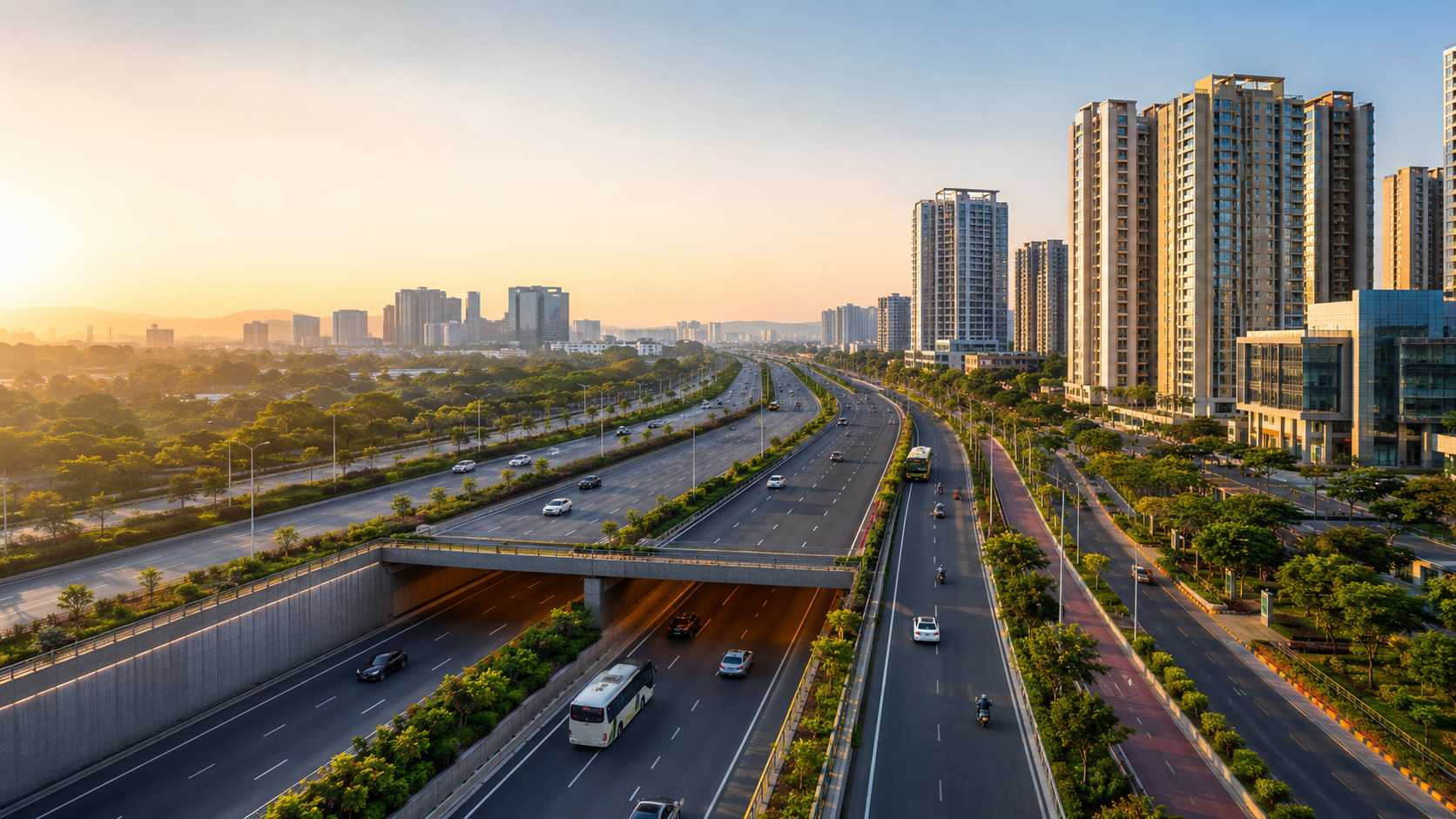
Wakad-Tathawade Service Road: Gadkari’s Fast-Track Order Reshapes Pune’s Western Corridor
Introduction
Anyone who has tried to cross the Wakad Bridge stretch of NH-48 during evening rush hour knows the drill: bumper-to-bumper traffic, a crawl through the underpass, and commute times that stretch well beyond what the map suggests. For thousands of IT professionals traveling to and from Hinjawadi, and for residents of Wakad, Tathawade, Punawale, and Ravet, this has been a daily reality for years.
That is why a recent announcement from Union Minister for Road Transport and Highways Nitin Gadkari has generated so much interest locally. During a review meeting on pending national highway projects held in Pune, Gadkari directed officials to expedite the completion of service roads in Tathawade, Punawale, and Wakad, and approved the widening of existing underpasses in the area. The decision came after sustained representations from local MLA Shankar Jagtap, who has been pushing for these works for months.
For a corridor that has seen explosive residential and commercial growth over the last decade — largely fueled by its proximity to Hinjawadi IT Park — this is more than a routine roadworks update. Infrastructure announcements of this kind tend to influence how buyers, investors, and developers think about a micro-market, even before a single shovel hits the ground. This article breaks down exactly what was announced, why the existing road network has struggled to keep up, and what it could mean for real estate in Wakad, Tathawade, Punawale, Hinjawadi, and Ravet — while being clear about what is confirmed versus what remains to be executed.
What Was Announced?
The announcement covers three connected strands of work along the Pune Western Bypass (NH-48) corridor:
Fast-tracking of pending service roads in Tathawade, Punawale, and Wakad, which had been delayed for an extended period despite being critical for local traffic movement.
Widening/expansion of existing underpasses at Tathawade and Punawale, aimed at increasing capacity at points that currently bottleneck badly during peak hours.
Approval of three new box-structure underpasses along the NH-48 stretch through Pimpri-Chinchwad, at Punawale, Tathawade, and Wakad, sanctioned by the National Highways Authority of India (NHAI) at an estimated cost of roughly ₹70–80 crore. Box-structure underpasses are typically faster and cheaper to build than conventional ones, since they need less excavation and can use pre-cast or cast-in-situ concrete segments.
This sits within a broader push on the corridor. Separately, NHAI has already approved around ₹321 crore worth of service road development between Dehu Road and the Khed-Shivapur toll plaza, and asphalting work has reportedly been completed on stretches from the Pavana River crossing up to the Punawale underpass, and from Punawale to the Tathawade underpass, with work extending toward Bhumkar Chowk. Officials have also flagged longer-horizon items on the same corridor, including additional bridge capacity and a proposed Kiwale–Balewadi elevated corridor, though these remain at an earlier planning stage.
The core objective across all these interventions is the same: decongest one of the busiest and fastest-growing stretches of the Mumbai–Bengaluru highway, which also functions as the primary commuting spine for Hinjawadi’s IT workforce.
A note on timelines: while the fast-track directive and NHAI approvals are confirmed, tendering for the new underpasses has only recently commenced, and government infrastructure projects in India frequently see schedule slippage. Buyers and investors should treat completion timelines as indicative rather than guaranteed.
Existing Problems on the Wakad-Tathawade Corridor
To understand why this announcement matters, it helps to look at what commuters have been dealing with:
NH-48 bottlenecks: The Pune Western Bypass section running through Wakad, Punawale, and Tathawade currently has only two functional underpasses serving a rapidly expanding population — a number that has simply not kept pace with vehicle growth in the area.
Congestion near Wakad Bridge: This junction is a well-known chokepoint, especially during morning and evening peak hours, as traffic converges from Hinjawadi, Baner, and the PCMC side.
Underpass overcrowding: Existing underpasses at Tathawade and Punawale routinely see long queues, and several also face waterlogging during the monsoon, which worsens congestion further.
IT commute strain: A large share of daily traffic on this stretch consists of IT employees traveling to and from Hinjawadi IT Park. Local reporting has pointed to peak-hour delays running into one to two hours on some days — a significant drag on quality of life and productivity.
Service road gaps: Incomplete or poorly maintained service roads have historically forced local traffic onto the main highway carriageway, adding to congestion and safety risks.
These aren’t new complaints — they’ve built up over years of rapid urbanization in a corridor that grew faster than its supporting road infrastructure.
Benefits After Completion
If executed as planned, the fast-tracked service roads and expanded/new underpasses are expected to deliver several tangible improvements:
Faster travel times for daily commuters between Wakad, Tathawade, Punawale, Ravet, and Hinjawadi.
Reduced congestion at key chokepoints, particularly around Wakad Bridge, Bhumkar Chowk, and the Tathawade and Punawale underpasses.
Improved east-west connectivity across NH-48, reducing the burden on the two existing underpasses.
Better road safety, as separating local and through traffic tends to reduce accident risk.
Improved logistics movement along the Mumbai–Bengaluru highway corridor, benefiting commercial and industrial users, not just commuters.
Better emergency vehicle access, an often-overlooked but important benefit of decongested junctions.
Higher overall quality of life for residents who currently lose significant time to commuting.
It’s worth repeating: these are the expected outcomes once works are completed, not outcomes that exist today. The gap between approval and ground-level completion is where execution risk lives.
Impact on Real Estate
Infrastructure and real estate values tend to move together, and this corridor’s history is a good illustration of that pattern. Wakad and Hinjawadi’s residential boom over the last fifteen years was itself substantially driven by proximity to IT parks and improving road access. The current round of works could extend that pattern to the neighboring, comparatively younger markets of Tathawade, Punawale, and Ravet.
Property appreciation: Areas with improving connectivity typically see a re-rating in buyer perception even before physical construction is complete, simply because reduced commute friction is one of the most tangible things a home buyer values. That said, appreciation is rarely instant — it tends to build gradually and depends heavily on whether the promised works are actually delivered on schedule.
Rental demand: For a corridor as dependent on IT employment as this one, shorter and more predictable commutes to Hinjawadi could support rental demand, particularly from tenants who currently avoid certain pockets specifically because of traffic.
New project launches: Developers often use infrastructure milestones — approvals, tenders, or construction starts — as marketing anchors for new launches. Expect increased project activity and pre-launch interest in Tathawade, Punawale, and Ravet, where land is comparatively more available than in mature Wakad.
Investor confidence: A visible, funded government commitment (backed by NHAI approvals and a specific budget) tends to be viewed more credibly by investors than mere proposals, which can support steadier buying interest over the medium term.
Commercial growth: Improved logistics movement along NH-48 could also benefit commercial real estate — warehousing, light industrial space, and retail catering to the growing residential base along the corridor.
Areas Benefiting Most
AreaBenefitInvestment PotentialWakadReduced congestion at Wakad Bridge; new/expanded underpass capacity easing the area’s most notorious chokepointMature market; moderate further upside, but improved liveability supports steady demandTathawadeDirect underpass widening and service road completion; among the most directly impacted locationsHigh — still comparatively affordable with strong infrastructure catalystsPunawaleNew underpass, service road completion, and benefit from the broader Dehu Road–Khed Shivapur service road packageHigh — growing residential base with room for further developmentHinjawadiIndirect but significant benefit as the corridor’s primary commute destination; smoother access for its IT workforceModerate to High — demand closely tied to IT sector growth and connectivityRavetPart of the Wakad–Mamurdi service road stretch benefiting from ongoing worksModerate — benefits from proximity to the corridor without being at its coreBalewadiLonger-term potential beneficiary via the proposed Kiwale–Balewadi elevated corridor (early planning stage)Moderate — upside is more speculative given the corridor’s early planning status
Why Buyers Should Pay Attention
Several factors make this a moment worth watching closely rather than reacting to impulsively:
Better connectivity is being actively funded, not just proposed — NHAI budget allocation and tendering activity indicate real intent, which differentiates this from many announcements that stall at the planning stage.
Metro expansion in the broader Pune Metropolitan Region continues to progress, and corridors with both road and transit improvements tend to see compounding connectivity benefits over time.
Continued IT sector growth in and around Hinjawadi remains a structural demand driver for the entire western Pune belt, independent of any single road project.
Layered infrastructure pipeline — the service roads and underpasses sit alongside other planned works (additional bridge capacity, the proposed elevated corridor, drainage improvements) that together aim to future-proof the corridor rather than offer a one-off fix.
Long-term appreciation tends to reward early movers in infrastructure-linked corridors, though this needs to be weighed against the real possibility of delays.
Investment Outlook (2026–2030)
Looking ahead, here is a measured view of how this corridor could evolve, contingent on execution:
Capital appreciation: Tathawade and Punawale, being less mature than Wakad, have more room for price appreciation if connectivity genuinely improves and IT-linked employment continues to grow in the region.
Rental growth: Reduced commute times could gradually strengthen rental yields in pockets currently seen as less convenient relative to Hinjawadi, particularly Tathawade and Ravet.
Demand increase: Expect steady, rather than explosive, demand growth as visible construction progress (not just announcements) builds buyer confidence.
Infrastructure-driven development: New residential and mixed-use projects are likely to cluster along improved service road stretches, following the well-established pattern of development trailing infrastructure investment.
None of this is guaranteed. The 2026–2030 window depends on multiple moving parts — construction pace, funding continuity, metro progress, and the broader health of Pune’s IT and real estate sectors — all playing out roughly as expected.
Expert Opinion
From a real estate analyst’s perspective, infrastructure projects of this nature are among the more reliable long-term value drivers in any urban corridor, precisely because they address a fundamental pain point — commute time — that directly affects how desirable a location is to live and work in. Historically, Pune’s western IT belt has demonstrated this relationship clearly: areas that gained meaningful road and transit access saw sustained buyer interest that outlasted short-term market cycles.
That said, three caveats matter. First, execution risk is real — India’s infrastructure project timelines are frequently extended, and a fast-track order is a directive, not a completion certificate. Second, appreciation is rarely uniform — it tends to concentrate around zones closest to the actual infrastructure improvement, not the entire micro-market. Third, market conditions matter as much as infrastructure — broader factors like interest rates, IT sector hiring trends, and overall housing demand in Pune will continue to shape outcomes alongside any single road project. Buyers and investors should treat this announcement as a meaningful positive signal, not a standalone reason to act.
Conclusion
The fast-tracking of service roads and the expansion of underpasses across Wakad, Tathawade, and Punawale represents genuinely good news for a corridor that has long struggled with traffic congestion disproportionate to its residential and commercial importance. With NHAI approvals, a defined budget, and active tendering already underway for the new underpasses, this goes beyond a routine political statement — though the gap between approval and ground reality still needs to be watched closely.
For home buyers and investors, the sensible approach is to track construction progress over the coming months rather than price in benefits that haven’t yet materialized. Areas like Tathawade and Punawale, still in a relatively earlier stage of development compared to Wakad, may offer the more interesting risk-reward profile if these works proceed on schedule.
If you’re exploring residential options in this corridor, now is a good time to start evaluating premium projects in Wakad, Tathawade, Punawale, and Hinjawadi — while keeping execution timelines, developer track records, and your own investment horizon firmly in view.
Leave a Reply
You must be logged in to post a comment.