Category: Real Estate Investment

  • Gera Advantage: What Pune Homebuyers Should Know About Job-Loss Support and the 10-Year Structural Warranty

    Gera Advantage: What Pune Homebuyers Should Know About Job-Loss Support and the 10-Year Structural Warranty

    Buying a home is a major financial commitment. For many families, it involves years of savings, a home loan and the expectation that their income will remain stable while the property is being constructed.

    But life does not always follow the financial plan. A job loss, a medical emergency or an unexpected expense can make it difficult to manage payments on an under-construction home. Even after possession, questions about maintenance and structural defects can create uncertainty.

    Against this backdrop, Gera Developments has introduced The Gera Advantage, a programme that combines conditional financial assistance before possession with specified home-care and structural warranty benefits.

    The programme has attracted attention because it includes job-loss support and a 10-year structural warranty. However, homebuyers should look beyond the headline claims. The eligibility criteria, repayment obligations, exclusions and written agreement matter just as much as the advertised benefits.

    This guide explains what the programme offers, how it differs from statutory protections under RERA, and what buyers should verify before relying on any developer’s homebuyer protection scheme.

    What is The Gera Advantage?

    The Gera Advantage is a developer-provided programme described on Gera Developments’ official website. It contains four components:

    1. EMI Shield: Conditional support for eligible salaried buyers facing involuntary job loss.
    2. Home Equity Power: Short-term financial assistance linked to a buyer’s eligible own contribution.
    3. Medical Emergency Support: Options to transfer a home or move to a lower-value home in qualifying circumstances.
    4. Extended Home Protection: Annual home health checks for seven years and a 10-year structural warranty, subject to applicable terms.

    The programme is intended to address some of the financial and practical challenges that can arise between booking a home and taking possession, as well as certain maintenance concerns after possession.

    Important: These benefits are not unconditional guarantees. Gera’s published programme information makes them subject to eligibility requirements, assessments, approvals and applicable terms and conditions.

    1. EMI Shield: What happens if a homebuyer loses a job?

    A job loss during construction can put pressure on a household budget, especially when the buyer is paying pre-EMIs on a home loan while also paying rent.

    According to Gera’s published terms, eligible salaried customers who experience involuntary job loss may receive reimbursement of qualifying home-loan pre-EMI payments.

    What does the support include?

    The published programme describes the following conditions:

    • The buyer must meet the scheme’s eligibility requirements.
    • The Agreement for Sale must be registered for an eligible under-construction Gera project.
    • The qualifying job loss must occur after registration and at least six months before the scheduled Occupancy Certificate date.
    • Reimbursement can continue for up to six months or until the buyer finds a new job, whichever happens first.
    • The benefit can be used once per unit.
    • The assistance is interest-free but must be repaid according to the programme’s repayment schedule.
    • Buyers paying full EMI rather than pre-EMI are not eligible for this particular benefit, according to the published FAQ.

    Applications require supporting documentation and approval.

    Is the money a grant?

    No. The published terms describe temporary financial assistance, not a permanent waiver of the buyer’s loan obligations.

    For example, a buyer who receives eligible pre-EMI reimbursement should not assume the money is theirs to keep. Repayment obligations remain, and the buyer must understand when instalments become due.

    What should buyers verify?

    Before relying on EMI Shield, ask the developer to confirm in writing:

    • What qualifies as involuntary job loss?
    • What documents must be submitted?
    • What is the maximum reimbursable amount?
    • How will the support be calculated and paid?
    • When exactly must the amount be repaid?
    • What happens if possession or the Occupancy Certificate occurs earlier than expected?
    • Does the benefit apply to the specific project and unit being purchased?

    A useful financial plan should still include emergency savings. A conditional support programme should be treated as an additional safeguard, not a substitute for financial preparedness.

    2. Home Equity Power: Access to part of your own contribution

    Unexpected expenses can arise even when a homebuyer has already committed a substantial amount of personal savings to a property.

    Gera’s Home Equity Power is described as a facility through which eligible customers may request short-term financial assistance linked to their own contribution already paid towards their home.

    The published programme describes a maximum amount calculated as the lower of:

    • 50% of the eligible own contribution already paid; or
    • 10% of the home’s consideration value,

    with GST excluded from the calculation.

    The buyer must have contributed at least 10% of the consideration value from their own funds. Money disbursed by a bank or another financial institution is excluded from the eligible own contribution.

    The facility carries applicable interest and is repayable within six months or by possession, whichever occurs earlier, subject to the programme’s terms and approval.

    What does this mean for a buyer?

    The facility may provide temporary liquidity, but it is not the same as a refund or a reduction in the purchase price. The money must be repaid, and the interest and repayment dates need to be understood before applying.

    Ask for a written calculation showing the eligible contribution, maximum assistance, interest rate, repayment date and any conditions imposed by the home-loan lender.

    Do not assume that money paid from borrowed funds qualifies as your own contribution.

    3. Medical Emergency Support: Transfer or downgrade options

    A serious medical emergency or the death of a family member can change a household’s financial position significantly.

    Gera’s published programme describes two options for eligible customers facing specified medical emergencies or certain death-related circumstances before the project receives its Occupancy Certificate.

    Option A: Transfer the home

    An eligible customer may identify another buyer and seek approval for a transfer. The programme states that Gera’s transfer fee may be waived for an approved qualifying transfer.

    However, this should not be interpreted as a waiver of every cost. The company’s published terms state that applicable statutory charges, taxes and other required costs remain payable.

    The buyer should confirm the approval process, documentation, settlement calculation and responsibilities of all parties before proceeding.

    Option B: Move to a lower-value home

    An eligible customer may request a move to an available home with a lower value and smaller carpet area.

    The final financial adjustment depends on the replacement property’s availability, applicable pricing, payments already made, outstanding dues and the scheme’s terms. The change is not necessarily an automatic refund or a simple cancellation.

    What should buyers ask?

    Before booking, request clarification on:

    • Which medical conditions and family relationships qualify?
    • What medical or other supporting documents are required?
    • What is the deadline for submitting an application?
    • How will appreciation, deductions, outstanding dues and refunds be calculated?
    • Which statutory costs remain payable?
    • What happens if a suitable replacement home is unavailable?

    These details are important because the practical value of an emergency benefit depends on the conditions under which it can actually be used.

    4. Extended Home Protection: Seven-year checks and a 10-year structural warranty

    The programme’s post-possession component combines annual preventive home health checks for seven years from the Occupancy Certificate date with a 10-year structural warranty.

    Gera’s published information identifies specified structural components, including beams and columns, as examples of covered components, subject to the applicable warranty terms.

    The annual inspections are intended to identify observations and recommended actions. Gera says customers receive a Home Health Check Report following each inspection. Repairs that fall outside warranty coverage may be arranged on a chargeable basis with the customer’s prior approval.

    Does the 10-year warranty cover every defect in a flat?

    Not necessarily.

    A structural warranty is not the same as a blanket warranty covering every issue in an apartment. Gera’s published programme information says the structural warranty is subject to applicable terms and identifies non-structural masonry wall cracks as an exclusion.

    Buyers should therefore distinguish between structural concerns and other issues such as finishes, fittings, plumbing, waterproofing, paint, common-area maintenance and routine wear and tear.

    The treatment of each issue depends on the relevant contractual terms and applicable law.

    What should you obtain before booking?

    Ask for the complete warranty document and confirm:

    • The exact start and end dates of the coverage.
    • Which structural elements are covered.
    • The exclusions and limitations.
    • How a defect must be reported.
    • Whether inspections are automatic or must be requested.
    • The expected inspection and complaint-resolution process.
    • Who is responsible for repairs and related costs.
    • Whether and how the coverage applies to a resale purchaser or subsequent owner.

    Do not rely solely on a brochure, sales presentation or verbal assurance. Keep the written warranty and any related correspondence with your property documents.

    5. Gera’s programme versus statutory RERA protection

    This is one of the most important distinctions for a homebuyer to understand.

    The Real Estate (Regulation and Development) Act, 2016 provides statutory protections that are separate from a developer’s additional customer-support programme.

    Under Section 14(3) of RERA, where a structural defect or another specified defect in workmanship, quality or provision of services, or another relevant obligation under the Agreement for Sale, is brought to the promoter’s notice within five years from the date of handing over possession, the promoter is required to rectify the defect without further charge within 30 days. If the promoter fails to do so, the affected allottee may be entitled to appropriate compensation under the Act.

    The actual application of the provision depends on the facts, the nature of the defect and the relevant legal requirements.

    How are the two protections different?

    RERA is statutory. It establishes legal obligations and remedies that apply according to the Act.

    The Gera Advantage is a company programme. Its additional benefits depend on the published scheme, eligibility, approvals and contractual terms.

    The 10-year structural warranty may offer an additional period of specified coverage, but it does not automatically mean that every defect is covered for ten years. Conversely, buyers should not assume that a developer’s exclusions or scheme conditions eliminate rights available to them under applicable law.

    If a dispute arises, review the registered Agreement for Sale, the written warranty, relevant correspondence and the applicable legal provisions. Consider obtaining independent legal advice where necessary.

    6. A homebuyer’s due-diligence checklist

    Whether you are considering a Gera project or another developer’s property, evaluate the home itself as carefully as the additional benefits.

    Project and legal checks

    • Verify the project’s MahaRERA registration and declared completion details.
    • Review the registered Agreement for Sale and payment schedule.
    • Check sanctioned plans, relevant approvals and the status of required permissions.
    • Verify the promised possession date and applicable delay-related provisions.
    • Confirm the Occupancy Certificate status before taking possession, where applicable.

    Construction and maintenance checks

    • Ask about construction quality, waterproofing, plumbing and electrical systems.
    • Understand the defect-reporting and rectification process.
    • Review the scope of structural and non-structural warranties.
    • Ask how common areas, amenities and long-term maintenance will be managed.
    • Obtain written information about inspection schedules, exclusions and chargeable repairs.

    Financial checks

    • Calculate the total acquisition cost, including applicable taxes, charges and other expenses.
    • Assess the affordability of pre-EMIs, full EMIs, rent and household expenses together.
    • Maintain an emergency fund rather than relying on conditional assistance.
    • Understand the repayment obligations of any temporary financial support.
    • Compare the payment schedule with your expected cash flow and possession timeline.

    Location and liveability checks

    • Assess actual commuting time to work, schools, healthcare and essential services.
    • Verify water supply arrangements and infrastructure readiness.
    • Evaluate traffic, public transport, surrounding development and future maintenance costs.
    • Visit the location at different times of day where practical.
    • Compare the property with alternatives based on total cost, usable space, location and long-term suitability.

    A buyer should choose a property because the project, location, price and contractual commitments make sense—not only because an additional benefit sounds attractive.

    7. Questions to ask the developer before booking

    Use this list during a project presentation or before signing the Agreement for Sale.

    1. Can I receive the complete Gera Advantage terms in writing before booking?
    2. Is the specific project and unit eligible for every component of the programme?
    3. What events qualify for EMI Shield, and how is reimbursement calculated?
    4. When must financial assistance be repaid?
    5. What interest rate and other conditions apply to Home Equity Power?
    6. What medical emergencies qualify, and how are transfer or downgrade settlements calculated?
    7. Which components are covered by the 10-year structural warranty?
    8. What defects and costs are excluded?
    9. When does the warranty begin, and what process applies to reporting a defect?
    10. How do these additional benefits interact with the Agreement for Sale and statutory rights?

    Keep the answers in writing and compare them with the final documents. If a verbal promise is not reflected in the applicable agreement or scheme terms, ask for clarification before committing.

    Frequently asked questions

    What is Gera Advantage?

    It is a Gera Developments programme combining conditional financial assistance before possession with home health checks and a specified structural warranty after possession.

    Does Gera pay a buyer’s home-loan EMI after job loss?

    The published EMI Shield benefit covers qualifying pre-EMI payments for eligible salaried customers, for up to six months or until re-employment, whichever is earlier. It is subject to approval and must be repaid under the programme terms. It is not an unconditional payment of every buyer’s full EMI.

    Is the 10-year structural warranty the same as RERA protection?

    No. The warranty is a developer-provided benefit subject to its terms. RERA establishes separate statutory obligations and remedies, including those under Section 14(3).

    Does the warranty cover all cracks and repairs?

    No blanket coverage should be assumed. The published programme specifies covered structural components and excludes at least some non-structural issues. Obtain the complete warranty document to understand the scope and exclusions.

    Can a buyer use Medical Emergency Support to cancel a booking?

    The published programme describes transfer and downgrade options for qualifying circumstances. These options are subject to eligibility, approval, documentation and financial settlement. They should not be treated as an unconditional right to cancel and receive a full refund.

    Should the Gera Advantage influence a purchase decision?

    It can be a useful additional consideration, especially for buyers concerned about financial uncertainty during construction and specified post-possession structural coverage. However, it should be assessed alongside the project’s legal status, construction quality, location, affordability, possession commitments and written contract terms.

    Final takeaway: Verify the benefit, not just the headline

    Gera Advantage highlights an important issue in homebuying: the financial and practical challenges do not end when a booking form is signed.

    Job-loss assistance, medical-emergency options, temporary liquidity and an extended structural warranty may offer additional reassurance to eligible customers. Their real value, however, depends on the detailed terms, exclusions, repayment obligations and the developer’s documented commitments.

    Before booking any property in Pune, verify the project approvals, understand the Agreement for Sale, review warranty documents and assess the long-term affordability of the purchase.

    At VJ Real Estate, we encourage buyers to compare projects through a structured, evidence-based process—looking beyond marketing claims to the legal, financial, construction and location factors that matter over the long term.

    Buy smart. Verify first.

    Explore more homebuyer education and property guidance at VJ Real Estate.

    Disclaimer: This article is for general educational purposes and is not legal, financial or investment advice. Programme details are based on the developer’s published information available at the time of research. Eligibility, coverage and obligations must be confirmed from the current written scheme terms and relevant transaction documents. For a specific dispute or legal interpretation, consult a qualified professional.
  • Top 10 Investment Locations in Pune (2026): Complete Area Guide for Homebuyers & Investors

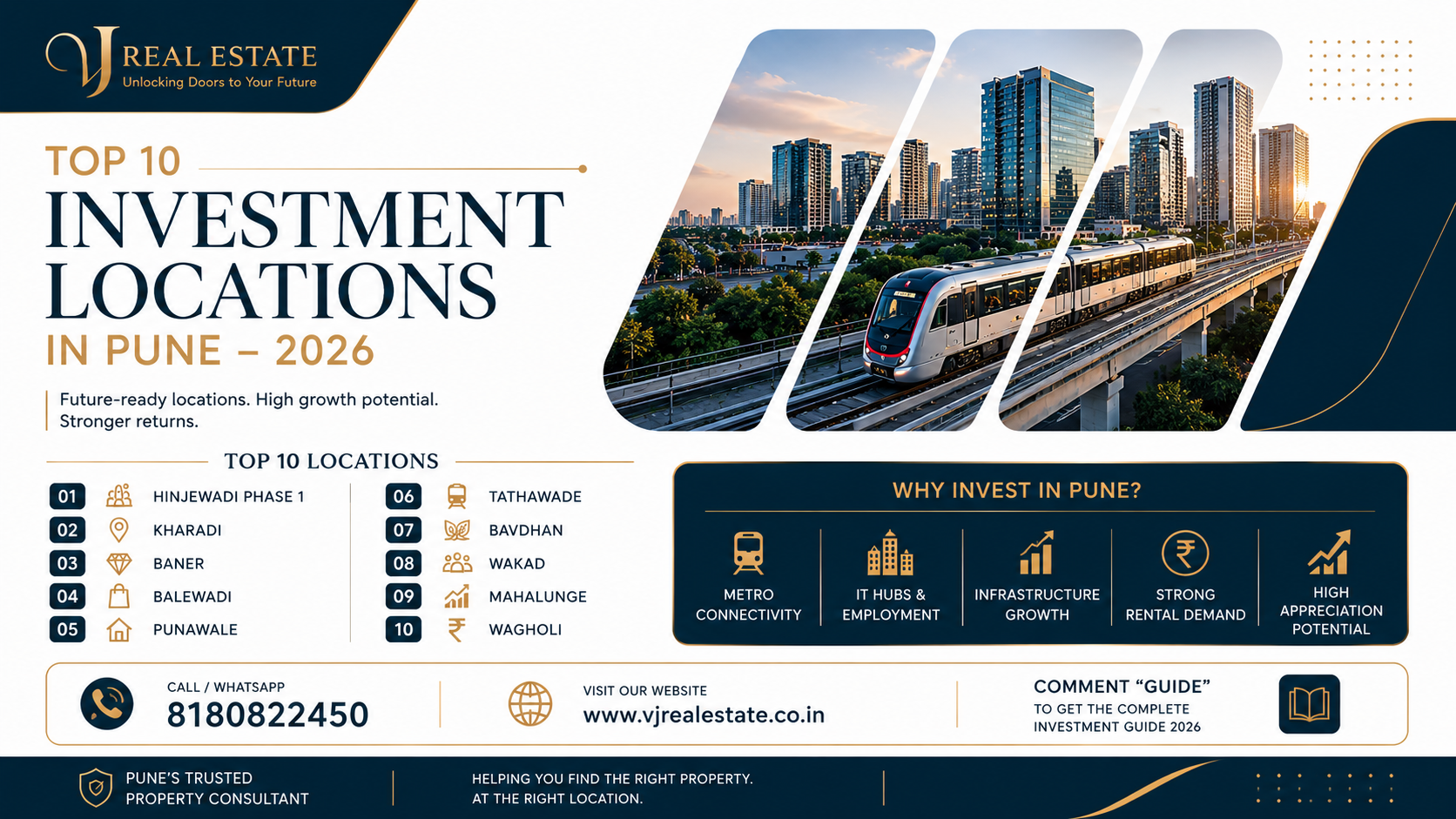
    Top 10 Investment Locations in Pune (2026): Complete Area Guide for Homebuyers & Investors

    Top 10 Investment Locations in Pune (2026): Where Smart Investors Are Buying Today

    Pune has emerged as one of India’s fastest-growing real estate destinations, driven by a thriving IT sector, Metro expansion, world-class infrastructure, and sustained demand from homebuyers and investors. Whether you’re purchasing your first home, investing for rental income, or planning long-term wealth creation, selecting the right micro-market is the key to maximizing returns.

    This guide ranks the Top 10 investment locations in Pune for 2026 based on infrastructure growth, employment opportunities, connectivity, lifestyle, rental demand, and appreciation potential.

    Why Invest in Pune Real Estate in 2026?

    Pune continues to attract professionals, multinational companies, startups, and NRIs due to its strong economic fundamentals.

    Key Growth Drivers
    Pune Metro expansion
    Mumbai–Pune Expressway connectivity
    Ring Road and infrastructure projects
    Major IT hubs
    Strong rental demand
    Premium township developments
    High quality of life
    Excellent educational institutions
    1. Hinjewadi Phase 1

    Best For: IT Professionals, Rental Income & Long-Term Investment

    Hinjewadi remains Pune’s largest IT corridor with thousands of professionals working in Rajiv Gandhi Infotech Park. The Metro project and commercial expansion continue to boost residential demand.

    Highlights

    Excellent rental demand
    Strong appreciation
    Premium townships
    Ideal for NRIs
    2. Kharadi

    One of Pune’s most premium investment destinations with EON IT Park, World Trade Center and multiple multinational companies.

    Best for

    Luxury investment
    Rental income
    High appreciation
    3. Baner

    Baner offers premium living with excellent social infrastructure, commercial offices and strong resale value.

    Ideal for

    Luxury homebuyers
    Investors
    Professionals
    4. Balewadi

    Balewadi continues to grow because of Metro connectivity, High Street retail, sports infrastructure and luxury developments.

    5. Punawale

    Punawale is one of Pune’s fastest-growing residential markets due to affordability, excellent connectivity and township projects.

    Ideal Budget

    ₹60 Lakhs – ₹1.20 Crore

    6. Tathawade

    A preferred location for families, students and IT professionals because of educational institutions and proximity to Hinjewadi.

    7. Bavdhan

    Bavdhan combines green surroundings with premium developments and excellent connectivity to Baner, Kothrud and Chandani Chowk.

    8. Wakad

    Wakad remains one of Pune’s strongest rental markets with consistent demand and good resale opportunities.

    9. Mahalunge

    A rapidly emerging destination benefiting from township developments, commercial growth and sports infrastructure.

    10. Wagholi

    Affordable pricing, improving infrastructure and proximity to Kharadi make Wagholi attractive for long-term investors.

    If you’re planning to invest in Pune in 2026, these ten locations offer the strongest balance of infrastructure, connectivity, rental demand, and long-term appreciation. The ideal choice depends on your investment horizon, budget, and financial goals.

  • Why Mamurdi Is Pune’s Next Real Estate Investment Hotspot in 2026

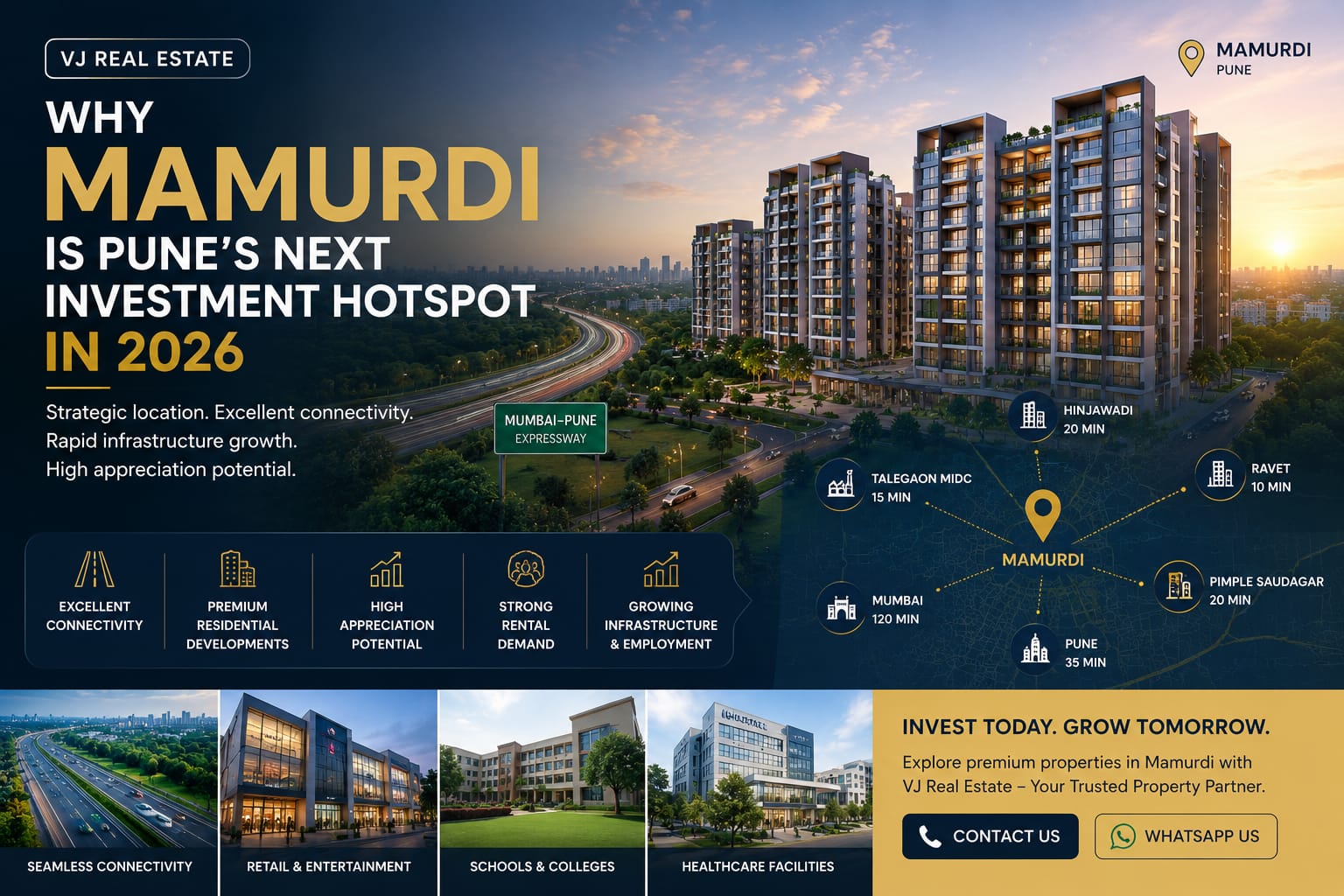
    Why Mamurdi Is Pune’s Next Real Estate Investment Hotspot in 2026

    Why Mamurdi Is Pune’s Next Real Estate Investment Hotspot in 2026

    Introduction

    Pune’s real estate market has consistently rewarded investors who identified emerging growth corridors before they became mainstream. Locations such as Baner, Balewadi, Wakad, and Hinjawadi witnessed substantial appreciation over the last decade, transforming from developing suburbs into some of Pune’s most sought-after residential destinations.

    Today, another location is attracting the attention of smart investors and homebuyers looking for long-term growth opportunities—Mamurdi.

    Strategically located along the Mumbai-Pune Expressway and surrounded by rapidly developing residential and commercial hubs, Mamurdi has emerged as one of the most promising investment destinations in Pune West. With improving infrastructure, growing social amenities, proximity to major employment centers, and relatively affordable property prices, the locality offers a compelling combination of present-day convenience and future appreciation potential.

    But what exactly makes Mamurdi stand out in Pune’s competitive real estate market?

    Let’s take a closer look.

    Where Is Mamurdi Located?

    Mamurdi is situated in the north-western part of Pune, near Ravet, Punawale, Gahunje, and Somatane. It enjoys excellent connectivity to both Pune city and Mumbai, thanks to its strategic location near the Mumbai-Pune Expressway and Old Mumbai Highway.

    The locality is also well-connected to major employment hubs such as Hinjawadi IT Park, Pimpri-Chinchwad, Talegaon MIDC, and Chakan Industrial Area, making it an attractive residential destination for working professionals.

    Its location places residents within easy reach of educational institutions, healthcare facilities, shopping centers, and entertainment zones while maintaining a comparatively peaceful residential environment.

    Why Investors Are Looking at Mamurdi

    One of the key reasons investors are increasingly considering Mamurdi is its position within Pune’s growth cycle.

    While locations like Baner and Wakad have already matured and command premium property prices, Mamurdi remains in the early stages of large-scale development. This creates an opportunity for investors to enter at a relatively affordable price point before future infrastructure and demand drive values higher.

    The locality is witnessing increasing interest from reputed developers who are launching modern residential projects, integrated townships, and lifestyle communities designed for long-term growth.

    As a result, Mamurdi is gradually transitioning from a developing suburb into a well-planned residential destination.

    Excellent Connectivity Drives Demand

    Connectivity remains one of the strongest factors influencing real estate appreciation, and Mamurdi scores exceptionally well in this regard.

    Key Connectivity Advantages

    * Direct access to the Mumbai-Pune Expressway
    * Easy connectivity to Pune-Bengaluru Highway
    * Quick access to Old Mumbai Highway
    * Seamless travel to Hinjawadi IT Park
    * Convenient connectivity to Pimpri-Chinchwad
    * Access to Talegaon MIDC and Chakan Industrial Belt
    * Well-connected road network across Pune West

    For professionals working in Hinjawadi, Wakad, Tathawade, Ravet, or industrial corridors near Talegaon and Chakan, Mamurdi offers a practical and affordable residential alternative.

    Improved accessibility not only enhances daily convenience but also contributes significantly to property appreciation and rental demand.

    Growing Social Infrastructure

    Modern homebuyers no longer evaluate a location solely based on connectivity. Access to schools, healthcare facilities, retail destinations, and lifestyle amenities plays a major role in determining long-term livability.

    Fortunately, Mamurdi benefits from its proximity to established social infrastructure.

    Educational Institutions Nearby

    * Symbiosis Skills and Professional University
    * Podar International School
    * Akshara International School
    * Indira College
    * JSPM Educational Institutes

    Healthcare Facilities

    * Aditya Birla Memorial Hospital
    * Ojas Multispeciality Hospital
    * Lifepoint Multispeciality Hospital
    * Several healthcare centers across Ravet and PCMC

    Shopping & Entertainment

    * Phoenix Mall of the Millennium
    * Elpro City Square Mall
    * City One Mall
    * Local retail hubs and convenience stores
    * MCA International Cricket Stadium, Gahunje

    The continued growth of social infrastructure enhances the area’s appeal for both end-users and investors.

    —

    Township Development Is Transforming Mamurdi

    One of the biggest trends shaping Mamurdi’s future is township-led development.

    Several developers are introducing large-scale residential communities that offer modern amenities such as:

    * Clubhouses
    * Swimming pools
    * Sports facilities
    * Landscaped gardens
    * Children’s play areas
    * Retail convenience spaces
    * Co-working facilities

    Township projects create self-sustaining ecosystems that improve overall quality of life while increasing the long-term desirability of the location.

    Historically, Pune’s successful residential destinations have benefited significantly from township development, and Mamurdi appears to be following a similar trajectory.

    Property Price Trends in Mamurdi

    Compared to established residential locations in Pune West, Mamurdi continues to offer relatively affordable property prices.

    Comparative Market Position

    | Location | Market Stage |
    | ——– | ———— |
    | Baner | Mature |
    | Balewadi | Mature |
    | Wakad | Developed |
    | Punawale | Growing |
    | Mamurdi | Emerging |

    This positioning creates a unique investment opportunity.

    Investors entering the market during the early stages of development often benefit from future appreciation driven by infrastructure growth, increasing demand, and improving social amenities.

    As residential projects continue to launch and infrastructure improves, Mamurdi’s pricing advantage may gradually narrow over the coming years.

    —

    Rental Demand Outlook

    Rental demand is another important factor that supports real estate investment performance.

    Mamurdi is well-positioned to benefit from demand generated by:

    * Hinjawadi IT professionals
    * Employees working in Talegaon MIDC
    * Professionals employed in Chakan’s manufacturing sector
    * Students attending nearby educational institutions
    * Families seeking affordable housing near employment hubs

    As Pune’s employment ecosystem expands, demand for quality housing within commuting distance of workplaces is expected to remain strong.

    This trend supports both occupancy levels and rental growth over the long term.

    Infrastructure Projects Supporting Future Growth

    Infrastructure development remains one of the most significant drivers of real estate appreciation.

    Several ongoing and proposed projects are expected to benefit the Mamurdi region.

    Pune Ring Road

    The proposed Pune Ring Road aims to improve regional connectivity, reduce congestion, and enhance accessibility across various parts of the city.

    Expansion of Employment Hubs

    Continued growth in Hinjawadi, Talegaon, and Chakan is expected to support residential demand across Pune’s western corridor.

    Road Network Improvements

    Ongoing road widening and infrastructure upgrades will further strengthen connectivity between Mamurdi and key commercial zones.

    Pune Metropolitan Region Growth

    As the Pune Metropolitan Region continues expanding, emerging locations such as Mamurdi are expected to attract increased residential and commercial investment.

    Who Should Invest in Mamurdi?

    Mamurdi is particularly suitable for:

    First-Time Homebuyers

    Those looking for affordable homes with strong future growth potential.

    Long-Term Investors

    Investors seeking capital appreciation over a 5–10 year horizon.

    NRI Investors

    NRIs interested in entering Pune’s residential market before prices rise significantly.

    IT Professionals

    Professionals working in Hinjawadi and surrounding employment hubs.

    Families

    Homebuyers seeking modern residential communities with access to essential amenities.

    Who May Not Find Mamurdi Suitable?

    Mamurdi may not be ideal for:

    * Short-term speculative investors
    * Buyers expecting immediate high appreciation
    * Investors with very short holding periods

    The locality’s strongest value proposition lies in medium-to-long-term growth rather than short-term gains.

    Future Growth Outlook

    Over the next decade, Mamurdi is expected to benefit from multiple growth drivers:

    * Continued infrastructure development
    * Expansion of employment centers
    * Increasing residential demand
    * Growth of township projects
    * Enhanced social infrastructure
    * Improved regional connectivity

    These factors collectively position Mamurdi among the most promising emerging residential destinations in Pune West.

    While no investment can guarantee future returns, the area’s underlying fundamentals suggest a strong foundation for sustainable long-term growth.

    Final Verdict

    Mamurdi offers a compelling blend of affordability, connectivity, infrastructure growth, and future appreciation potential.

    Its strategic location near the Mumbai-Pune Expressway, proximity to Hinjawadi and industrial employment hubs, growing social infrastructure, and ongoing residential development make it one of the most attractive emerging real estate markets in Pune.

    For investors looking to enter Pune’s next growth corridor before property values move significantly higher, Mamurdi deserves serious consideration.

    As always, investors should evaluate project quality, developer reputation, pricing, and long-term goals before making a purchase decision.

    Looking to Invest in Mamurdi?

    At VJ Real Estate, we help homebuyers and investors identify the most suitable projects based on budget, lifestyle requirements, and investment objectives.

    Our team provides:

    ✔ Project Comparison Assistance
    ✔ Site Visit Arrangements
    ✔ Builder Negotiation Support
    ✔ Home Loan Guidance
    ✔ Investment Consultation

    Contact VJ Real Estate today to explore the best residential and investment opportunities in Mamurdi and Pune West.

    Frequently Asked Questions

    Is Mamurdi a good place to invest in Pune?

    Yes. Mamurdi offers strong long-term growth potential due to its strategic connectivity, affordability, infrastructure development, and proximity to major employment hubs.

    What is the future of Mamurdi real estate?

    The locality is expected to witness significant residential and infrastructure growth over the next decade, making it an attractive destination for long-term investors.

    Is Mamurdi suitable for end-users?

    Yes. Mamurdi provides a balance of affordability, connectivity, modern residential projects, and access to essential amenities.

    What are the major employment hubs near Mamurdi?

    Hinjawadi IT Park, Talegaon MIDC, Chakan Industrial Area, and Pimpri-Chinchwad are among the major employment centers near Mamurdi.

    Does Mamurdi have good rental demand?

    Rental demand is increasing due to growing employment opportunities and demand from professionals working in nearby business and industrial hubs.

    Is Mamurdi better than Punawale for investment?

    Both locations have strong potential. Mamurdi generally appeals to investors seeking an earlier-stage growth market with potentially higher long-term appreciation prospects.

  • Best Areas in Pune for Rental Income and Property Investment in 2026

    Best Areas in Pune for Rental Income and Property Investment in 2026

    Best Areas in Pune for Rental Income and Property Investment in 2026

    Pune continues to be one of India’s most attractive real estate markets thanks to its thriving IT sector, educational institutions, infrastructure development, and growing population. For investors, choosing the right location is critical to maximizing rental income and capital appreciation.

    In this guide, we explore the best areas in Pune for property investment and rental returns in 2026.

    1. Hinjewadi
    Why Invest?

    Hinjewadi remains Pune’s largest IT hub and employment center. Thousands of professionals relocate here every year, creating consistent demand for rental housing.

    Average Property Price

    ₹75 Lakhs – ₹2 Crore+

    Rental Yield

    3.5% – 4.5%

    Best For

    • Rental income investors

    • IT professionals

    • First-time buyers

    • Long-term appreciation

    2. Baner

    Baner has emerged as one of Pune’s premium residential locations. Its excellent social infrastructure, connectivity, and luxury projects make it highly desirable.

    Average Property Price

    ₹1.2 Crore – ₹4 Crore+

    Rental Yield

    3% – 4%

    Best For

    • Luxury homebuyers

    • High-net-worth investors

    • Premium rental properties

    3. Balewadi

    Balewadi benefits from its proximity to Baner and Hinjewadi while offering excellent lifestyle amenities and commercial growth.

    Average Property Price

    ₹1 Crore – ₹3 Crore+

    Rental Yield

    3% – 4.2%

    Best For

    • Mid to premium investors

    • Professionals

    • Families

    4. Bavdhan

    Bavdhan is rapidly becoming one of Pune’s preferred residential destinations due to its greenery, connectivity, and premium developments.

    Average Property Price

    ₹90 Lakhs – ₹3 Crore+

    Rental Yield

    3% – 4%

    Best For

    • End-users

    • Luxury buyers

    • Long-term investors

    5. Wakad

    Wakad offers affordability combined with excellent access to IT hubs and major highways.

    Average Property Price

    ₹80 Lakhs – ₹2 Crore+

    Rental Yield

    3.5% – 4.2%

    Best For

    • First-time buyers

    • Rental investors

    • Young professionals

    6. Tathawade

    Tathawade continues to attract buyers looking for affordable investment opportunities near Hinjewadi.

    Average Property Price

    ₹70 Lakhs – ₹1.5 Crore+

    Rental Yield

    3.5% – 4.5%

    Best For

    • Budget-conscious investors

    • Early-stage appreciation seekers

    Factors That Influence Rental Yield

    Before investing, evaluate:

    • Employment hubs nearby

    • Metro connectivity

    • Schools and hospitals

    • Future infrastructure projects

    • Supply and demand trends

    • Developer reputation

    Which Area Offers the Highest Rental Demand?

    Currently, Hinjewadi leads Pune in rental demand due to:

    • IT workforce concentration

    • Corporate leasing demand

    • Metro infrastructure growth

    • Continuous migration of professionals

    Frequently Asked Questions
    Which area in Pune gives the highest rental yield?

    Hinjewadi and Tathawade typically offer some of Pune’s strongest rental yields due to high demand from working professionals.

    Is Baner a good investment?

    Yes. Baner remains one of Pune’s premium residential destinations with strong appreciation and resale demand.

    Which Pune location is best for first-time investors?

    Hinjewadi, Wakad, and Tathawade offer attractive entry prices and strong growth potential.

    Is Pune a good city for real estate investment in 2026?

    Yes. Pune continues to benefit from infrastructure development, IT growth, educational institutions, and increasing housing demand.

    Final Thoughts

    Whether your goal is rental income, capital appreciation, or long-term wealth creation, Pune offers opportunities across multiple budget segments. Areas like Hinjewadi, Baner, Balewadi, Bavdhan, Wakad, and Tathawade continue to be among the most promising investment destinations in 2026.

    Choosing the right location today can significantly improve your investment returns over the next decade.

  • Baner vs Hinjewadi: Which Area is Better for Property Investment in Pune?

    Baner vs Hinjewadi: Which Area is Better for Property Investment in Pune?

    Baner vs Hinjewadi: Which Area is Better for Property Investment in Pune?

    Baner and Hinjewadi are two of Pune’s most popular real estate destinations. Both locations attract homebuyers, IT professionals, NRIs, and investors looking for long-term appreciation and rental income.

    But which area offers the better investment opportunity in 2026?

    The answer depends on your budget, investment goals, and expected returns.

    Overview of Baner

    Baner has evolved into one of Pune’s premium residential neighborhoods. Known for luxury developments, high-end restaurants, excellent infrastructure, and proximity to business districts, Baner attracts affluent professionals and business owners.

    Advantages of Investing in Baner

    • Premium residential environment

    • Excellent social infrastructure

    • Strong resale demand

    • Luxury apartment projects

    • Close to Balewadi High Street

    • Better lifestyle quotient

    Average Property Prices in Baner

    • 2 BHK: ₹1.1 Cr – ₹1.8 Cr

    • 3 BHK: ₹1.8 Cr – ₹4 Cr+

    • Luxury Residences: ₹4 Cr+

    Baner generally commands higher property prices than most Pune locations.

    Overview of Hinjewadi

    Hinjewadi is Pune’s largest IT and employment hub. Home to thousands of professionals, it continues to experience strong residential demand driven by job growth and infrastructure development.

    Advantages of Investing in Hinjewadi

    • Strong rental demand

    • Lower entry pricing

    • Continuous infrastructure growth

    • Metro connectivity improvements

    • High appreciation potential

    • Large IT workforce

    Average Property Prices in Hinjewadi

    • 2 BHK: ₹75 Lakhs – ₹1.2 Cr

    • 3 BHK: ₹1.1 Cr – ₹2 Cr

    • Premium Projects: ₹2 Cr+

    Hinjewadi offers more affordable entry points for investors.

    Baner vs Hinjewadi Comparison
    Property Price

    Winner: Hinjewadi

    Hinjewadi offers lower investment entry points compared to Baner.

    Rental Yield

    Winner: Hinjewadi

    The large concentration of IT professionals creates consistent rental demand.

    Luxury Lifestyle

    Winner: Baner

    Baner offers superior social infrastructure, dining, entertainment, and premium residential communities.

    Capital Appreciation

    Winner: Tie

    Both locations are expected to witness strong appreciation due to infrastructure and employment growth.

    Connectivity

    Winner: Baner

    Baner enjoys better connectivity to central Pune and key business districts.

    Who Should Invest in Baner?

    Baner is ideal for:

    • Luxury homebuyers

    • High-income professionals

    • Families seeking premium lifestyle

    • Long-term wealth preservation

    • Buyers prioritizing location prestige

    Who Should Invest in Hinjewadi?

    Hinjewadi is ideal for:

    • First-time investors

    • IT professionals

    • Rental income investors

    • NRI buyers

    • Buyers seeking appreciation potential

    Frequently Asked Questions
    Is Baner more expensive than Hinjewadi?

    Yes. Baner generally commands higher property prices due to its premium positioning.

    Which area gives better rental returns?

    Hinjewadi often delivers stronger rental demand because of its IT workforce.

    Which area is better for luxury living?

    Baner offers a more premium residential environment and lifestyle amenities.

    Is Hinjewadi a good investment in 2026?

    Yes. Continued IT growth, Metro expansion, and infrastructure development make it one of Pune’s strongest investment destinations.

    Final Verdict

    Choose Baner if your priority is luxury living, premium neighborhoods, and long-term asset quality.

    Choose Hinjewadi if your focus is rental income, affordability, and future appreciation potential.

    For many investors, both locations remain among the safest and most rewarding real estate markets in Pune

  • Is Hinjewadi a Good Place to Invest in Property in Pune in 2026?

    Is Hinjewadi a Good Place to Invest in Property in Pune in 2026?

    Is Hinjewadi a Good Place to Invest in Property in Pune in 2026?

    If you’re planning to invest in Pune real estate, Hinjewadi is likely one of the first locations you’ll encounter. Home to Rajiv Gandhi Infotech Park and some of India’s largest IT companies, Hinjewadi has transformed from a suburban area into Pune’s most important residential and commercial hub.

    But is Hinjewadi still a good property investment in 2026?

    The short answer is yes.

    With growing employment opportunities, Metro connectivity, infrastructure upgrades, and strong rental demand, Hinjewadi remains one of the most attractive investment destinations in Pune.

    Why is Hinjewadi So Popular?

    Hinjewadi is home to thousands of professionals working at companies such as Infosys, Wipro, TCS, Cognizant, Tech Mahindra, Capgemini, and Accenture.

    This continuous influx of professionals creates consistent demand for:

    • Residential apartments

    • Rental properties

    • Commercial spaces

    • Co-living investments

    As a result, property values have witnessed steady appreciation over the last decade.

    What Are Property Prices in Hinjewadi in 2026?

    Property prices vary depending on project quality and exact location.

    Average Pricing:

    • Affordable Projects: ₹75 Lakhs – ₹95 Lakhs

    • Mid-Segment Projects: ₹95 Lakhs – ₹1.5 Crore

    • Premium Projects: ₹1.5 Crore – ₹3 Crore+

    Many new launches are still available at attractive pricing, allowing investors to benefit from future appreciation.

    What Rental Yield Can Investors Expect?

    One of Hinjewadi’s biggest advantages is rental demand.

    Average Rental Yield:

    • 2 BHK Apartments: 3.5% – 4.5%

    • 3 BHK Apartments: 3% – 4%

    • Premium Properties: 2.8% – 4%

    Compared to many Indian cities, Hinjewadi offers a strong balance of rental income and capital growth.

    Infrastructure Projects Driving Growth

    Several major infrastructure projects are expected to boost property values:

    Pune Metro Expansion

    The Metro will significantly improve connectivity between Hinjewadi and central Pune.

    Pune Ring Road

    The upcoming Ring Road project is expected to reduce travel times and increase accessibility.

    Highway Connectivity

    Direct access to Mumbai-Bengaluru Highway continues to make Hinjewadi a strategic residential destination.

    Best Property Types for Investment

    Investors generally prefer:

    2 BHK Apartments

    Ideal for rental income and first-time buyers.

    3 BHK Apartments

    Popular among families and senior professionals.

    Pre-Launch Projects

    Offer lower entry prices and higher appreciation potential.

    Frequently Asked Questions
    Is Hinjewadi a good place to invest in property?

    Yes. Hinjewadi offers strong rental demand, employment growth, infrastructure development, and long-term appreciation potential.

    What is the average property price in Hinjewadi?

    Property prices typically range from ₹75 Lakhs to ₹3 Crore+, depending on project location and amenities.

    Is Hinjewadi suitable for rental income?

    Yes. The area has one of Pune’s strongest rental markets due to the concentration of IT professionals.

    Which projects are worth considering in Hinjewadi?

    Premium residential projects such as Kohinoor Royale Towers, township developments, and RERA-approved new launches are popular choices among buyers.

    Final Verdict

    For buyers seeking long-term capital appreciation, stable rental income, and exposure to Pune’s fastest-growing IT corridor, Hinjewadi remains one of the strongest real estate investment destinations in 2026.

    Whether you’re a first-time homebuyer, NRI investor, or experienced property investor, Hinjewadi deserves serious consideration for your next real estate investment.