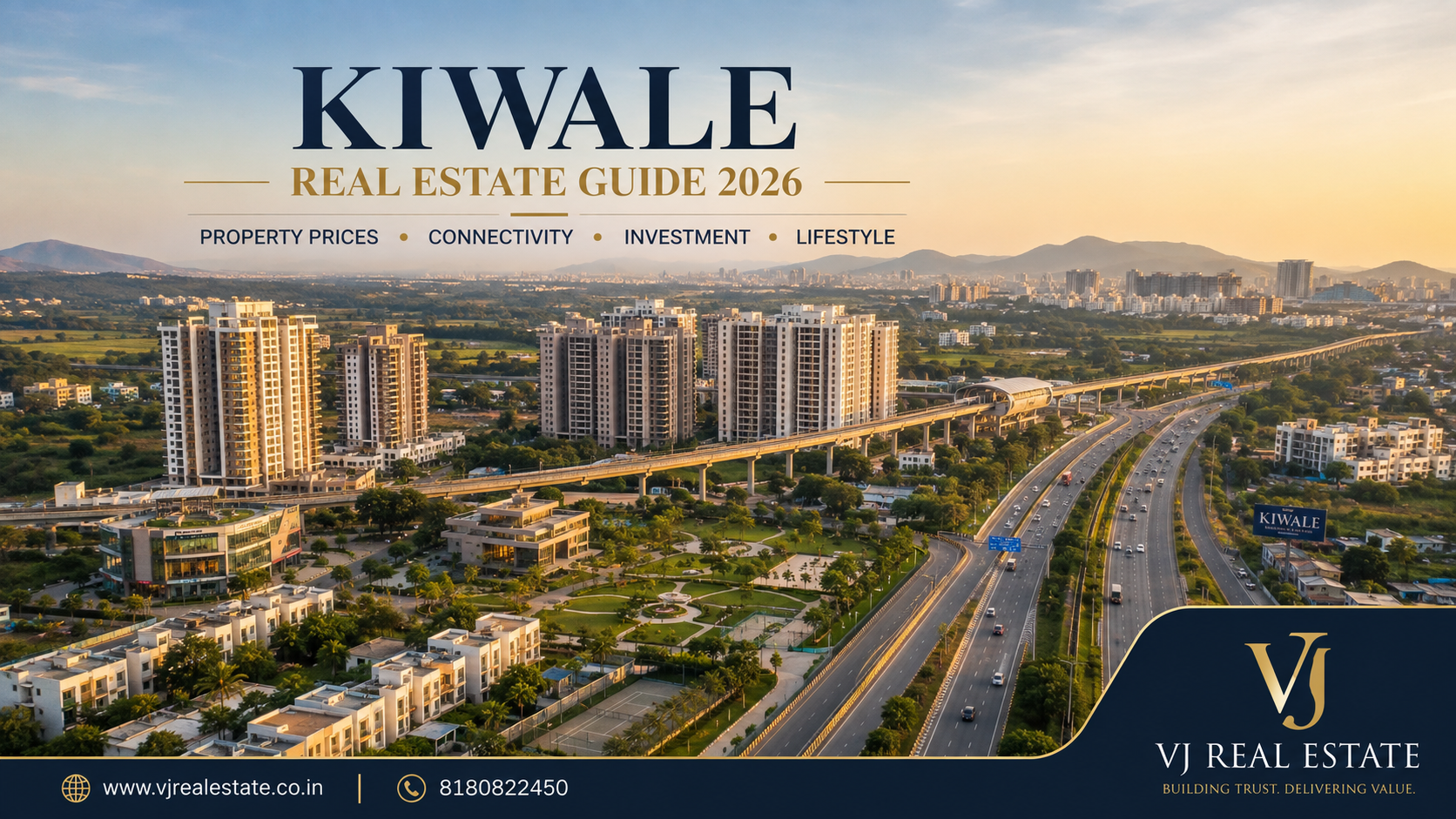
Kiwale has quietly transformed from a peripheral suburb into one of the most promising residential destinations in Pune West. Located along the Mumbai–Pune Expressway and strategically positioned near Ravet, Punawale, Tathawade, and Hinjawadi, the locality is increasingly attracting first-time homebuyers, investors, working professionals, and families seeking a balance between affordability and connectivity.
Unlike many mature residential markets where property prices have already appreciated significantly, Kiwale continues to offer relatively affordable housing while benefiting from large-scale infrastructure development across the Pimpri-Chinchwad region. Improved road connectivity, proximity to employment hubs, the proposed metro expansion, and the upcoming Pune Ring Road are expected to shape the area’s long-term growth trajectory.
One of Kiwale’s biggest strengths is its strategic location. Residents enjoy seamless access to the Mumbai–Pune Expressway, Dehu Road, Nigdi, Ravet, and the rapidly expanding IT corridor of Hinjawadi. This connectivity has encouraged several reputed developers to launch residential projects catering to a wide range of buyers, from compact 2 BHK apartments to premium family homes.
The locality is also witnessing steady social infrastructure development. Schools, hospitals, shopping centres, restaurants, parks, and recreational facilities are expanding alongside residential growth, making Kiwale increasingly suitable not only for investment but also for end-use living.
Whether you are:
buying your first home,
looking for a long-term investment,
upgrading to a larger apartment,
searching for rental income,
or planning to relocate closer to Pune’s employment hubs,
this comprehensive guide will help you understand everything you need to know about Kiwale’s real estate market in 2026.
Where is Kiwale?
Kiwale is located in the north-western part of Pune within the Pimpri-Chinchwad Municipal Corporation (PCMC). The locality lies adjacent to Ravet and enjoys direct connectivity to the Mumbai–Pune Expressway, making it one of the most accessible residential locations in Pune West.
Its location places residents within convenient driving distance of major employment centres, educational institutions, healthcare facilities, and commercial zones.
Strategic Location
| Location | Approximate Distance |
| ————————– | ——————-: |
| Ravet | 2 km |
| Punawale | 3 km |
| Tathawade | 5 km |
| Nigdi | 6 km |
| Dehu Road Railway Station | 4 km |
| Akurdi | 8 km |
| Hinjawadi Phase 1 | 14–16 km |
| Wakad | 10 km |
| Balewadi High Street | 18 km |
| Pune Railway Station | 27 km |
| Pune International Airport | 31–33 km |
Location Highlights
Kiwale enjoys proximity to several established residential and commercial micro-markets:
Ravet
Punawale
Tathawade
Nigdi
Akurdi
Dehu Road
Hinjawadi IT Park
Pimpri-Chinchwad industrial belt
Its location benefits from easy regional connectivity through:
Mumbai–Pune Expressway
Old Mumbai Highway (NH-48)
Mumbai–Bengaluru Highway
Aundh–Ravet BRTS corridor
Proposed Pune Ring Road
Map Description
Imagine Kiwale positioned as a gateway between Pune city and Mumbai.
Expressway to the north
Ravet to the east
Punawale to the south
Dehu Road to the west
Hinjawadi approximately 20–25 minutes away under normal traffic conditions
This strategic positioning is one of the primary reasons why Kiwale has emerged as a preferred residential destination for both end-users and investors.
Kiwale Quick Facts (2026)
| Parameter | Details |
| —————————– | —————————————————————- |
| Location | Pune West / PCMC |
| Pincode | 412101 |
| Municipal Authority | Pimpri-Chinchwad Municipal Corporation (PCMC) |
| Nearest Highway | Mumbai–Pune Expressway (NH-48) |
| Nearest Metro | Nigdi (existing connectivity plans and future network expansion) |
| Nearest Railway Station | Dehu Road Railway Station |
| Nearest Airport | Pune International Airport |
| Dominant Property Type | Residential Apartments |
| Typical Configurations | 2 & 3 BHK |
| Average Property Rate | ₹7,500–₹10,500 per sq. ft. |
| Rental Yield | 3.2–4.1% annually |
| Estimated 5-Year Appreciation | 35–50% (micro-market dependent) |
| Buyer Profile | Families, IT Professionals, First-time Buyers, Investors |
| Best For | Affordable housing with long-term appreciation potential |
Why Kiwale is Becoming Popular
Over the last few years, Kiwale has moved beyond being considered merely an affordable suburb. Today, it is developing into a well-connected residential destination with growing infrastructure, improved liveability, and attractive investment prospects.
Several factors have contributed to this transformation.
1. Affordable Property Prices
Compared with established locations such as Wakad, Baner, Balewadi, and even parts of Tathawade, Kiwale still offers comparatively accessible entry prices.
This affordability allows buyers to purchase larger homes within similar budgets while retaining long-term appreciation potential.
For first-time buyers, Kiwale often represents a practical balance between budget and location.
2. Excellent Connectivity
Connectivity remains one of Kiwale’s strongest advantages.
Residents can access:
Mumbai–Pune Expressway
NH-48
Ravet
Punawale
Nigdi
Akurdi
Hinjawadi
Pimpri-Chinchwad industrial belt
Daily commuting has become increasingly convenient for professionals working across Pune’s western employment corridors.
3. Rapid Residential Development
Several reputed developers have launched projects featuring:
gated communities
landscaped gardens
clubhouses
children’s play areas
swimming pools
gyms
co-working spaces
sports amenities
This has significantly improved the quality of housing available in the locality.
4. Growing Infrastructure
Government investment in roads, metro connectivity, and regional planning is expected to strengthen Kiwale’s position over the coming years.
Major developments include:
Pune Ring Road
road widening projects
improved junctions
metro expansion plans
enhanced public transport connectivity
These projects are likely to improve accessibility while supporting future property value appreciation.
📈 Market Trend
Property demand in Kiwale has shifted from predominantly investor-led purchases to a healthier mix of end-users and investors. This transition often indicates a maturing residential market with stronger long-term stability.
5. Family-Friendly Environment
Unlike highly congested urban neighbourhoods, Kiwale offers:
relatively wider roads
lower density in several pockets
better air quality
growing green spaces
quieter residential surroundings
These characteristics make it appealing for families with children and senior citizens.
6. Educational Institutions Nearby
The locality is supported by several well-known schools and colleges in Ravet, Nigdi, Akurdi, and Tathawade.
This reduces travel time for students while enhancing the area’s appeal to families.
7. Employment Accessibility
Although Kiwale itself is primarily residential, it offers convenient access to multiple employment hubs:
Hinjawadi IT Park
Talawade IT Park
Pimpri industrial area
Chakan manufacturing belt
Akurdi
Nigdi commercial zones
This broad employment catchment helps sustain housing demand.
💡 Investment Tip
Areas that combine affordable entry prices with strong connectivity and improving infrastructure often have better long-term appreciation potential than already saturated premium markets.
Connectivity
Connectivity is one of the primary reasons behind Kiwale’s growing popularity. The locality benefits from excellent road infrastructure and improving public transport, enabling residents to travel conveniently across Pune and towards Mumbai.
Road Connectivity
Kiwale enjoys direct access to several major road networks.
Key Roads
Mumbai–Pune Expressway
NH-48
Old Mumbai Highway
Aundh–Ravet BRTS Road
Spine Road via Nigdi
Dehu Road Corridor
These routes facilitate efficient movement for both daily commuters and long-distance travellers.
Metro Connectivity
While Kiwale does not currently have its own metro station, future network expansion and nearby stations are expected to improve public transport access.
The broader Pune Metro expansion and PCMC connectivity initiatives are expected to strengthen links between Kiwale and major commercial areas over the medium to long term.
Railway Connectivity
Nearest stations include:
Dehu Road Railway Station
Akurdi Railway Station
Chinchwad Railway Station
These stations provide suburban rail connectivity towards Pune and Mumbai.
Airport Connectivity
Pune International Airport can typically be reached in:
45–70 minutes
depending on traffic conditions.
The proposed regional infrastructure improvements may further enhance airport accessibility in the coming years.
Public Transport
Residents benefit from:
PMPML bus services
Auto-rickshaws
App-based taxis
Shared mobility services
Public transport options continue to improve as residential density increases.
Future Infrastructure
Several infrastructure initiatives are expected to influence Kiwale’s accessibility over the next decade:
Pune Ring Road
Metro expansion
Expressway improvements
Junction upgrades
Road widening
Enhanced BRT connectivity
Estimated Travel Time
| Destination | Approximate Time |
| ——————– | —————: |
| Ravet | 5 minutes |
| Punawale | 8 minutes |
| Tathawade | 12 minutes |
| Nigdi | 15 minutes |
| Hinjawadi Phase 1 | 25–30 minutes |
| Balewadi | 30–35 minutes |
| Baner | 35–40 minutes |
| Pimpri | 20 minutes |
| Pune Railway Station | 50–60 minutes |
| Pune Airport | 45–70 minutes |
🧠 Expert Insight
For many buyers working in Hinjawadi or the PCMC industrial belt, Kiwale offers a practical compromise between commuting convenience and housing affordability. As transport infrastructure improves, this accessibility advantage could become even more significant.
Infrastructure Developments
Infrastructure remains one of the biggest catalysts for Kiwale’s real estate growth. Over the past few years, the locality has benefited from public investment in transportation, urban planning, and civic development, with several additional projects planned or under implementation.
These improvements are expected to enhance connectivity, attract new residential demand, and support long-term property appreciation.
1. Pune Ring Road
One of the most significant regional infrastructure projects is the proposed Pune Ring Road.
Once operational, it is expected to:
improve connectivity between western and northern Pune,
reduce travel time by bypassing congested city routes,
enhance access to industrial and IT hubs,
improve logistics and regional mobility.
For Kiwale, better regional connectivity could strengthen demand from both homebuyers and investors.
2. Metro Expansion
The continued expansion of Pune Metro and the long-term vision for improved PCMC connectivity are expected to make public transport more convenient for residents.
Although Kiwale currently depends on nearby metro access rather than a dedicated station, future network growth is likely to reduce dependence on private vehicles for commuting.
3. Road Widening and Junction Improvements
PCMC has undertaken and planned multiple road enhancement initiatives across western Pune.
These include:
widening of key arterial roads,
junction redesigns,
signal optimisation,
improved pedestrian infrastructure,
better traffic management.
Such upgrades improve everyday commuting and contribute to higher residential attractiveness.
4. Employment Growth
Kiwale benefits indirectly from employment expansion in nearby hubs, including:
Hinjawadi IT Park,
Talawade IT Park,
Pimpri-Chinchwad industrial corridor,
Chakan manufacturing belt.
As these employment centres continue to grow, housing demand in well-connected residential locations like Kiwale is expected to remain healthy.
5. PMRDA and PCMC Urban Development
Planned urban development by regional authorities includes improvements in:
road infrastructure,
drainage,
public amenities,
transport integration,
urban mobility.
These initiatives aim to support the long-term growth of rapidly developing suburbs across Pune West.
🔮 Future Outlook
Kiwale is transitioning from an emerging suburb to a more established residential market. Infrastructure projects underway today are likely to shape buyer demand and property values well beyond 2030.
Property Prices in Kiwale (2026)
Kiwale’s residential market offers a diverse range of housing options, catering to first-time buyers, families upgrading to larger homes, and investors seeking long-term appreciation.
Compared with many established western Pune localities, Kiwale continues to offer relatively competitive pricing while benefiting from improving infrastructure and connectivity.
Estimated Property Price Range (2026)
| Property Type | Approximate Price Range |
| ————————- | ——————————————–: |
| 1 BHK Apartment | ₹40–60 Lakhs |
| 2 BHK Apartment | ₹58–95 Lakhs |
| 3 BHK Apartment | ₹85 Lakhs–₹1.45 Crore |
| Premium/Luxury Apartments | ₹1.40–2.20 Crore+ |
| Residential Plots* | Varies based on location, size, and approvals |
| Commercial Shops | ₹65 Lakhs onwards (project dependent) |
*Plot availability within Kiwale is relatively limited compared to apartment developments.
Average Apartment Rates
| Segment | Approximate Rate |
| ———– | ———————-: |
| Affordable | ₹7,500–₹8,500/sq. ft. |
| Mid-Segment | ₹8,500–₹9,500/sq. ft. |
| Premium | ₹9,500–₹10,500+/sq. ft. |
Actual pricing varies based on developer reputation, project amenities, construction stage, floor level, views, and payment plans.
Market Trends
Key trends shaping the 2026 market include:
steady demand from end-users,
healthy absorption in new launches,
increasing preference for larger homes,
improved amenity expectations,
growing interest from investors anticipating infrastructure-led appreciation.
Factors Influencing Prices
Several variables affect property pricing in Kiwale:
proximity to the Expressway,
connectivity to Ravet and Punawale,
developer reputation,
construction quality,
project amenities,
inventory availability,
infrastructure improvements,
overall market sentiment.
Price Appreciation in Kiwale
Over the past five years, Kiwale has emerged as one of the fastest-growing residential micro-markets in Pune West. While it started as an affordable extension of Ravet and Dehu Road, improved infrastructure, increasing developer interest, and growing demand from homebuyers have steadily pushed property values upward.
Unlike mature localities such as Baner or Wakad—where price growth has moderated due to higher base values—Kiwale still has room for appreciation because it is transitioning from a developing suburb to a well-established residential destination.
Historical Price Trend
| Year | Approx. Average Rate (₹/sq. ft.) | Growth |
| ——– | ——————————-: | ——-: |
| 2021 | ₹5,400–₹6,000 | — |
| 2022 | ₹5,900–₹6,700 | 8–10% |
| 2023 | ₹6,400–₹7,300 | 7–9% |
| 2024 | ₹6,900–₹8,100 | 8–11% |
| 2025 | ₹7,300–₹9,000 | 6–9% |
| 2026 | ₹7,500–₹10,500 | 5–8% |
Indicative market ranges. Actual pricing depends on project, builder reputation, amenities, inventory, and location.
What is Driving Appreciation?
Infrastructure Development
Large public infrastructure projects often have a direct impact on residential demand. Kiwale benefits from:
Mumbai–Pune Expressway connectivity
Road widening initiatives
Proposed Pune Ring Road
Metro network expansion
Improved internal roads
Better access to employment hubs
Growing Housing Demand
Demand is coming from multiple buyer categories:
IT professionals
Manufacturing professionals
First-time homebuyers
Families upgrading from older housing
Long-term investors
This diversified demand makes the market more stable than one driven only by investors.
Supply by Reputed Developers
Several established developers have launched integrated residential projects in Kiwale, increasing buyer confidence and improving the overall quality of housing stock.
Employment Growth
Nearby employment centres include:
Hinjawadi IT Park
Talawade IT Park
Pimpri MIDC
Chakan Industrial Area
Akurdi commercial district
Employment growth continues to support residential demand.
📈 Market Trend
Kiwale has evolved from an investor-focused destination into a balanced end-user market. This shift generally supports more sustainable price appreciation over the long term.
Future Appreciation Outlook (2026–2030)
Considering planned infrastructure, employment growth, and ongoing residential development, Kiwale is expected to remain one of the stronger-performing residential corridors in Pune West.
Potential appreciation drivers include:
Completion of regional infrastructure
Increased metro accessibility
Limited premium land parcels
Rising replacement cost of construction
Continued migration toward PCMC
While future price growth cannot be guaranteed, Kiwale is well positioned for long-term capital appreciation relative to many already mature locations.
✔ Investment Tip
Buyers with a holding period of 7–10 years may benefit more than short-term investors, especially if they purchase in projects by reputed developers with strong construction quality and good connectivity.
Rental Market in Kiwale
Kiwale’s rental market has expanded steadily as the locality has developed. The area attracts working professionals, families, and employees from nearby industrial and IT hubs.
Although rental yields are moderate compared with central Pune, they remain competitive for an emerging residential suburb.
Estimated Monthly Rentals (2026)
| Configuration | Monthly Rent |
| —————— | ————–: |
| 1 BHK | ₹12,000–₹17,000 |
| 2 BHK | ₹18,000–₹28,000 |
| 3 BHK | ₹28,000–₹42,000 |
| Premium Apartments | ₹40,000+ |
Typical Rental Yield
Average rental yield:
3.2%–4.1% annually
Yield depends on:
Project quality
Furnishing
Connectivity
Amenities
Maintenance
Tenant profile
Who Rents in Kiwale?
The tenant mix is becoming increasingly diverse.
IT Professionals
Many professionals working in:
Hinjawadi
Talawade
Wakad
choose Kiwale for its relatively affordable rentals.
Families
Families appreciate:
Modern gated communities
Schools nearby
Parks
Better living environment
Larger apartments
Industrial Employees
Professionals working in:
Pimpri MIDC
Chakan
Akurdi
also contribute to rental demand.
Students
Students attending educational institutions in Ravet, Nigdi, and Akurdi occasionally choose rental accommodation in Kiwale, although families remain the dominant tenant segment.
💡 Buyer Tip
Investors seeking rental income should prioritize projects close to major roads, public transport, and social infrastructure, as these generally attract stronger tenant demand.
Lifestyle in Kiwale
Kiwale has developed beyond being just a residential suburb. Residents today have access to improving social infrastructure that supports day-to-day living.
Education
Nearby educational institutions include:
City Pride School
Orchids The International School
Indira National School
Akshara International School
Delhi Public School (nearby corridor)
Dr. D. Y. Patil educational institutions
Symbiosis Skills and Professional University
These institutions make Kiwale attractive for families with school-going children.
Healthcare
Residents have access to multiple hospitals and healthcare centres nearby, including:
Ojas Multispeciality Hospital
Varad Hospital
Unique Multispeciality Hospital
Aditya Birla Memorial Hospital (regional tertiary care)
D. Y. Patil Hospital
Shopping & Retail
Nearby shopping destinations include:
City One Mall
Elpro City Square
Vision One Mall
Local retail markets
Daily convenience stores
Supermarkets
Restaurants & Cafés
Kiwale and nearby localities offer a growing range of dining options, from local eateries to branded restaurants, cafés, bakeries, and quick-service outlets.
Parks & Recreation
Residents enjoy access to:
Community gardens
Children’s play areas
Jogging tracks
Clubhouses
Indoor games
Swimming pools
Fitness centres
Many newer projects include these amenities within gated communities.
Sports & Fitness
Popular recreational facilities include:
Cricket grounds
Badminton courts
Football turfs
Gyms
Yoga studios
Cycling routes
🧠 Expert Insight
Lifestyle infrastructure is one of the strongest differentiators between today’s Kiwale and the locality a decade ago. Modern residential communities have significantly improved the overall living experience.
Top Residential Projects in Kiwale
The locality features projects from several reputed developers, catering to different budgets and lifestyle preferences.
1. Crestline Shreshtha
Developer: Crestline Developers
Configuration
2 BHK
3 BHK
Amenities
Clubhouse
Swimming Pool
Gym
Children’s Play Area
Landscaped Garden
Security
USP
Modern lifestyle homes with excellent Expressway connectivity.
Ideal Buyer
Families and first-time buyers.
2. Unique K Town
Developer: Unique Group
Configuration
2 BHK
3 BHK
Amenities
Clubhouse
Sports Facilities
Gardens
Multipurpose Hall
Fitness Centre
USP
Integrated township-style living with community-focused planning.
Ideal Buyer
End-users seeking long-term residence.
3. Gini Viviana
Developer: Gini Constructions
Configuration
2 & 3 BHK
Amenities
Swimming Pool
Gym
Indoor Games
Landscaped Podium
Children’s Area
USP
Contemporary design with premium specifications.
Ideal Buyer
Working professionals and families.
4. Kohinoor Uptown Avenue
Developer: Kohinoor Group
Configuration
2 BHK
3 BHK
Amenities
Clubhouse
Sports Amenities
Jogging Track
Security
Community Spaces
USP
Reputed developer with strong brand value.
Ideal Buyer
Buyers seeking established developer credibility.
5. Saniket The Rising
Developer: Saniket Builders
Configuration
2 & 3 BHK
Amenities
Landscaped Gardens
Children’s Play Area
Gym
Community Hall
USP
Affordable homes with good connectivity.
Ideal Buyer
Budget-conscious families.
Who Should Buy Property in Kiwale?
First-Time Homebuyers
Kiwale offers one of the better combinations of affordability and future growth within Pune West.
Families
Suitable due to:
Schools
Hospitals
Modern gated communities
Parks
Relatively peaceful surroundings
IT Professionals
Reasonable commuting distance to:
Hinjawadi
Talawade
Wakad
while offering larger homes at comparatively affordable prices.
Investors
Kiwale appeals to investors looking for:
Capital appreciation
Rental demand
Infrastructure-led growth
Long-term wealth creation
Retirees
The locality offers:
Lower congestion than central Pune
Growing healthcare access
Community living
Green spaces
NRIs
NRIs seeking long-term residential assets in Pune West may find Kiwale attractive due to:
Reputed developers
Improving infrastructure
Competitive pricing
Future appreciation potential
Advantages of Buying in Kiwale
Excellent Expressway connectivity
Affordable compared to Baner and Wakad
Good access to Hinjawadi
Strong future infrastructure
Growing social amenities
Reputed developers
Modern gated communities
Family-friendly environment
Improving rental demand
Good long-term appreciation potential
Access to schools and hospitals
Less congestion than older city areas
Wide range of apartment options
Better value for money
Increasing buyer confidence
Disadvantages of Kiwale
A balanced assessment is important before making a purchase decision.
Some challenges include:
Peak-hour traffic on major approach roads.
Ongoing construction activity in developing pockets.
Public transport options are still evolving.
Metro connectivity is not yet directly available within the locality.
Certain civic infrastructure is catching up with rapid residential growth.
Premium retail and entertainment options remain concentrated in nearby areas such as Wakad and Baner.
Appreciation may vary significantly depending on the project’s location and developer quality.
✔ Buyer Tip
Evaluate projects based not only on price but also on construction quality, legal approvals, builder track record, maintenance planning, and proximity to daily conveniences.
Kiwale vs Ravet
| Parameter | Kiwale | Ravet |
| ——————— | —————————– | ——————– |
| Property Price | Lower to Moderate | Moderate |
| Infrastructure | Rapidly Developing | Well Established |
| Connectivity | Excellent | Excellent |
| Social Infrastructure | Improving | Mature |
| Rental Demand | Growing | Strong |
| Future Appreciation | High Potential | Moderate to High |
| Suitable For | First-time buyers & investors | Families & end-users |
Kiwale vs Punawale
| Parameter | Kiwale | Punawale |
| ——————– | ————– | ———— |
| Average Price | Slightly Lower | Higher |
| IT Connectivity | Good | Excellent |
| Premium Projects | Moderate | More Options |
| Traffic | Lower | Higher |
| Investment Potential | High | High |
| Family Living | Good | Excellent |
Kiwale vs Tathawade
| Parameter | Kiwale | Tathawade |
| ———————- | ————— | —————- |
| Entry Price | More Affordable | Higher |
| Educational Hub | Nearby | Strong |
| IT Connectivity | Good | Excellent |
| Premium Housing | Growing | Well Established |
| Rental Market | Growing | Strong |
| Long-term Appreciation | High | Moderate to High |
Future Growth Potential (2026–2030)
Kiwale is entering a new phase of development. Earlier viewed primarily as an affordable extension of Ravet, it is now evolving into a self-sustaining residential destination supported by infrastructure, employment accessibility, and modern housing.
Over the next five years, several factors are expected to influence the locality’s growth.
1. Infrastructure Will Continue to Drive Demand
Major public infrastructure projects are expected to improve regional connectivity and reduce travel times.
Key growth catalysts include:
Pune Ring Road
Road widening projects
Junction improvements
Metro network expansion
Better public transport integration
Continued development within the PCMC region
Improved accessibility generally makes residential locations more attractive to both homebuyers and investors.
2. Employment Hubs Will Support Housing Demand
Kiwale benefits from its proximity to several employment corridors:
Hinjawadi IT Park
Talawade IT Park
Pimpri MIDC
Chakan Industrial Area
Akurdi commercial belt
As these employment centres continue to expand, housing demand in nearby residential locations is expected to remain healthy.
3. Better Social Infrastructure
The locality continues to witness growth in:
Schools
Hospitals
Retail outlets
Restaurants
Supermarkets
Recreation facilities
Banking services
This reduces the need for residents to travel to older parts of Pune for everyday requirements.
4. Shift Towards End-User Demand
Historically, many emerging suburbs were dominated by investors. Today, Kiwale is seeing a larger share of end-users, including:
Young professionals
Families
First-time homebuyers
Home upgraders
A healthy end-user market often contributes to long-term price stability.
5. Limited Supply of Well-Located Land
As development progresses, the availability of strategically located residential land is likely to reduce. Over time, this may support property values, particularly in projects by reputed developers with strong amenities and connectivity.
🔮 Future Outlook
While no real estate market can guarantee returns, Kiwale’s combination of affordability, infrastructure upgrades, and employment connectivity positions it as one of the more promising residential micro-markets in Pune West through 2030.
Investment Scorecard
| Parameter | Rating (Out of 10) |
| ——————— | —————–: |
| Affordability | |9.2 |
| Road Connectivity | |9.0 |
| Metro Potential | | 7.8 |
| Social Infrastructure | | 8.3 |
| Schools & Healthcare | | 8.5 |
| Rental Demand | | 8.0 |
| Investment Potential | | 9.0 |
| Future Appreciation | | 8.8 |
| Family Living | | 8.9 |
| Overall Liveability | | 8.7 |
Overall Investment Score
⭐ 8.8 / 10
Why?
Kiwale scores highly because it offers:
Competitive entry prices.
Excellent connectivity to the Mumbai–Pune Expressway.
Proximity to employment hubs.
Modern residential projects.
Ongoing infrastructure development.
Good long-term appreciation potential.
Expert Opinion (VJ Real Estate)
At VJ Real Estate, we believe Kiwale has matured into one of Pune West’s most balanced residential markets. It appeals to both end-users and investors because it combines affordability with improving infrastructure and access to major employment corridors.
For buyers with a medium- to long-term investment horizon, Kiwale offers an opportunity to enter a growing market before it reaches the pricing levels of more established micro-markets.
Our recommendations:
For First-Time Buyers
A well-planned 2 BHK apartment in a reputed gated community typically provides the best balance of affordability, functionality, and resale potential.
For Families
Choose projects that offer:
Larger open spaces
Clubhouse facilities
Schools nearby
Good road connectivity
Reliable water supply
Strong builder reputation
For Investors
Focus on:
Projects by established developers.
Locations close to major roads.
Ready or near-possession homes.
Areas benefiting directly from infrastructure improvements.
For NRIs
Prefer projects with:
Clear legal documentation
RERA registration
Professional maintenance
Good rental demand
Strong resale prospects
🧠 Expert Insight
Instead of selecting a property solely because it appears affordable, evaluate its long-term value by considering the developer’s credibility, construction quality, location, connectivity, future infrastructure, and maintenance standards.
Frequently Asked Questions (FAQs)
1. Is Kiwale a good place to invest in 2026?
Yes. Kiwale offers a combination of affordability, improving infrastructure, and proximity to employment hubs, making it attractive for medium- to long-term investment.
2. What is the average property price in Kiwale?
In 2026, apartment prices typically range between ₹7,500 and ₹10,500 per sq. ft., depending on the project, location, and amenities.
3. Is Kiwale better than Ravet?
Kiwale generally offers more affordable entry prices and stronger future appreciation potential, while Ravet has more established social infrastructure.
4. Is Kiwale better than Punawale?
Punawale has a larger supply of premium projects, whereas Kiwale often provides better affordability and value for budget-conscious buyers.
5. Is Kiwale suitable for families?
Yes. Modern residential projects, schools, healthcare facilities, parks, and improving civic infrastructure make it suitable for family living.
6. Is Kiwale close to Hinjawadi?
Yes. Hinjawadi Phase 1 is approximately 25–30 minutes away under normal traffic conditions, making Kiwale a practical choice for many IT professionals.
7. What configurations are most commonly available?
The market is dominated by 2 BHK and 3 BHK apartments, with selected projects offering larger premium homes.
8. What is the rental yield in Kiwale?
Typical gross rental yields range from 3.2% to 4.1% annually, depending on the property and tenant demand.
9. Does Kiwale have metro connectivity?
There is currently no dedicated metro station within Kiwale, but nearby and planned metro network expansion is expected to improve connectivity over time.
10. Which developers have projects in Kiwale?
Several reputed developers have launched residential projects in Kiwale, offering apartments across affordable, mid-segment, and premium categories.
11. Is Kiwale suitable for first-time buyers?
Yes. It remains one of the more affordable residential markets in Pune West while offering modern housing options.
12. Is Kiwale a good location for IT professionals?
Yes. Its connectivity to Hinjawadi, Talawade, Wakad, and the PCMC region makes it convenient for many professionals.
13. Are schools available nearby?
Yes. Multiple reputed schools and educational institutions are located within Kiwale and neighbouring localities.
14. Are hospitals easily accessible?
Yes. Residents have access to multispeciality hospitals and healthcare centres within a short driving distance.
15. What are the biggest advantages of buying in Kiwale?
Key advantages include affordability, connectivity, infrastructure growth, family-friendly communities, and long-term appreciation potential.
16. What are the main disadvantages?
Some pockets still experience construction activity, evolving civic infrastructure, and peak-hour traffic congestion.
17. Is Kiwale suitable for long-term investment?
For buyers with a 7–10 year horizon, Kiwale has favourable characteristics such as infrastructure development and sustained housing demand.
18. Are ready-possession projects available?
Yes. Buyers can choose from both ready-possession and under-construction projects, depending on their requirements.
19. Which apartment size is the most popular?
The 2 BHK segment continues to account for the highest buyer demand.
20. Why should I consult VJ Real Estate before buying?
VJ Real Estate provides market insights, project comparisons, price guidance, site visit assistance, and personalised recommendations to help buyers make informed decisions.
Call to Action
Looking to Buy Property in Kiwale?
Whether you’re searching for your first home, comparing projects, or planning a long-term investment, choosing the right property requires local market knowledge and unbiased guidance.
VJ Real Estate helps you make confident decisions with:
✔ Free one-to-one property consultation
✔ Latest developer price lists and offers
✔ Side-by-side comparison of Kiwale projects
✔ Assistance with site visits and project shortlisting
✔ Home loan guidance through leading banks
✔ End-to-end support from property selection to registration
✔ Insights into future infrastructure and investment potential
Get in touch with VJ Real Estate today to schedule your free consultation, request the latest price list, compare the best projects in Kiwale, and book a site visit to find the home or investment that best fits your goals.
Leave a Reply
You must be logged in to post a comment.