Introduction
Cities rarely transform because of a single infrastructure project. Instead, long-term growth is driven by a combination of transportation networks, employment opportunities, industrial expansion, and government investment. Airports are among the most influential components of this ecosystem because they connect cities to national and global markets.
Pune has steadily evolved from a traditional educational centre into one of India’s fastest-growing metropolitan economies. It is home to a thriving IT sector, a robust automobile manufacturing ecosystem, globally recognised educational institutions, defence establishments, and an expanding startup ecosystem. These strengths have attracted multinational corporations, skilled professionals, entrepreneurs, and investors over the past two decades.
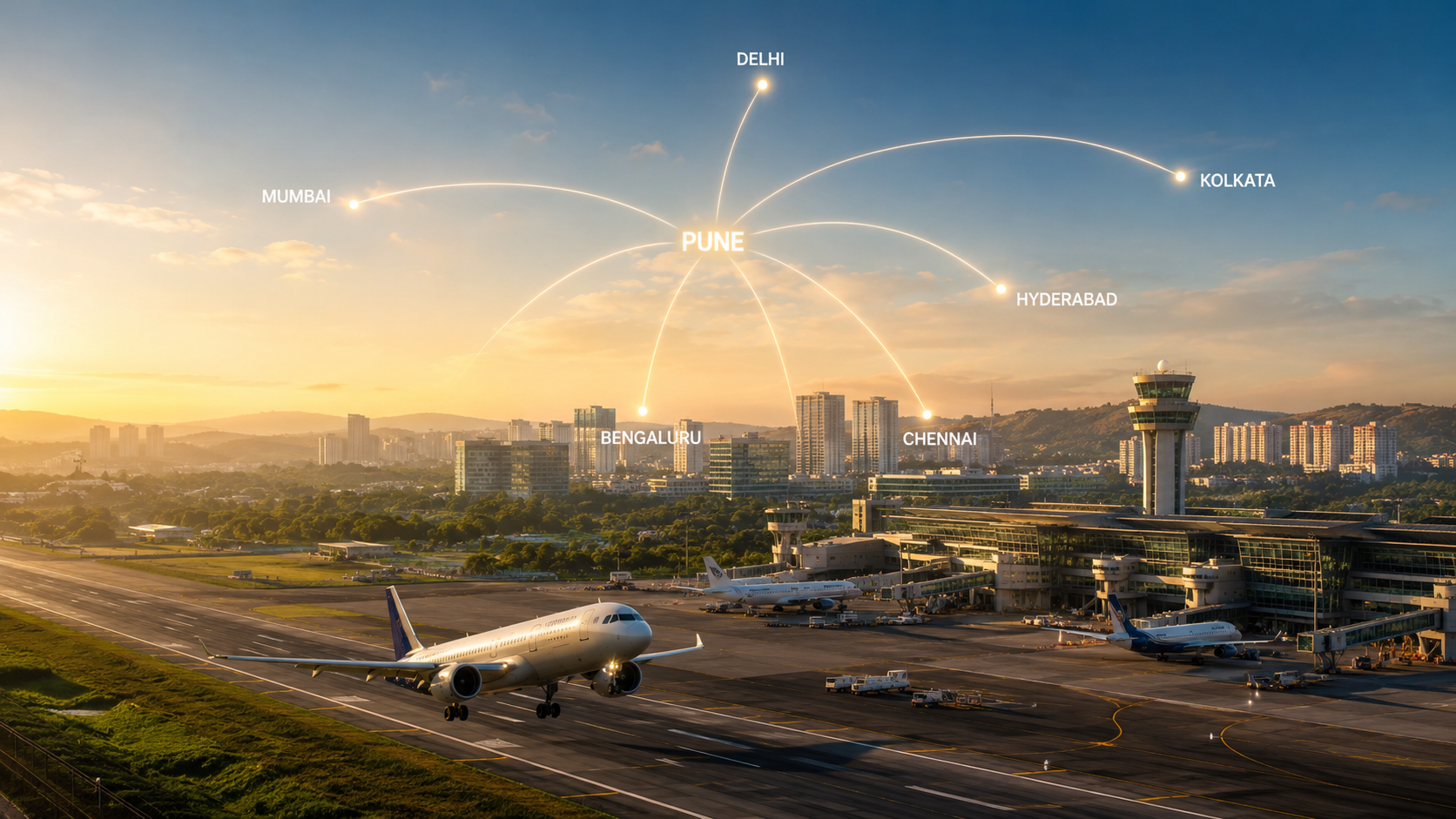
Against this backdrop, recent reports that Pune Airport has undergone a preliminary assessment for inclusion in India’s proposed Hub-and-Spoke Aviation Network have generated significant interest. While no official decision has been announced, the evaluation highlights Pune’s growing importance within India’s aviation strategy.
For frequent flyers, enhanced connectivity could eventually mean smoother domestic and international journeys. For businesses, it could improve operational efficiency and strengthen Pune’s competitiveness. For the real estate sector, improved aviation infrastructure is another long-term growth catalyst that complements ongoing projects such as Pune Metro, the PMRDA Ring Road, the High Capacity Mass Transit Route (HCMTR), and regional road upgrades.
However, it is equally important to separate confirmed developments from future possibilities. At present, the Hub-and-Spoke initiative remains under evaluation, and any long-term benefits will depend on policy decisions, infrastructure investments, airline participation, and operational readiness.
This article explains what the proposal means, why Pune is being considered, and how it could influence the city’s economy, connectivity, and real estate market over the coming years.
What Happened?
According to reports, Pune Airport recently hosted a preliminary assessment to evaluate its readiness for participation in India’s proposed Hub-and-Spoke Aviation Network.
The assessment involved representatives from multiple agencies, including:
Ministry of Civil Aviation
Airports Authority of India (AAI)
Airport operators
Immigration authorities
Customs officials
CISF
Airline representatives
Ground handling agencies
Other operational stakeholders
The purpose of this exercise was not to announce a new airport project or designate Pune as a hub. Instead, it was intended to evaluate whether the airport possesses—or could develop—the operational capabilities required to participate in a coordinated national aviation network.
The assessment examined areas such as:
Passenger processing
Check-in procedures
Security screening
Immigration processes
Baggage transfer systems
Inter-agency coordination
Terminal operations
Infrastructure readiness
Operational efficiency
This evaluation is part of a broader effort to improve India’s aviation ecosystem as passenger traffic continues to grow.
Current Status
As of now:
✅ Preliminary assessment completed
✅ Operational evaluation conducted
✅ Stakeholder consultations held
❌ No final approval announced
❌ Pune has not officially become a Hub Airport
❌ No implementation timeline has been released
This distinction is important because many news headlines can be interpreted as confirmation, whereas the current stage is an assessment rather than an approved rollout.
What Is India’s Hub-and-Spoke Aviation Network?
To understand why this assessment matters, it helps to understand how modern airline networks operate.
There are two primary models used worldwide:
| Point-to-Point | Hub-and-Spoke |
| ———————————— | ————————————— |
| Direct flights between cities | Passengers connect through central hubs |
| More routes required | Fewer routes needed |
| Efficient for high-demand city pairs | Efficient for serving many destinations |
| Higher operational costs | Better aircraft utilisation |
| Limited flexibility | Greater network connectivity |
Passenger:
Pune → Singapore
The airline must operate a dedicated international route.
If passenger demand is insufficient, the route may not be commercially viable.
Hub-and-Spoke Model
Passenger:
Pune → Delhi → Singapore
or
Pune → Mumbai → London
or
Pune → Bengaluru → Tokyo
Instead of launching direct international flights from every city, airlines consolidate passengers through major hubs before operating long-haul services.
This allows airlines to optimise fleet utilisation, improve seat occupancy, and expand network coverage without introducing hundreds of direct routes.
Why Airlines Prefer This Model
The Hub-and-Spoke model offers several operational advantages:
Better aircraft utilisation
Higher passenger loads
Lower operating costs
Simplified scheduling
Improved international connectivity
Easier expansion into new markets
Many of the world’s busiest airports—including Atlanta, Dubai, Doha, Frankfurt, Singapore, and Istanbul—operate on variations of this model.
India is exploring similar approaches to enhance domestic connectivity while improving international transit efficiency.
How Could It Benefit Passengers?
If implemented effectively, passengers may eventually experience:
Better flight connectivity
Shorter overall travel times for certain routes
More coordinated flight schedules
Improved baggage transfer systems
Smoother transit processes
Better utilisation of connecting flights
However, the exact passenger experience would depend on how the final model is implemented and which airports are formally integrated into the network.
Why Was Pune Selected for Evaluation?
Pune’s inclusion in the preliminary assessment reflects its growing strategic importance rather than a sudden policy shift.
Several structural factors make the city a logical candidate for evaluation.
1. One of India’s Largest IT Hubs
Pune has emerged as one of India’s most significant technology destinations, hosting major IT parks in:
Hinjawadi
Baner
Balewadi
Kharadi
Yerawada
Magarpatta
Thousands of professionals travel regularly for domestic and international business, creating sustained demand for reliable air connectivity.
2. Manufacturing Powerhouse
Pune is among India’s leading manufacturing centres.
Industries include:
Automobile manufacturing
Engineering
Precision manufacturing
Electronics
Industrial equipment
Research & Development
Companies operating in and around Pune depend heavily on efficient logistics and business travel.
3. Defence Significance
Unlike many metropolitan cities, Pune also hosts important defence establishments and military infrastructure.
This strategic importance contributes to the city’s role within India’s broader transportation and logistics ecosystem.
4. Education Capital
Pune attracts students from across India and abroad.
Its universities, research institutions, and professional colleges generate consistent passenger movement throughout the year, supporting steady airport demand.
5. Growing Startup Ecosystem
Pune has become one of India’s leading startup destinations, particularly in:
SaaS
Artificial Intelligence
Manufacturing Technology
FinTech
Mobility
Deep Technology
Frequent investor meetings, conferences, and business travel further increase aviation demand.
6. Rising Passenger Traffic
Although Pune Airport operates under certain operational constraints due to its shared use with the Indian Air Force, passenger traffic has grown steadily over the years. This sustained demand underscores the need for continuous infrastructure improvements and more efficient operational models.
As both leisure and business travel continue to recover and expand, aviation authorities are evaluating ways to optimise airport capacity and enhance connectivity without compromising safety or operational efficiency.
Current Status of Pune Airport
Pune Airport has undergone significant modernization in recent years, yet it continues to face capacity and operational limitations.
Existing Strengths
The airport serves:
Major metropolitan cities across India
Select international destinations
Business travelers
Tourists
Students
Defence personnel
Corporate executives
It functions as one of western India’s busiest airports outside Mumbai.
Recent Improvements
Recent infrastructure enhancements include:
A new integrated terminal building with expanded passenger handling capacity.
Modernized check-in, baggage handling, and security systems.
Improved passenger amenities and circulation areas.
Upgraded operational facilities designed to accommodate future growth.
These investments have strengthened the airport’s ability to manage increasing passenger volumes, although operational constraints remain.
Key Challenges
Despite these upgrades, Pune Airport continues to face several structural limitations:
Shared civil and military operations, which can affect scheduling flexibility.
Limited runway and airspace capacity compared with major international hubs.
Growing passenger demand that may outpace existing infrastructure over time.
Dependence on future expansion and policy decisions to support larger-scale aviation ambitions.
These factors are central to any assessment of Pune’s role in a broader hub-and-spoke network.
What Could Change if Pune Joins the Hub-and-Spoke Aviation Network?
It is important to reiterate that Pune has not yet been designated as a hub airport. The preliminary assessment is an early step in evaluating whether the airport can support specific operational functions within India’s proposed aviation network.
If Pune is eventually integrated into the Hub-and-Spoke system, the impact could extend beyond aviation. Improved connectivity often influences business confidence, tourism, logistics, corporate expansion, and, over time, the real estate market.
Below are the potential areas of impact, clearly distinguishing between confirmed objectives of the model and possible long-term outcomes.
1. Better Passenger Connectivity
One of the primary objectives of the Hub-and-Spoke model is to improve network efficiency.
Potential benefits include:
More convenient domestic connections.
Better scheduling between domestic and international flights.
Reduced transfer complexity.
Improved baggage handling for connecting passengers.
More seamless travel experiences.
For Pune’s large population of IT professionals, consultants, entrepreneurs, students, and business travelers, these improvements could make air travel more efficient.
2. Stronger Business Ecosystem
Air connectivity is a major factor considered by multinational corporations when selecting locations for regional offices, research centres, and manufacturing facilities.
Pune already hosts leading companies in:
Information Technology
Automobile Manufacturing
Engineering
Biotechnology
Financial Services
Artificial Intelligence
Research & Development
Improved aviation infrastructure supports faster business travel, client meetings, investor visits, and executive mobility.
Although airport improvements alone do not determine investment decisions, they strengthen Pune’s overall competitiveness.
3. Tourism Growth
Pune serves as a gateway to several popular destinations, including:
Lonavala
Lavasa
Mahabaleshwar
Panchgani
Mulshi
Western Ghats
Religious tourism circuits
Enhanced aviation connectivity may increase tourist arrivals, supporting:
Hotels
Restaurants
Retail
Event venues
Travel operators
Tourism growth generally creates additional employment and stimulates local economic activity.
4. Cargo & Logistics Opportunities
Modern airports increasingly support cargo operations alongside passenger services.
Improved airport efficiency may benefit:
Pharmaceutical exports
Engineering products
Automobile components
Electronics
High-value manufacturing
Pune already has a strong industrial base, making logistics improvements particularly relevant for exporters.
5. Greater International Visibility
Global investors often assess transportation infrastructure when evaluating cities for expansion.
Improved aviation connectivity can enhance Pune’s profile as a destination for:
Foreign Direct Investment (FDI)
Global Capability Centres (GCCs)
Corporate headquarters
International conferences
Startup investment
Impact on Pune’s Economy
Infrastructure investments typically create multiplier effects across multiple sectors.
While the Hub-and-Spoke evaluation is still at an early stage, stronger airport connectivity could complement Pune’s ongoing economic growth.
Employment Generation
Improved airport operations can create employment in:
Aviation
Ground handling
Security
Hospitality
Retail
Logistics
Maintenance
Cargo
Tourism
Indirect employment often exceeds direct airport jobs through supporting industries.
IT Industry
Pune’s IT ecosystem depends heavily on domestic and international travel.
Companies operating from:
Hinjawadi
Baner
Balewadi
Kharadi
Yerawada
frequently require executives and clients to travel across India and overseas.
Improved connectivity enhances Pune’s attractiveness as an IT destination.
Manufacturing Sector
Pune is among India’s largest automobile and engineering clusters.
Leading manufacturers require:
Executive travel
Supplier visits
Technical collaboration
International partnerships
Efficient aviation networks contribute to faster business operations.
Hospitality Industry
Business travel directly benefits:
Hotels
Serviced apartments
Restaurants
Event venues
Conference centres
Cities with stronger connectivity generally experience higher business tourism.
Startup Ecosystem
Venture capital firms, investors, founders, and global partners travel frequently.
Enhanced aviation infrastructure strengthens Pune’s appeal as a startup ecosystem.
Impact on Pune Real Estate
Transportation infrastructure has historically influenced real estate demand.
Examples include:
Metro corridors
Expressways
Ring Roads
Railway upgrades
Airport expansion
However, it is important to understand that airport improvements alone do not guarantee property price appreciation. Property values are influenced by employment growth, housing supply, affordability, infrastructure integration, and broader economic conditions.
Residential Real Estate
Professionals often prefer locations with:
Better connectivity
Shorter commute times
Access to employment hubs
Quality social infrastructure
As Pune strengthens its transportation network, demand may remain strong in well-connected residential corridors.
Commercial Real Estate
Businesses prioritize:
Airport accessibility
Metro connectivity
Expressways
Talent availability
Commercial office demand generally increases in cities offering efficient transport infrastructure.
Luxury Housing
Senior executives, NRIs, and business owners often value proximity to airports for convenience.
Premium residential developments in established neighborhoods may continue attracting this buyer segment.
Rental Market
Improved corporate activity can support rental demand from:
IT professionals
Consultants
Expatriates
Executives
Students
Rental growth depends on job creation and migration rather than airport development alone.
Logistics & Warehousing
Industrial and logistics assets could benefit if airport-linked cargo activity expands in the future.
Potential beneficiaries include:
Warehousing
Industrial parks
Distribution centres
Last-mile logistics
Which Areas Could Benefit?
Every locality will not benefit equally.
Areas with strong employment centres, existing infrastructure, and planned transport projects are generally better positioned.
Baner
Why it matters
Baner is already one of Pune’s premier residential and commercial destinations.
Advantages:
Metro connectivity
Mumbai-Bengaluru Highway
High-quality office space
Strong social infrastructure
Investment Outlook:
Excellent long-term potential.
Balewadi
Balewadi continues to attract premium residential developments alongside commercial growth.
Key drivers:
Sports infrastructure
Corporate offices
Metro access
Highway connectivity
Investment Outlook:
Very Strong
Hinjawadi
The largest IT hub in western India.
Growth drivers:
Rajiv Gandhi Infotech Park
Metro Line 3
Thousands of IT jobs
Large township developments
Airport improvements would primarily benefit business travelers working in this corridor.
Investment Outlook:
Excellent
Wakad
One of Pune’s fastest-growing residential markets.
Strengths:
IT workforce
Highway connectivity
Metro accessibility
Established retail ecosystem
Investment Outlook:
Excellent
Punawale
Punawale has transformed into an attractive destination for first-time buyers and investors.
Drivers include:
Ring Road influence
Metro accessibility via adjoining corridors
Affordable premium housing
Township developments
Investment Outlook:
Very Good
Tathawade
Known for educational institutions and emerging residential projects.
Suitable for:
Families
Investors
Rental income
Investment Outlook:
Very Good
Bavdhan
Strategically located between Kothrud, Chandani Chowk, and the Mumbai Highway.
Advantages:
Premium residential developments
Proximity to central Pune
Access to western suburbs
Investment Outlook:
Strong
Mahalunge
An emerging high-growth corridor supported by:
PMRDA planning
Balewadi High Street proximity
Township developments
Investment Outlook:
High Growth Potential
Kharadi
Eastern Pune’s largest commercial district.
Major advantages:
EON IT Park
World Trade Center
Corporate headquarters
High rental demand
Investment Outlook:
Excellent
Viman Nagar
One of the biggest beneficiaries of airport-related activity.
Advantages:
Immediate airport proximity
Business hotels
Corporate offices
Premium retail
Investment Outlook:
Excellent for premium residential and commercial assets
Kalyani Nagar
Established luxury market with excellent connectivity.
Investment Outlook:
Stable Premium Market
Yerawada
Benefits from:
Central location
Business connectivity
Metro expansion
Investment Outlook:
Strong
Lohegaon
Located close to Pune Airport.
Growth drivers:
Residential expansion
Airport accessibility
Future infrastructure
Investment Outlook:
Good Long-Term Potential
Wagholi
A major residential growth corridor.
Strengths:
Affordable housing
Large land availability
Connectivity improvements
Investment Outlook:
Good
Pune Airport vs Navi Mumbai International Airport
| Factor | Pune Airport | Navi Mumbai International Airport |
| ———————- | ————————————— | —————————————– |
| Current Role | Regional business airport | New international mega hub |
| Expansion Potential | Moderate due to operational constraints | Significant planned capacity |
| Primary Strength | IT, manufacturing, education | International connectivity |
| Real Estate Impact | Supports established urban growth | Drives development in surrounding regions |
| Investment Perspective | Strong for existing corridors | Strong for emerging corridors |
These airports are likely to play complementary rather than competing roles within Maharashtra’s broader aviation network.
Challenges Ahead
Before Pune can assume a larger role in a national hub-and-spoke system, several challenges would need to be addressed:
Airspace coordination due to shared civil and military operations.
Continued terminal and operational capacity upgrades.
Expansion of passenger processing systems.
Enhanced baggage transfer and interline facilities.
Regulatory approvals from aviation authorities.
Airline participation and route planning.
Integration with national aviation policy and infrastructure investments.
These factors will determine the pace and scale of any future implementation.
Frequently Asked Questions (FAQs)
1. Is Pune Airport officially becoming a hub airport?
No. As of July 2026, Pune Airport has only undergone a preliminary assessment for inclusion in India’s proposed Hub-and-Spoke Aviation Network. No official approval or implementation timeline has been announced.
2. What is a Hub-and-Spoke aviation network?
It is an airline operating model where passengers travel from smaller cities (spokes) to a major airport (hub) before connecting to domestic or international destinations. This helps airlines improve efficiency and expand connectivity.
3. Why was Pune selected for evaluation?
Pune’s growing passenger demand, strong IT sector, manufacturing base, educational institutions, defence establishments, and business ecosystem make it an important city in India’s aviation network.
4. Will Pune get more international flights?
Possibly in the future, but there is no official announcement confirming additional international routes as part of this assessment.
5. Will ticket prices become cheaper?
Not necessarily. Airfares depend on airline competition, demand, fuel prices, airport charges, and route economics.
6. How does airport infrastructure affect real estate?
Improved airport connectivity can support business growth, tourism, and investment, which may strengthen long-term demand for residential and commercial property. However, airport development alone does not guarantee higher property prices.
7. Which areas in Pune could benefit the most?
Potential beneficiaries include:
Baner
Balewadi
Hinjawadi
Wakad
Punawale
Tathawade
Bavdhan
Mahalunge
Kharadi
Viman Nagar
Kalyani Nagar
Lohegaon
Yerawada
Wagholi
The extent of any benefit will depend on employment growth, infrastructure integration, and market conditions.
8. Is this good news for property investors?
The assessment is a positive long-term indicator, but investment decisions should also consider location, infrastructure, employment, supply, and project quality.
9. Does this mean Pune Airport will expand immediately?
No. Any operational changes or expansion would require further studies, approvals, and infrastructure investments.
10. What role does Pune Airport play today?
Pune Airport serves domestic and limited international routes and is one of western India’s busiest business airports. It also operates under shared civil and military use.
11. How is this different from a new airport project?
This initiative relates to operational integration into a national aviation network, not the construction of a new airport.
12. Could this improve business travel?
Potentially yes. Better scheduling and connectivity can make travel more efficient for corporate passengers.
13. Will logistics and cargo benefit?
If airport capabilities expand over time, logistics, pharmaceuticals, engineering exports, and manufacturing could benefit from improved cargo handling.
14. Does this affect Pune Metro or Ring Road projects?
No. These projects are separate initiatives but collectively contribute to Pune’s overall infrastructure ecosystem.
15. Could this attract more multinational companies?
Efficient transportation infrastructure is one of several factors considered by multinational companies when evaluating business locations.
16. Will this increase rental demand?
If stronger connectivity supports employment and corporate activity, rental demand may benefit over the long term.
17. Is Pune competing with Navi Mumbai Airport?
Not directly. Both airports serve different strategic roles and are expected to complement Maharashtra’s aviation ecosystem.
18. Should first-time homebuyers act immediately?
Homebuyers should base decisions on affordability, project quality, developer reputation, and long-term needs rather than a single infrastructure announcement.
19. What challenges remain?
Airspace coordination, operational capacity, regulatory approvals, airline participation, and future infrastructure upgrades remain key considerations.
20. Where can I stay updated on Pune infrastructure and property trends?
Follow trusted government announcements and reliable real estate advisory platforms that focus on Pune’s infrastructure and market developments.
Expert Analysis
Confirmed Facts
A preliminary assessment has been conducted.
Multiple aviation stakeholders participated.
Pune has not been officially designated as a hub airport.
No implementation schedule has been announced.
Long-Term Opportunities
If Pune becomes part of the Hub-and-Spoke network, the city could strengthen its position as:
A leading IT and innovation hub.
A preferred destination for business travel.
A more attractive location for global investment.
A logistics and manufacturing centre with enhanced connectivity.
Risks and Constraints
Future outcomes depend on:
Government approvals.
Airport infrastructure upgrades.
Airline participation.
Airspace management.
Passenger demand.
Broader economic conditions.
Final Verdict
Pune’s inclusion in a preliminary assessment for India’s proposed Hub-and-Spoke Aviation Network reflects the city’s growing strategic importance rather than a confirmed operational change.
The assessment itself is encouraging because it acknowledges Pune’s expanding role in technology, manufacturing, education, defence, and business. However, it should not be interpreted as confirmation that Pune has become an aviation hub.
For homebuyers and investors, the bigger picture is more important. Pune is simultaneously benefiting from major infrastructure initiatives such as Metro expansion, the PMRDA Ring Road, highway upgrades, and continued employment growth. If airport connectivity also improves over time, it could reinforce the city’s long-term investment appeal.
The most successful real estate investments are rarely driven by a single announcement. Instead, they result from identifying locations where employment, infrastructure, connectivity, and quality development converge. Pune continues to demonstrate many of these characteristics, making it one of India’s most closely watched property markets.
Leave a Reply
You must be logged in to post a comment.