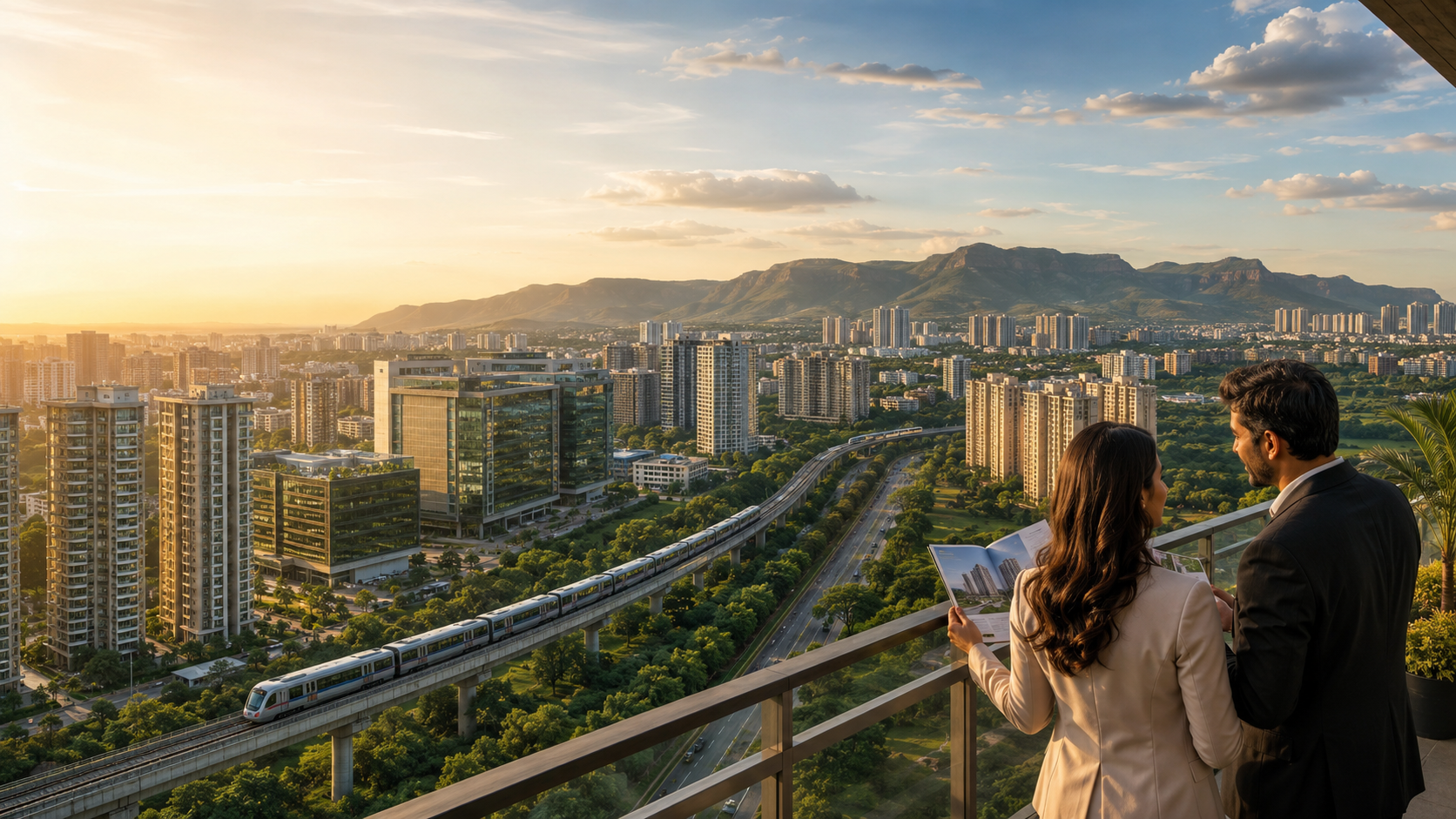
1. Introduction: Why Pune in 2026?
Pune has quietly transformed from a serene educational hub into one of India’s most dynamic real estate markets. For Non-Resident Indians (NRIs) looking to invest in Indian property, Pune presents a compelling case that rivals—and in some ways surpasses—traditional favourites like Mumbai and Bengaluru.
What makes Pune special in 2026? The city sits at the intersection of three powerful forces: affordability relative to Mumbai, a booming IT economy, and unprecedented infrastructure development. While Mumbai’s property rates hover around ₹25,000–₹35,000 per sq ft, Pune offers quality housing at ₹7,000–₹15,000 per sq ft—a significant entry point for NRI investors seeking value.
Pune has emerged as one of India’s most attractive real estate destinations due to its thriving IT sector, educational institutions, and expanding infrastructure. The city’s transformation is visible everywhere—from the gleaming office towers of Hinjawadi to the premium residential enclaves of Baner and the emerging suburbs of Punawale and Tathawade.
For NRIs living in the USA, Canada, UK, UAE, Australia, Singapore, and Europe, Pune offers something rare: a mature market with growth potential. The city combines the stability of an established real estate market with the appreciation potential of an emerging one.
Key question answered in this guide: Is buying property in Pune a good investment for NRIs in 2026? The short answer is yes—but the long answer requires understanding the nuances of location, property type, legal compliance, and market timing. This guide covers all of that and more.
NRI investing in Pune reached new heights in 2026, with NRI investments accounting for about 18 per cent of total real estate investments in India, up from 15 per cent in 2022, and this share is expected to rise to nearly 20 per cent by 2026 and potentially 25-26 per cent by 2030. Pune is capturing a significant portion of this NRI capital.
2. Why NRIs Are Investing in Pune in 2026
2.1 Favourable Exchange Rates
NRIs earning in US dollars, British pounds, Euros, or UAE dirhams enjoy significant purchasing power in India. The rupee’s position makes Indian real estate more affordable for overseas buyers, and Pune’s pricing offers excellent value compared to global property markets.
2.2 MahaRERA-Backed Transparency
The Maharashtra Real Estate Regulatory Authority (MahaRERA) has transformed the Pune property market. With over 10,379 housing projects approved across Maharashtra in FY26, the regulatory framework ensures project timelines, financial transparency, and buyer protection. NRIs can invest with confidence knowing that developers are accountable.
2.3 Strong Rental Yields
Pune offers rental yields of 3.5% to 5% across IT corridors, driven by steady leasing demand from the IT/ITeS workforce. This makes Pune attractive for NRIs seeking both capital appreciation and regular rental income.
2.4 IT Sector Growth
Pune’s IT corridors—Hinjawadi, Kharadi, Baner, and Wakad—continue to attract global tech companies. The premium real estate segment in Pune is recording an annual growth rate of nearly 15%, supported by these IT corridors.
2.5 Infrastructure Boom
From the Pune Metro to the Ring Road and the Mumbai-Pune Missing Link, infrastructure projects are reshaping Pune’s real estate landscape. Properties along these corridors are witnessing significant appreciation.
2.6 Educational and Healthcare Hub
Pune’s reputation as the “Oxford of the East” ensures a steady influx of students and professionals. World-class educational institutions and healthcare facilities make the city attractive for NRIs planning to return to India or send children for education.
2.7 Lifestyle and Climate
Pune offers a superior quality of life with its pleasant climate, green spaces, and cosmopolitan culture. Compared to Mumbai’s humidity and congestion, Pune provides a more balanced lifestyle.
3. Pune Real Estate Market Overview 2026
3.1 Market Size and Position
Pune is the third largest residential real estate market among India’s top seven cities, accounting for 18% of the area sold in FY2024. The city recorded 7% year-on-year growth in housing sales during the 12 months ended June 2026—marking the first annual sales recovery in four years.
3.2 Price Trends
The average residential price in Pune increased 4.8% to a record ₹7,082 per sq ft, compared with an annual growth of 7.3% in the previous year. However, these averages mask significant variation across micro-markets.
Property prices across top eight cities sustained a broad-based upcycle in Q1 2026, with Pune and Hyderabad witnessing increases of 12% and 11%, respectively.
| Metric | | 2026 Figure |
|—————————-| |—————-|
| Average residential price | | ₹7,082/sq ft |
| Year-on-year price growth | | 4.8% |
| Housing sales growth (YoY) | | 7% |
| NRI share of investments | | ~18% |
| Rental yields (IT corridors) | | 3.5%–5% |
3.3 Demand Drivers
IT/ITeS workforce driving rental and ownership demand
Infrastructure projects creating new growth corridors
Affordable housing initiatives expanding the buyer base
NRI investments supporting luxury and premium segments
3.4 Market Forecast 2026-2030
Pune real estate prices are forecasted to grow steadily at 5-10% annually through 2026 and beyond, driven by IT expansion, metro projects, and infrastructure like the ring road.
4. Infrastructure Projects Driving Growth
4.1 Pune Metro
The Pune Metro is a game-changer for the city’s real estate. Line 3 (Hinjawadi-Shivajinagar) —a 23.2-km elevated corridor with 23 stations—is the most significant for NRI investors.
The first phase of the Hinjawadi-Shivajinagar Metro, covering a 12-km stretch, commenced operations from July 15, 2026. The full corridor is expected to become operational by December 2026.
Impact on Real Estate:
Properties along the Metro corridor have appreciated 15-25%
Hinjawadi, Wakad, Baner, and Balewadi are prime beneficiaries
Improved connectivity reduces commute times, increasing property desirability
4.2 Pune Ring Road
The PMRDA is advancing an 83-kilometre, 65-metre-wide Inner Ring Road designed to improve regional connectivity by linking suburban areas, growth centres, state highways, and national highways while easing traffic in the city core.
The western part of the Ring Road is expected to be completed by mid-2026, allowing traffic to bypass the city and cutting heavy vehicle traffic by nearly 30%.
Impact on Real Estate:
West Pune localities—Sus, Bavdhan, Punawale, Tathawade—are set to benefit
Reduced congestion increases liveability and property values
New commercial and residential development along the corridor
4.3 Mumbai-Pune Missing Link
After seven years of construction, the 13.3-km Missing Link on the Mumbai-Pune Expressway opened to commuters on May 1, 2026. The ₹6,695–₹7,181 crore project replaces a 19.8-km stretch of winding ghat roads with a high-speed alignment comprising viaducts, a 650-metre cable-stayed bridge, and twin tunnels.
Impact on Real Estate:
Reduces travel time between Mumbai and Pune by 25–30 minutes
Creates an economy worth ₹70,000 crore
Makes Pune more accessible for Mumbai-based investors and professionals
4.4 Airport Expansion
Pune Airport is undergoing significant upgrades. The New Integrated Terminal Building was inaugurated in March 2025, and the renovated old terminal is slated to begin operations soon.
The refurbished terminal will enable the airport to handle up to 3,000 passengers per hour. Additional features include 15 new check-in counters (taking the total to 49), expanded security holding areas, and DigiYatra gates.
The airport aims for a projected growth of around 7% in 2026 compared to 2025.
Impact on Real Estate:
Improved international connectivity attracts NRI investors
Areas near the airport (Viman Nagar, Kharadi) benefit from enhanced accessibility
Commercial real estate around the airport sees increased demand
4.5 IT Parks
Pune’s IT ecosystem continues to expand. The Hinjawadi IT Park remains the crown jewel, housing global tech giants. PMRDA has initiated plans to develop four connector roads linking major routes in the Hinjewadi-Maan-Marunji-Wakad belt to ease traffic congestion.
Other significant IT corridors include:
Kharadi – EON IT Park, World Trade Center
Baner-Balewadi – Corporate offices and commercial hubs
Wakad-Hinjawadi – The extended IT belt
4.6 PMRDA Development
The Pune Metropolitan Region Development Authority (PMRDA) has approved a ₹4,628.85 crore budget for 2026-27, with a strong emphasis on infrastructure development and administrative reforms.
Key PMRDA initiatives:
Structural plan for the Pune Metropolitan Region (expected within 18 months)
Twin tunnels in Pune city
Last-mile connectivity improvements ahead of Metro Line 3 launch
Fire fund provision of ₹100.05 crore
5. Best Areas for NRI Investment
Pune offers diverse investment opportunities across its micro-markets. Here’s a detailed analysis of the top 10 areas for NRI investing in Pune.
5.1 Hinjawadi
Overview: The undisputed IT hub of Pune, Hinjawadi (also spelled Hinjewadi) is home to Phase 1, 2, and 3 of the Rajiv Gandhi Infotech Park. It’s the epicentre of Pune’s IT boom.
| Parameter | | Details |
| ————– | | ————- |
| Price Range | |₹5,000–₹8,500/sq ft (Phase 3: ₹8,500/sq ft) |
| Rental Yield | | 3.5%–4.5% |
| 2 BHK Rent | |₹17,300–₹24,000/month |
| 3 BHK Rent | | ₹24,000–₹29,000+/month |
Connectivity: Excellent. Directly connected to Mumbai-Bangalore Highway (NH-48). Metro Line 3 (Hinjawadi-Shivajinagar) is now operational, with the first phase launched on July 15, 2026.
Rental Demand: Very high. Driven by the IT workforce of over 300,000 professionals.
Future Appreciation: Strong. The Metro and ongoing IT expansion will continue to drive prices. Properties in Phase 3 Hinjawadi have seen 25.9% appreciation in the last 3 years and 49.1% in the last 5 years.
Best Buyer Profile: NRIs seeking high rental yields and long-term capital appreciation from IT-driven demand.
Advantages:
Largest IT concentration in Pune
Excellent rental demand
Metro connectivity (now operational)
Wide range of housing options
Drawbacks:
Traffic congestion during peak hours (though improving with new roads)
Some infrastructure still developing
Limited luxury options compared to Baner
5.2 Baner
Overview: One of Pune’s most premium residential addresses. Baner is known for its upscale housing, proximity to IT hubs, and excellent social infrastructure.
| Parameter | | Details |
| ————– | | ————– |
| Price Range | | ₹15,700/sq ft (Baner), ₹70,000–₹95,000/sq ft (premium) |
| Rental Yield | | 3%–4% |
| Appreciation | | ₹13,900→₹15,700/sq ft (Jun 2025–Mar 2026) |
| Connectivity | | Excellent. Connected to Mumbai-Bangalore Highway , Pune University, and IT hubs. Metro Line 3 passes through Baner. |
Rental Demand: Strong, driven by IT professionals and corporate employees. Baner attracts premium tenants willing to pay higher rents for quality living.
Future Appreciation: Consistent. Baner has seen steady appreciation over the years. The locality continues to attract premium development and infrastructure.
Best Buyer Profile: NRIs seeking premium homes with strong capital appreciation. Ideal for those planning to return to India and settle in a well-established neighbourhood.
Advantages:
Premium residential address
Excellent social infrastructure (schools, hospitals, malls)
Proximity to Pune University and IT hubs
Well-developed road network
Drawbacks:
Higher entry price point
Limited availability of land for new development
Traffic congestion on main roads
5.3 Balewadi
Overview: Balewadi has emerged as a premium residential and commercial destination in West Pune, offering a slightly more affordable alternative to Baner.
| Parameter | | Details |
| ————– | | ———- |
| Price Range | | ₹10,000–₹14,500/sq ft (new projects) |
| Average Rate | | ₹14,900/sq ft (Mar 2026) |
| Appreciation | | ₹12,150→₹14,900/sq ft (Jun 2025–Mar 2026) |
| Connectivity | | Excellent. Connected to Baner, Pashan, and Hinjawadi. Metro Line 3 connectivity enhances accessibility. |
Rental Demand: High. Balewadi attracts both IT professionals and corporate employees due to its strategic location and quality housing.
Future Appreciation: Strong. The locality offers newer housing stock than Baner at a slight discount, making it attractive for investors.
Best Buyer Profile: NRIs wanting a premium West Pune address with newer construction and better value than Baner.
Advantages:
Premium West Pune location
Newer housing stock
Slightly more affordable than Baner
Excellent social infrastructure
Drawbacks:
Some areas still developing
Traffic congestion during peak hours
5.4 Sus
Overview: Sus is an emerging residential destination along the Sus-Pashan Road, offering affordable housing options close to established areas.
| Parameter | | Details |
| ————- | | ———– |
| Price Range | | ₹8,500–₹9,400/sq ft |
| Average Rate | | ₹8,513–₹8,731/sq ft |
| Rental Yield | | 3.5%–4.5% |
Connectivity: Good. Connected to Pashan, Baner, and the Mumbai-Bangalore Highway. Proximity to the proposed Ring Road.
Rental Demand: Moderate to good. Sus attracts budget-conscious IT professionals and students.
Future Appreciation: Promising. The Sus-Pashan Road corridor is seeing significant development. The Ring Road and Metro connectivity will boost property values.
Best Buyer Profile: NRIs looking for affordable entry into West Pune with good appreciation potential.
Advantages:
Affordable entry point
Proximity to Baner and Pashan
Good connectivity
Development potential
Drawbacks:
Less developed social infrastructure
Some areas lack premium amenities
Still emerging as a residential destination
5.5 Bavdhan
Overview: Bavdhan, located along the Pune-Bangalore Highway, has emerged as a popular residential destination offering a mix of affordable and premium housing.
| Parameter | | Details |
| ————- | | —————- |
| Price Range | | ₹8,900–₹13,525/sq ft |
| Average Rate | | ₹11,950/sq ft (Mar 2026) |
| Rental Yield | | 3.5%–4% |
| Average Rent | | ₹39/sq ft |
Connectivity: Excellent. Located on the Pune-Bangalore Highway (NH-48). Good connectivity to Chandani Chowk, Kothrud, and West Pune.
Rental Demand: Good. Bavdhan attracts IT professionals, students, and families.
Future Appreciation: Steady. Bavdhan has shown consistent appreciation, with projects like Suyog Padmavati Hills seeing 41.4% YOY appreciation.
Best Buyer Profile: NRIs seeking a balanced mix of affordability and appreciation in a well-connected location.
Advantages:
Excellent highway connectivity
Mix of affordable and premium options
Good social infrastructure
Proximity to Chandani Chowk commercial hub
Drawbacks:
Traffic congestion on the highway
Some micro-markets have uneven development
Limited Metro connectivity
5.6 Punawale
Overview: Punawale is emerging as Pune’s next housing hotspot, driven by its proximity to the Hinjawadi IT hub and a steady pipeline of new housing launches.
| Parameter | | Details |
| ————– | | ———— |
| Price Range | | ₹5,500–₹10,450/sq ft |
| Registration Rate | | ~₹9,900/sq ft |
| Rental Yield | | 3.5%–4.5% |
| 3 BHK Rent | | ₹32,200/month |
| Average Rent | | ₹31/sq ft |
Connectivity: Good. Located on the Mumbai-Bangalore Highway, close to Hinjawadi Phase 3. Future Metro connectivity will enhance accessibility.
Rental Demand: High. Driven by IT professionals working in Hinjawadi.
Future Appreciation: Very strong. Industry estimates indicate residential prices in Punawale have appreciated steadily over the past few years. The area is poised for significant growth.
Best Buyer Profile: NRIs seeking high growth potential and strong rental demand at affordable prices.
Advantages:
Proximity to Hinjawadi IT hub
Affordable prices with strong appreciation
High rental demand
New housing developments
Drawbacks:
Some infrastructure still developing
Traffic congestion on the highway
Limited premium social infrastructure
5.7 Tathawade
Overview: Tathawade is a rapidly developing residential area along the Mumbai-Bangalore Highway, offering affordable housing options with good connectivity.
| Parameter | | Details |
| ————— | | —————- |
| Price Range | | ₹8,100–₹8,150/sq ft |
| YOY Growth | | 6.6% |
| Rental Range | | ₹18,900–₹1,03,200/month |
Connectivity: Excellent. Located on the Mumbai-Bangalore Highway, close to Hinjawadi and Punawale.
Rental Demand: Good. Tathawade attracts IT professionals and students.
Future Appreciation: Promising. The area is seeing significant residential development, and the proposed infrastructure projects will boost property values.
Best Buyer Profile: NRIs seeking affordable entry into the Hinjawadi catchment area with good growth potential.
Advantages:
Affordable pricing
Good highway connectivity
Proximity to IT hubs
New housing developments
Drawbacks:
Some infrastructure gaps
Limited premium amenities
Traffic congestion on the highway
5.8 Wakad
Overview: Wakad is a well-established residential and commercial area in West Pune, known for its proximity to IT hubs and excellent social infrastructure.
| Parameter | | Details |
| ————- | | ———– |
| Price Range | | ₹9,350–₹12,350/sq ft |
| Appreciation | | ₹11,150→₹12,350/sq ft (Jun 2025–Mar 2026) |
| Rental Range | | ₹19,900–₹1,10,700/month |
Connectivity: Excellent. Connected to Hinjawadi, Baner, and Balewadi. Metro Line 3 enhances connectivity.
Rental Demand: Very high. Wakad attracts IT professionals, corporate employees, and students.
Future Appreciation: Steady. Wakad is a mature market with consistent appreciation and strong demand.
Best Buyer Profile: NRIs seeking established locality with proven appreciation and rental demand.
Advantages:
Excellent location with mature infrastructure
Strong rental demand
Good social infrastructure
Proximity to IT hubs
Drawbacks:
Higher entry price
Traffic congestion
Limited new development opportunities
5.9 Kiwale
Overview: Kiwale is an emerging residential destination offering affordable housing options with good connectivity.
| Parameter | | Details |
| ————- | | ———- |
| Price Range | | ₹6,350–₹8,900/sq ft |
| YOY Growth | | 5.8% |
| Rental Yield | | 3.5%–4% |
| Average Rent | | ₹31/sq ft |
Connectivity: Good. Located on the Mumbai-Bangalore Highway, close to Punawale and Tathawade.
Rental Demand: Moderate to good. Kiwale attracts budget-conscious IT professionals.
Future Appreciation: Promising. The area is seeing new housing developments and will benefit from the proposed infrastructure projects.
Best Buyer Profile: NRIs seeking affordable entry into West Pune with appreciation potential.
Advantages:
Affordable pricing
Good highway connectivity
New housing developments
Growth potential
Drawbacks:
Less developed social infrastructure
Some areas lack premium amenities
Limited Metro connectivity
5.10 Mahalunge
Overview: Mahalunge is a premium residential destination in West Pune, known for its luxury apartments and villas.
| Parameter | | Details |
| Price Range | | ₹8,700–₹11,750/sq ft |
| Average Rent | | ₹40/sq ft |
| Quality of Life Score | | 4.2/5 |
Connectivity: Good. Connected to Baner, Balewadi, and the Mumbai-Bangalore Highway.
Rental Demand: Good. Mahalunge attracts premium tenants seeking quality living.
Future Appreciation: Steady. Mahalunge has shown consistent appreciation, with prices rising from ₹11,450 to ₹11,750 per sq ft over the past year.
Best Buyer Profile: NRIs seeking luxury homes with good appreciation and quality living.
Advantages:
Premium residential address
Luxury apartments and villas
Good social infrastructure
Quality of life
Drawbacks:
Higher entry price
Some infrastructure gaps
Limited Metro connectivity
Location Comparison Table
| Area | | Price/sq ft | | Rental Yield | | Best For | | Appreciation Potential |
| —— | | ————- | | —————- | | ————— | | —————————- |
| Hinjawadi | | ₹5,000–₹8,500 | | 3.5–4.5% | | Rental income, IT-driven growth | | Very High |
| Baner | | ₹15,700+ | | 3–4% | | Premium homes, capital appreciation | | High |
| Balewadi | | ₹10,000–₹14,500 | | 3.5–4.5% | | Premium value, newer stock | | High |
| Sus | | ₹8,500–₹9,400 | | 3.5–4.5% | | Affordable entry, growth potential | | High |
| Bavdhan | | ₹8,900–₹13,525 | | 3.5–4% | | Balanced investment | | Steady |
| Punawale | | ₹5,500–₹10,450 | | 3.5–4.5% | | Growth potential, rental demand | | Very High |
| Tathawade | | ₹8,100–₹8,150 | | 3.5–4% | | Affordable entry | | Promising |
| Wakad | | ₹9,350–₹12,350 | | 3.5–4.5% | | Established locality | | Steady |
| Kiwale | | ₹6,350–₹8,900 | | 3.5–4% | | Affordable entry | | Promising |
| Mahalunge | | ₹8,700–₹11,750 | | 3.5–4% | | Luxury homes | | Steady |
6. Property Types for NRIs
6.1 Apartments
The most common property type for NRI investors. Apartments range from affordable 1 BHK units to premium 4 BHK luxury apartments.
Advantages:
Lower maintenance
Gated community with amenities
Easier to rent and manage
MahaRERA registered projects provide transparency
Considerations:
Check the project’s MahaRERA registration
Verify possession timelines for under-construction projects
Review maintenance charges and society rules
6.2 Luxury Homes
Pune’s luxury segment is growing rapidly, with premium apartments and villas in Baner, Balewadi, and Mahalunge.
Advantages:
Higher capital appreciation
Premium tenants
Quality construction and amenities
Considerations:
Higher entry price
Longer holding period for optimal returns
Higher maintenance costs
6.3 Townships
Integrated townships offer a complete living experience with schools, hospitals, retail, and recreational facilities.
Advantages:
Self-contained communities
Amenities within the township
Good for families planning to return
Considerations:
Higher maintenance charges
Location may be on the outskirts
Longer commute to city centre
6.4 Commercial Property
NRIs can also invest in commercial real estate, including office spaces, retail shops, and co-working spaces.
Advantages:
Higher rental yields (6–8%)
Long-term leases
Triple-net leases (tenant pays all costs)
Considerations:
Higher entry price
Market volatility
Vacancy risk
6.5 Ready Possession vs. Under Construction
| Factor | | Ready Possession | | Under Construction |
| ——- | | ——————— | | ———————— |
| Price | | Higher | | Lower (10–20% discount) |
| Risk | | Lower | | Higher (delays, quality issues) |
| Returns | | Immediate rental income | | Higher appreciation potential |
| Timeline | | Move-in immediately | | Wait 2–4 years |
| RERA Protection | | Already completed | | RERA registration mandatory |
Expert Tip: For NRIs buying from abroad, ready possession or near-completion projects (with RERA registration) are safer choices. Under-construction projects offer better returns but require careful due diligence.
7. FEMA & RBI Rules for NRIs
7.1 Who Can Buy Property in India?
Under FEMA (Foreign Exchange Management Act) Section 6(5) , the following can buy property in India without prior RBI approval:
Non-Resident Indians (NRIs) – Indian citizens residing abroad
Overseas Citizens of India (OCI) – Foreign citizens of Indian origin
Persons of Indian Origin (PIO) – (now merged with OCI)
7.2 What Property Can NRIs Buy?
| Allowed | | Not Allowed |
| ————- | | ————— |
| ✅ Residential apartments | | ❌ Agricultural land |
| ✅ Commercial properties | |❌ Plantation property |
| ✅ Office spaces | | ❌ Farmhouses |
| ✅ Retail shops | | ❌ (Requires special RBI permission) |
NRIs and OCI cardholders can buy residential and commercial properties in India without taking prior permission from the RBI.
7.3 Documents Required
Essential documents for NRI property purchase in India:
Passport (copy with valid visa)
PAN Card (mandatory for all property transactions)
NRE/NRO Bank Account details
Power of Attorney (POA) – If buying through a representative
Employment letter / Income proof
Bank statements (last 6 months)
Credit report (for home loans)
RBI approval (only for agricultural/farmhouse property)
7.4 Payment Methods
NRIs can make payments through:
NRE Account (Non-Resident External Account)
NRO Account (Non-Resident Ordinary Account)
FCNR Account (Foreign Currency Non-Resident Account)
Direct remittance from abroad (through banking channels)
Important: Payments must be made in Indian rupees. Foreign currency cannot be used directly for property purchase.
7.5 Power of Attorney (POA)
NRIs often execute a General Power of Attorney (GPA) or Special Power of Attorney (SPA) to authorize a trusted representative in India to handle the transaction.
Key Points:
Must be notarized in the country of residence
Should be apostilled (if the country is part of the Hague Convention)
Should clearly specify the scope of authority
7.6 Home Loans for NRIs
NRIs are eligible for home loans in India:
Criteria Details
Age 21–60/65 years (at loan maturity)
Employment Minimum 1 year continuous overseas employment
Loan-to-Value Up to 75–80% (loans > ₹30 lakh); up to 90% (loans < ₹30 lakh)
Credit Score Good credit score (750+)
Interest Rates Competitive (slightly higher than resident loans)
Important Update: Effective January 1, 2026, the RBI has prohibited all regulated entities from charging prepayment or foreclosure fees on floating-rate loans for individuals.
7.7 Tax Implications
A. TDS (Tax Deducted at Source)
When an NRI buys property from an Indian resident for more than ₹50,00,000 (50 lakh) , the buyer must deduct 1% TDS on the purchase price and deposit it with the tax department.
When the seller is an NRI, TDS is deducted at higher rates—often ranging from 12.5% to as high as 31.2% , depending on the nature of capital gains.
B. Rental Income Taxation
Rental income from Indian property is taxable in India
The tenant must deduct TDS at 31.2% (30% + surcharge + cess) when paying rent to an NRI
NRIs can claim deductions under Section 24 (interest on home loan) and Section 80C (principal repayment)
C. Capital Gains Tax
| Gain Type | | Holding Period | | Tax Rate |
| ------------ | | --------------------- | | ----------------- |
| Short-Term Capital Gains | | < 24 months | | As per income tax slab |
| Long-Term Capital Gains | | ≥ 24 months | | 12.5% (without indexation, for properties acquired after July 23, 2024) |
Older properties may fall under 20% taxation with indexation benefits.
7.8 Repatriation Rules
NRIs can repatriate (send back) sale proceeds of property in India:
Up to USD 1 million per financial year from NRO funds
Requires Form 15CA and 15CB (chartered accountant certification)
No upper limit for repatriation from NRE accounts
Important: FEMA compliance is crucial. Breaking FEMA rules can lead to penalties.
8. Step-by-Step Buying Process
Step 1: Define Your Investment Goals
Are you buying for rental income, capital appreciation, or future settlement?
What is your budget range?
Which location suits your goals?
Step 2: Research and Shortlist
Identify preferred areas based on your investment criteria
Research property prices, rental yields, and appreciation trends
Review MahaRERA registrations for shortlisted projects
Step 3: Engage a Trusted Real Estate Partner
Work with a reputed local real estate consultant (like VJ Real Estate)
Get expert guidance on locations, pricing, and legal compliance
Access verified projects and developer partnerships
Step 4: Property Site Visit (Physical or Virtual)
Visit the property in person (if possible)
Or take a virtual tour of the property and surrounding area
Evaluate construction quality, amenities, and neighbourhood
Step 5: Legal Due Diligence
Verify property title and ownership
Check all necessary approvals (PMC/PCMC, MahaRERA)
Review the sale agreement and builder-buyer agreement
Ensure FEMA compliance
Step 6: Arrange Finances
Arrange funds through NRE/NRO accounts
Apply for home loan if needed (with necessary documentation)
Ensure funds are available in Indian rupees
Step 7: Execute Power of Attorney (if applicable)
Execute GPA/SPA for your representative in India
Get it notarized and apostilled (if required)
Step 8: Sign the Agreement
Sign the sale agreement and builder-buyer agreement
Pay the booking amount (usually 10–20% of property value)
Review all terms and conditions carefully
Step 9: Registration and Stamp Duty
Register the property at the sub-registrar's office
Pay stamp duty (typically 5–7% of property value in Maharashtra)
The registration process takes 30–90 days
Step 10: Possession and Handover
Take possession of the property (for ready possession)
For under-construction, track project progress through RERA updates
Complete all handover formalities
Step 11: Post-Purchase Management
Set up rental management (if renting out)
Pay property taxes and maintenance charges
File income tax returns (if applicable)
9. Common Mistakes NRIs Should Avoid
❌ Mistake 1: Not Checking RERA Registration
Always verify the project's MahaRERA registration before booking. RERA registration ensures project timelines, financial transparency, and buyer protection.
❌ Mistake 2: Skipping Legal Due Diligence
Title verification, approval checks, and document scrutiny are essential. Never skip this step.
❌ Mistake 3: Ignoring FEMA Compliance
FEMA violations can lead to penalties. Ensure all payments are made through proper banking channels and all necessary approvals are obtained.
❌ Mistake 4: Not Understanding Tax Implications
TDS, capital gains tax, and rental income tax apply to NRIs. Plan your taxes in advance to avoid surprises.
❌ Mistake 5: Buying Without a Power of Attorney
Without a POA, your representative in India cannot sign documents or complete transactions on your behalf.
❌ Mistake 6: Overlooking Repatriation Rules
Ensure you understand the repatriation limits and documentation requirements before selling.
❌ Mistake 7: Not Factoring in All Costs
Consider stamp duty, registration fees, brokerage, legal fees, maintenance charges, and property taxes when calculating your investment.
❌ Mistake 8: Relying Solely on Online Research
Online research is helpful, but nothing replaces on-the-ground knowledge. Work with local experts like VJ Real Estate.
❌ Mistake 9: Timing the Market
Real estate is a long-term investment. Focus on fundamentals rather than trying to time the market perfectly.
❌ Mistake 10: Not Having an Exit Strategy
Plan your exit strategy—whether you plan to sell, rent, or hold the property long-term.
10. Rental Income & ROI Analysis
Sample Calculation: 2 BHK Apartment in Hinjawadi
| Parameter | | Value |
| ------------- | | ---------------- |
| Property Price | | ₹80,00,000 (approx. 1,000 sq ft × ₹8,000/sq ft) |
| Down Payment (20%) | | ₹16,00,000 |
| Home Loan (80%) | | ₹64,00,000 |
| Monthly EMI (8.5%, 20 years) | | ~₹55,500 |
| Monthly Rent | | ₹25,000 |
| Annual Rent | | ₹3,00,000 |
| Property Tax & Maintenance | | ₹30,000/year |
| Net Annual Rental Income | | ₹2,70,000 |
| Gross Rental Yield | | 3.75% |
| Net Rental Yield | | 3.38% |
| Annual Capital Appreciation (7%) | | ₹5,60,000 |
| Total Annual Return | | ₹8,30,000 |
| ROI on Down Payment | | ~52% (first year, including appreciation) |
Sample Calculation: 3 BHK Apartment in Punawale
| Parameter | | Value |
| --------------- | | ---------- |
| Property Price | | ₹75,00,000 (approx. 1,100 sq ft × ₹6,800/sq ft) |
| Down Payment (20%) | | ₹15,00,000 |
| Home Loan (80%) | | ₹60,00,000 |
| Monthly EMI (8.5%, 20 years) | | ~₹52,000 |
| Monthly Rent | | ₹32,200 |
| Annual Rent | | ₹3,86,400 |
| Property Tax & Maintenance | | ₹25,000/year |
| Net Annual Rental Income | | ₹3,61,400 |
| Gross Rental Yield | | 5.15% |
| Net Rental Yield | | 4.82% |
| Annual Capital Appreciation (8%) | | ₹6,00,000 |
| Total Annual Return | | ₹9,61,400 |
| ROI on Down Payment | | ~64% (first year, including appreciation) |
ROI Summary by Location
| Location | | Rental Yield | | Appreciation | | Potential |
| Hinjawadi | | 3.5–4.5% | | Very High | | High |
| Baner | | 3–4% | | High | | High |
| Balewadi | | 3.5–4.5% | | High | | High |
| Punawale | | 3.5–4.5% | | Very High | | Very High |
| Wakad | | 3.5–4.5% | | Steady | | Good |
Expert Insight: NRIs often achieve the best overall returns by combining rental income with capital appreciation. In high-growth areas like Punawale and Hinjawadi, capital appreciation contributes more to total returns than rental income.
11. Frequently Asked Questions (20 FAQs)
Q1: Can NRIs buy property in Pune without RBI approval?
A: Yes. Under FEMA Section 6(5), NRIs and OCI cardholders can buy residential and commercial properties in India without prior RBI approval.
Q2: Can NRIs buy agricultural land in Pune?
A: No. NRIs cannot buy agricultural land, plantation property, or farmhouses without special RBI permission.
Q3: What documents are required for an NRI to buy property in Pune?
A: Passport, PAN Card, NRE/NRO bank account details, Power of Attorney (if applicable), employment letter, bank statements, and credit report.
Q4: Can NRIs get home loans in India?
A: Yes. NRIs are eligible for home loans subject to age, employment, and credit criteria.
Q5: What is the maximum home loan amount for NRIs?
A: Up to 75–80% of property value for loans above ₹30 lakh; up to 90% for loans below ₹30 lakh.
Q6: How is rental income from Indian property taxed for NRIs?
A: Rental income is taxable in India. Tenants must deduct TDS at 31.2% when paying rent to NRIs.
Q7: What is the TDS rate when buying property from an NRI?
A: TDS is deducted at 12.5% to 31.2% depending on the nature of capital gains when the seller is an NRI.
Q8: Can NRIs repatriate sale proceeds of property in India?
A: Yes, up to USD 1 million per financial year from NRO funds, with Form 15CA and 15CB.
Q9: What is the capital gains tax rate for NRIs selling property in India?
A: 12.5% (without indexation) for properties acquired after July 23, 2024; 20% with indexation for older properties.
Q10: What is MahaRERA and why is it important?
A: MahaRERA is the Maharashtra Real Estate Regulatory Authority. It ensures project timelines, financial transparency, and buyer protection.
Q11: Which are the best areas for NRI investing in Pune?
A: Hinjawadi, Baner, Balewadi, Punawale, Wakad, Sus, Bavdhan, Tathawade, Kiwale, and Mahalunge are top choices.
Q12: What is the minimum investment required for NRI property in Pune?
A: Entry-level properties start at approximately ₹40–50 lakh in areas like Kiwale and Tathawade.
Q13: Can NRIs buy property jointly with resident Indians?
A: Yes, provided the funds are remitted from abroad or held in NRE/NRO accounts.
Q14: What is the stamp duty on property purchase in Pune?
A: Typically 5–7% of property value in Maharashtra.
Q15: Can NRIs invest in under-construction property?
A: Yes, but ensure the project is MahaRERA registered and verify the possession timeline.
Q16: How can NRIs manage their property in Pune from abroad?
A: Through a Power of Attorney to a trusted representative or through professional property management services.
Q17: What is the Pune Metro and how does it impact property values?
A: The Pune Metro Line 3 (Hinjawadi-Shivajinagar) is operational from July 2026. Properties along the Metro corridor have appreciated 15-25%.
Q18: What is the Pune Ring Road and how does it affect real estate?
A: The 83-km PMRDA Inner Ring Road will improve regional connectivity and reduce traffic congestion, benefiting West Pune localities.
Q19: What are the rental yields in Pune's IT corridors?
A: 3.5% to 5% across IT corridors like Hinjawadi, Wakad, and Baner.
Q20: Why should NRIs choose VJ Real Estate for property investment in Pune?
A: VJ Real Estate offers local expertise, verified projects, developer partnerships, virtual tours, documentation assistance, and end-to-end support for NRI investors.
12. Why Choose VJ Real Estate
🏢 Local Expertise
With deep roots in Pune's real estate market, VJ Real Estate understands the nuances of every micro-market. From price trends to infrastructure developments, our team provides insights that only come from years of on-the-ground experience.
✅ Verified Projects
We work exclusively with MahaRERA-registered projects, ensuring your investment is protected. Every project we recommend undergoes rigorous due diligence.
🤝 Developer Partnerships
Our strong relationships with Pune's leading developers give our clients access to exclusive inventory and preferential pricing.
💻 Virtual Tours
Can't visit Pune in person? We offer comprehensive virtual tours of properties, allowing you to explore every detail from anywhere in the world.
📱 WhatsApp Support
Our team is available on WhatsApp for real-time support, answering your questions and providing updates throughout the buying process.
📄 Documentation Assistance
From PAN Card verification to sale agreement review, we handle all documentation to ensure FEMA and legal compliance.
🏦 Home Loan Guidance
We connect NRIs with leading banks and financial institutions, helping you secure the best home loan terms based on your profile.
📋 Registration Support
We guide you through the entire registration process, including stamp duty payment and property registration at the sub-registrar's office.
🔧 After-Sales Service
Our relationship doesn't end at possession. We provide ongoing support for property management, maintenance, and rental assistance.
🏠 Rental Assistance
Need to rent out your property? We help you find quality tenants, draft lease agreements, and manage the rental process.
📊 Investment Advisory
Our experts provide data-driven investment advice, helping you choose the right location and property type for your specific goals.
13. Conclusion
Pune in 2026 presents a golden opportunity for NRI investors. The city combines affordability, strong rental demand, infrastructure growth, and regulatory transparency in a way that few Indian cities can match.
NRI investing in Pune is not just about buying property—it's about securing your financial future, building a legacy in India, and benefiting from one of the country's most dynamic real estate markets. Whether you're looking for rental income from Hinjawadi's IT professionals, a premium home in Baner, or high-growth potential in Punawale, Pune has something for every NRI investor.
The numbers tell the story: 7% sales growth, 4.8% price appreciation, 18% NRI market share, and rental yields of 3.5–5% . Add to that the Pune Metro, the Ring Road, the Mumbai-Pune Missing Link, and PMRDA's ambitious development plans, and you have a market poised for sustained growth.
But success in real estate investment requires the right partner—someone who understands the local market, can navigate the legal complexities, and will be there for you long after the transaction is complete.
That's where VJ Real Estate comes in.
Looking to invest in Pune from abroad?
VJ Real Estate helps NRIs buy premium homes across West Pune with complete transparency—from property selection and virtual tours to legal documentation and registration.
📞 Contact VJ Real Estate today to schedule your personalized NRI investment consultation.
Leave a Reply
You must be logged in to post a comment.