Blog

  • Kiwale Real Estate Guide 2026: Property Prices, Best Projects, Connectivity & Investment Analysis

    Kiwale Real Estate Guide 2026: Property Prices, Best Projects, Connectivity & Investment Analysis

    Kiwale has quietly transformed from a peripheral suburb into one of the most promising residential destinations in Pune West. Located along the Mumbai–Pune Expressway and strategically positioned near Ravet, Punawale, Tathawade, and Hinjawadi, the locality is increasingly attracting first-time homebuyers, investors, working professionals, and families seeking a balance between affordability and connectivity.

    Unlike many mature residential markets where property prices have already appreciated significantly, Kiwale continues to offer relatively affordable housing while benefiting from large-scale infrastructure development across the Pimpri-Chinchwad region. Improved road connectivity, proximity to employment hubs, the proposed metro expansion, and the upcoming Pune Ring Road are expected to shape the area’s long-term growth trajectory.

    One of Kiwale’s biggest strengths is its strategic location. Residents enjoy seamless access to the Mumbai–Pune Expressway, Dehu Road, Nigdi, Ravet, and the rapidly expanding IT corridor of Hinjawadi. This connectivity has encouraged several reputed developers to launch residential projects catering to a wide range of buyers, from compact 2 BHK apartments to premium family homes.

    The locality is also witnessing steady social infrastructure development. Schools, hospitals, shopping centres, restaurants, parks, and recreational facilities are expanding alongside residential growth, making Kiwale increasingly suitable not only for investment but also for end-use living.

    Whether you are:

    buying your first home,
    looking for a long-term investment,
    upgrading to a larger apartment,
    searching for rental income,
    or planning to relocate closer to Pune’s employment hubs,

    this comprehensive guide will help you understand everything you need to know about Kiwale’s real estate market in 2026.

    Where is Kiwale?

    Kiwale is located in the north-western part of Pune within the Pimpri-Chinchwad Municipal Corporation (PCMC). The locality lies adjacent to Ravet and enjoys direct connectivity to the Mumbai–Pune Expressway, making it one of the most accessible residential locations in Pune West.

    Its location places residents within convenient driving distance of major employment centres, educational institutions, healthcare facilities, and commercial zones.

    Strategic Location
    | Location | Approximate Distance |
    | ————————– | ——————-: |
    | Ravet | 2 km |
    | Punawale | 3 km |
    | Tathawade | 5 km |
    | Nigdi | 6 km |
    | Dehu Road Railway Station | 4 km |
    | Akurdi | 8 km |
    | Hinjawadi Phase 1 | 14–16 km |
    | Wakad | 10 km |
    | Balewadi High Street | 18 km |
    | Pune Railway Station | 27 km |
    | Pune International Airport | 31–33 km |

    Location Highlights

    Kiwale enjoys proximity to several established residential and commercial micro-markets:

    Ravet
    Punawale
    Tathawade
    Nigdi
    Akurdi
    Dehu Road
    Hinjawadi IT Park
    Pimpri-Chinchwad industrial belt

    Its location benefits from easy regional connectivity through:

    Mumbai–Pune Expressway
    Old Mumbai Highway (NH-48)
    Mumbai–Bengaluru Highway
    Aundh–Ravet BRTS corridor
    Proposed Pune Ring Road
    Map Description

    Imagine Kiwale positioned as a gateway between Pune city and Mumbai.

    Expressway to the north
    Ravet to the east
    Punawale to the south
    Dehu Road to the west
    Hinjawadi approximately 20–25 minutes away under normal traffic conditions

    This strategic positioning is one of the primary reasons why Kiwale has emerged as a preferred residential destination for both end-users and investors.

    Kiwale Quick Facts (2026)
    | Parameter | Details |
    | —————————– | —————————————————————- |
    | Location | Pune West / PCMC |
    | Pincode | 412101 |
    | Municipal Authority | Pimpri-Chinchwad Municipal Corporation (PCMC) |
    | Nearest Highway | Mumbai–Pune Expressway (NH-48) |
    | Nearest Metro | Nigdi (existing connectivity plans and future network expansion) |
    | Nearest Railway Station | Dehu Road Railway Station |
    | Nearest Airport | Pune International Airport |
    | Dominant Property Type | Residential Apartments |
    | Typical Configurations | 2 & 3 BHK |
    | Average Property Rate | ₹7,500–₹10,500 per sq. ft. |
    | Rental Yield | 3.2–4.1% annually |
    | Estimated 5-Year Appreciation | 35–50% (micro-market dependent) |
    | Buyer Profile | Families, IT Professionals, First-time Buyers, Investors |
    | Best For | Affordable housing with long-term appreciation potential |

    Why Kiwale is Becoming Popular

    Over the last few years, Kiwale has moved beyond being considered merely an affordable suburb. Today, it is developing into a well-connected residential destination with growing infrastructure, improved liveability, and attractive investment prospects.

    Several factors have contributed to this transformation.

    1. Affordable Property Prices

    Compared with established locations such as Wakad, Baner, Balewadi, and even parts of Tathawade, Kiwale still offers comparatively accessible entry prices.

    This affordability allows buyers to purchase larger homes within similar budgets while retaining long-term appreciation potential.

    For first-time buyers, Kiwale often represents a practical balance between budget and location.

    2. Excellent Connectivity

    Connectivity remains one of Kiwale’s strongest advantages.

    Residents can access:

    Mumbai–Pune Expressway
    NH-48
    Ravet
    Punawale
    Nigdi
    Akurdi
    Hinjawadi
    Pimpri-Chinchwad industrial belt

    Daily commuting has become increasingly convenient for professionals working across Pune’s western employment corridors.

    3. Rapid Residential Development

    Several reputed developers have launched projects featuring:

    gated communities
    landscaped gardens
    clubhouses
    children’s play areas
    swimming pools
    gyms
    co-working spaces
    sports amenities

    This has significantly improved the quality of housing available in the locality.

    4. Growing Infrastructure

    Government investment in roads, metro connectivity, and regional planning is expected to strengthen Kiwale’s position over the coming years.

    Major developments include:

    Pune Ring Road
    road widening projects
    improved junctions
    metro expansion plans
    enhanced public transport connectivity

    These projects are likely to improve accessibility while supporting future property value appreciation.

    📈 Market Trend
    Property demand in Kiwale has shifted from predominantly investor-led purchases to a healthier mix of end-users and investors. This transition often indicates a maturing residential market with stronger long-term stability.

    5. Family-Friendly Environment

    Unlike highly congested urban neighbourhoods, Kiwale offers:

    relatively wider roads
    lower density in several pockets
    better air quality
    growing green spaces
    quieter residential surroundings

    These characteristics make it appealing for families with children and senior citizens.

    6. Educational Institutions Nearby

    The locality is supported by several well-known schools and colleges in Ravet, Nigdi, Akurdi, and Tathawade.

    This reduces travel time for students while enhancing the area’s appeal to families.

    7. Employment Accessibility

    Although Kiwale itself is primarily residential, it offers convenient access to multiple employment hubs:

    Hinjawadi IT Park
    Talawade IT Park
    Pimpri industrial area
    Chakan manufacturing belt
    Akurdi
    Nigdi commercial zones

    This broad employment catchment helps sustain housing demand.

    💡 Investment Tip
    Areas that combine affordable entry prices with strong connectivity and improving infrastructure often have better long-term appreciation potential than already saturated premium markets.

    Connectivity

    Connectivity is one of the primary reasons behind Kiwale’s growing popularity. The locality benefits from excellent road infrastructure and improving public transport, enabling residents to travel conveniently across Pune and towards Mumbai.

    Road Connectivity

    Kiwale enjoys direct access to several major road networks.

    Key Roads
    Mumbai–Pune Expressway
    NH-48
    Old Mumbai Highway
    Aundh–Ravet BRTS Road
    Spine Road via Nigdi
    Dehu Road Corridor

    These routes facilitate efficient movement for both daily commuters and long-distance travellers.

    Metro Connectivity

    While Kiwale does not currently have its own metro station, future network expansion and nearby stations are expected to improve public transport access.

    The broader Pune Metro expansion and PCMC connectivity initiatives are expected to strengthen links between Kiwale and major commercial areas over the medium to long term.

    Railway Connectivity

    Nearest stations include:

    Dehu Road Railway Station
    Akurdi Railway Station
    Chinchwad Railway Station

    These stations provide suburban rail connectivity towards Pune and Mumbai.

    Airport Connectivity

    Pune International Airport can typically be reached in:

    45–70 minutes

    depending on traffic conditions.

    The proposed regional infrastructure improvements may further enhance airport accessibility in the coming years.

    Public Transport

    Residents benefit from:

    PMPML bus services
    Auto-rickshaws
    App-based taxis
    Shared mobility services

    Public transport options continue to improve as residential density increases.

    Future Infrastructure

    Several infrastructure initiatives are expected to influence Kiwale’s accessibility over the next decade:

    Pune Ring Road
    Metro expansion
    Expressway improvements
    Junction upgrades
    Road widening
    Enhanced BRT connectivity

    Estimated Travel Time
    | Destination | Approximate Time |
    | ——————– | —————: |
    | Ravet | 5 minutes |
    | Punawale | 8 minutes |
    | Tathawade | 12 minutes |
    | Nigdi | 15 minutes |
    | Hinjawadi Phase 1 | 25–30 minutes |
    | Balewadi | 30–35 minutes |
    | Baner | 35–40 minutes |
    | Pimpri | 20 minutes |
    | Pune Railway Station | 50–60 minutes |
    | Pune Airport | 45–70 minutes |

    🧠 Expert Insight
    For many buyers working in Hinjawadi or the PCMC industrial belt, Kiwale offers a practical compromise between commuting convenience and housing affordability. As transport infrastructure improves, this accessibility advantage could become even more significant.

    Infrastructure Developments

    Infrastructure remains one of the biggest catalysts for Kiwale’s real estate growth. Over the past few years, the locality has benefited from public investment in transportation, urban planning, and civic development, with several additional projects planned or under implementation.

    These improvements are expected to enhance connectivity, attract new residential demand, and support long-term property appreciation.

    1. Pune Ring Road

    One of the most significant regional infrastructure projects is the proposed Pune Ring Road.

    Once operational, it is expected to:

    improve connectivity between western and northern Pune,
    reduce travel time by bypassing congested city routes,
    enhance access to industrial and IT hubs,
    improve logistics and regional mobility.

    For Kiwale, better regional connectivity could strengthen demand from both homebuyers and investors.

    2. Metro Expansion

    The continued expansion of Pune Metro and the long-term vision for improved PCMC connectivity are expected to make public transport more convenient for residents.

    Although Kiwale currently depends on nearby metro access rather than a dedicated station, future network growth is likely to reduce dependence on private vehicles for commuting.

    3. Road Widening and Junction Improvements

    PCMC has undertaken and planned multiple road enhancement initiatives across western Pune.

    These include:

    widening of key arterial roads,
    junction redesigns,
    signal optimisation,
    improved pedestrian infrastructure,
    better traffic management.

    Such upgrades improve everyday commuting and contribute to higher residential attractiveness.

    4. Employment Growth

    Kiwale benefits indirectly from employment expansion in nearby hubs, including:

    Hinjawadi IT Park,
    Talawade IT Park,
    Pimpri-Chinchwad industrial corridor,
    Chakan manufacturing belt.

    As these employment centres continue to grow, housing demand in well-connected residential locations like Kiwale is expected to remain healthy.

    5. PMRDA and PCMC Urban Development

    Planned urban development by regional authorities includes improvements in:

    road infrastructure,
    drainage,
    public amenities,
    transport integration,
    urban mobility.

    These initiatives aim to support the long-term growth of rapidly developing suburbs across Pune West.

    🔮 Future Outlook
    Kiwale is transitioning from an emerging suburb to a more established residential market. Infrastructure projects underway today are likely to shape buyer demand and property values well beyond 2030.

    Property Prices in Kiwale (2026)

    Kiwale’s residential market offers a diverse range of housing options, catering to first-time buyers, families upgrading to larger homes, and investors seeking long-term appreciation.

    Compared with many established western Pune localities, Kiwale continues to offer relatively competitive pricing while benefiting from improving infrastructure and connectivity.

    Estimated Property Price Range (2026)
    | Property Type | Approximate Price Range |
    | ————————- | ——————————————–: |
    | 1 BHK Apartment | ₹40–60 Lakhs |
    | 2 BHK Apartment | ₹58–95 Lakhs |
    | 3 BHK Apartment | ₹85 Lakhs–₹1.45 Crore |
    | Premium/Luxury Apartments | ₹1.40–2.20 Crore+ |
    | Residential Plots* | Varies based on location, size, and approvals |
    | Commercial Shops | ₹65 Lakhs onwards (project dependent) |
    *Plot availability within Kiwale is relatively limited compared to apartment developments.

    Average Apartment Rates
    | Segment | Approximate Rate |
    | ———– | ———————-: |
    | Affordable | ₹7,500–₹8,500/sq. ft. |
    | Mid-Segment | ₹8,500–₹9,500/sq. ft. |
    | Premium | ₹9,500–₹10,500+/sq. ft. |

    Actual pricing varies based on developer reputation, project amenities, construction stage, floor level, views, and payment plans.
    Market Trends

    Key trends shaping the 2026 market include:

    steady demand from end-users,
    healthy absorption in new launches,
    increasing preference for larger homes,
    improved amenity expectations,
    growing interest from investors anticipating infrastructure-led appreciation.
    Factors Influencing Prices

    Several variables affect property pricing in Kiwale:

    proximity to the Expressway,
    connectivity to Ravet and Punawale,
    developer reputation,
    construction quality,
    project amenities,
    inventory availability,
    infrastructure improvements,
    overall market sentiment.

    Price Appreciation in Kiwale

    Over the past five years, Kiwale has emerged as one of the fastest-growing residential micro-markets in Pune West. While it started as an affordable extension of Ravet and Dehu Road, improved infrastructure, increasing developer interest, and growing demand from homebuyers have steadily pushed property values upward.

    Unlike mature localities such as Baner or Wakad—where price growth has moderated due to higher base values—Kiwale still has room for appreciation because it is transitioning from a developing suburb to a well-established residential destination.

    Historical Price Trend
    | Year | Approx. Average Rate (₹/sq. ft.) | Growth |
    | ——– | ——————————-: | ——-: |
    | 2021 | ₹5,400–₹6,000 | — |
    | 2022 | ₹5,900–₹6,700 | 8–10% |
    | 2023 | ₹6,400–₹7,300 | 7–9% |
    | 2024 | ₹6,900–₹8,100 | 8–11% |
    | 2025 | ₹7,300–₹9,000 | 6–9% |
    | 2026 | ₹7,500–₹10,500 | 5–8% |
    Indicative market ranges. Actual pricing depends on project, builder reputation, amenities, inventory, and location.

    What is Driving Appreciation?
    Infrastructure Development

    Large public infrastructure projects often have a direct impact on residential demand. Kiwale benefits from:

    Mumbai–Pune Expressway connectivity
    Road widening initiatives
    Proposed Pune Ring Road
    Metro network expansion
    Improved internal roads
    Better access to employment hubs
    Growing Housing Demand

    Demand is coming from multiple buyer categories:

    IT professionals
    Manufacturing professionals
    First-time homebuyers
    Families upgrading from older housing
    Long-term investors

    This diversified demand makes the market more stable than one driven only by investors.

    Supply by Reputed Developers

    Several established developers have launched integrated residential projects in Kiwale, increasing buyer confidence and improving the overall quality of housing stock.

    Employment Growth

    Nearby employment centres include:

    Hinjawadi IT Park
    Talawade IT Park
    Pimpri MIDC
    Chakan Industrial Area
    Akurdi commercial district

    Employment growth continues to support residential demand.

    📈 Market Trend
    Kiwale has evolved from an investor-focused destination into a balanced end-user market. This shift generally supports more sustainable price appreciation over the long term.

    Future Appreciation Outlook (2026–2030)

    Considering planned infrastructure, employment growth, and ongoing residential development, Kiwale is expected to remain one of the stronger-performing residential corridors in Pune West.

    Potential appreciation drivers include:

    Completion of regional infrastructure
    Increased metro accessibility
    Limited premium land parcels
    Rising replacement cost of construction
    Continued migration toward PCMC

    While future price growth cannot be guaranteed, Kiwale is well positioned for long-term capital appreciation relative to many already mature locations.

    ✔ Investment Tip
    Buyers with a holding period of 7–10 years may benefit more than short-term investors, especially if they purchase in projects by reputed developers with strong construction quality and good connectivity.

    Rental Market in Kiwale

    Kiwale’s rental market has expanded steadily as the locality has developed. The area attracts working professionals, families, and employees from nearby industrial and IT hubs.

    Although rental yields are moderate compared with central Pune, they remain competitive for an emerging residential suburb.

    Estimated Monthly Rentals (2026)
    | Configuration | Monthly Rent |
    | —————— | ————–: |
    | 1 BHK | ₹12,000–₹17,000 |
    | 2 BHK | ₹18,000–₹28,000 |
    | 3 BHK | ₹28,000–₹42,000 |
    | Premium Apartments | ₹40,000+ |

    Typical Rental Yield

    Average rental yield:

    3.2%–4.1% annually

    Yield depends on:

    Project quality
    Furnishing
    Connectivity
    Amenities
    Maintenance
    Tenant profile
    Who Rents in Kiwale?

    The tenant mix is becoming increasingly diverse.

    IT Professionals

    Many professionals working in:

    Hinjawadi
    Talawade
    Wakad

    choose Kiwale for its relatively affordable rentals.

    Families

    Families appreciate:

    Modern gated communities
    Schools nearby
    Parks
    Better living environment
    Larger apartments
    Industrial Employees

    Professionals working in:

    Pimpri MIDC
    Chakan
    Akurdi

    also contribute to rental demand.

    Students

    Students attending educational institutions in Ravet, Nigdi, and Akurdi occasionally choose rental accommodation in Kiwale, although families remain the dominant tenant segment.

    💡 Buyer Tip
    Investors seeking rental income should prioritize projects close to major roads, public transport, and social infrastructure, as these generally attract stronger tenant demand.

    Lifestyle in Kiwale

    Kiwale has developed beyond being just a residential suburb. Residents today have access to improving social infrastructure that supports day-to-day living.

    Education

    Nearby educational institutions include:

    City Pride School
    Orchids The International School
    Indira National School
    Akshara International School
    Delhi Public School (nearby corridor)
    Dr. D. Y. Patil educational institutions
    Symbiosis Skills and Professional University

    These institutions make Kiwale attractive for families with school-going children.

    Healthcare

    Residents have access to multiple hospitals and healthcare centres nearby, including:

    Ojas Multispeciality Hospital
    Varad Hospital
    Unique Multispeciality Hospital
    Aditya Birla Memorial Hospital (regional tertiary care)
    D. Y. Patil Hospital
    Shopping & Retail

    Nearby shopping destinations include:

    City One Mall
    Elpro City Square
    Vision One Mall
    Local retail markets
    Daily convenience stores
    Supermarkets
    Restaurants & Cafés

    Kiwale and nearby localities offer a growing range of dining options, from local eateries to branded restaurants, cafés, bakeries, and quick-service outlets.

    Parks & Recreation

    Residents enjoy access to:

    Community gardens
    Children’s play areas
    Jogging tracks
    Clubhouses
    Indoor games
    Swimming pools
    Fitness centres

    Many newer projects include these amenities within gated communities.

    Sports & Fitness

    Popular recreational facilities include:

    Cricket grounds
    Badminton courts
    Football turfs
    Gyms
    Yoga studios
    Cycling routes

    🧠 Expert Insight
    Lifestyle infrastructure is one of the strongest differentiators between today’s Kiwale and the locality a decade ago. Modern residential communities have significantly improved the overall living experience.

    Top Residential Projects in Kiwale

    The locality features projects from several reputed developers, catering to different budgets and lifestyle preferences.

    1. Crestline Shreshtha

    Developer: Crestline Developers

    Configuration

    2 BHK
    3 BHK

    Amenities

    Clubhouse
    Swimming Pool
    Gym
    Children’s Play Area
    Landscaped Garden
    Security

    USP

    Modern lifestyle homes with excellent Expressway connectivity.

    Ideal Buyer

    Families and first-time buyers.

    2. Unique K Town

    Developer: Unique Group

    Configuration

    2 BHK
    3 BHK

    Amenities

    Clubhouse
    Sports Facilities
    Gardens
    Multipurpose Hall
    Fitness Centre

    USP

    Integrated township-style living with community-focused planning.

    Ideal Buyer

    End-users seeking long-term residence.

    3. Gini Viviana

    Developer: Gini Constructions

    Configuration

    2 & 3 BHK

    Amenities

    Swimming Pool
    Gym
    Indoor Games
    Landscaped Podium
    Children’s Area

    USP

    Contemporary design with premium specifications.

    Ideal Buyer

    Working professionals and families.

    4. Kohinoor Uptown Avenue

    Developer: Kohinoor Group

    Configuration

    2 BHK
    3 BHK

    Amenities

    Clubhouse
    Sports Amenities
    Jogging Track
    Security
    Community Spaces

    USP

    Reputed developer with strong brand value.

    Ideal Buyer

    Buyers seeking established developer credibility.

    5. Saniket The Rising

    Developer: Saniket Builders

    Configuration

    2 & 3 BHK

    Amenities

    Landscaped Gardens
    Children’s Play Area
    Gym
    Community Hall

    USP

    Affordable homes with good connectivity.

    Ideal Buyer

    Budget-conscious families.

    Who Should Buy Property in Kiwale?
    First-Time Homebuyers

    Kiwale offers one of the better combinations of affordability and future growth within Pune West.

    Families

    Suitable due to:

    Schools
    Hospitals
    Modern gated communities
    Parks
    Relatively peaceful surroundings
    IT Professionals

    Reasonable commuting distance to:

    Hinjawadi
    Talawade
    Wakad

    while offering larger homes at comparatively affordable prices.

    Investors

    Kiwale appeals to investors looking for:

    Capital appreciation
    Rental demand
    Infrastructure-led growth
    Long-term wealth creation
    Retirees

    The locality offers:

    Lower congestion than central Pune
    Growing healthcare access
    Community living
    Green spaces
    NRIs

    NRIs seeking long-term residential assets in Pune West may find Kiwale attractive due to:

    Reputed developers
    Improving infrastructure
    Competitive pricing
    Future appreciation potential
    Advantages of Buying in Kiwale
    Excellent Expressway connectivity
    Affordable compared to Baner and Wakad
    Good access to Hinjawadi
    Strong future infrastructure
    Growing social amenities
    Reputed developers
    Modern gated communities
    Family-friendly environment
    Improving rental demand
    Good long-term appreciation potential
    Access to schools and hospitals
    Less congestion than older city areas
    Wide range of apartment options
    Better value for money
    Increasing buyer confidence
    Disadvantages of Kiwale

    A balanced assessment is important before making a purchase decision.

    Some challenges include:

    Peak-hour traffic on major approach roads.
    Ongoing construction activity in developing pockets.
    Public transport options are still evolving.
    Metro connectivity is not yet directly available within the locality.
    Certain civic infrastructure is catching up with rapid residential growth.
    Premium retail and entertainment options remain concentrated in nearby areas such as Wakad and Baner.
    Appreciation may vary significantly depending on the project’s location and developer quality.

    ✔ Buyer Tip
    Evaluate projects based not only on price but also on construction quality, legal approvals, builder track record, maintenance planning, and proximity to daily conveniences.

    Kiwale vs Ravet
    | Parameter | Kiwale | Ravet |
    | ——————— | —————————– | ——————– |
    | Property Price | Lower to Moderate | Moderate |
    | Infrastructure | Rapidly Developing | Well Established |
    | Connectivity | Excellent | Excellent |
    | Social Infrastructure | Improving | Mature |
    | Rental Demand | Growing | Strong |
    | Future Appreciation | High Potential | Moderate to High |
    | Suitable For | First-time buyers & investors | Families & end-users |

    Kiwale vs Punawale
    | Parameter | Kiwale | Punawale |
    | ——————– | ————– | ———— |
    | Average Price | Slightly Lower | Higher |
    | IT Connectivity | Good | Excellent |
    | Premium Projects | Moderate | More Options |
    | Traffic | Lower | Higher |
    | Investment Potential | High | High |
    | Family Living | Good | Excellent |

    Kiwale vs Tathawade
    | Parameter | Kiwale | Tathawade |
    | ———————- | ————— | —————- |
    | Entry Price | More Affordable | Higher |
    | Educational Hub | Nearby | Strong |
    | IT Connectivity | Good | Excellent |
    | Premium Housing | Growing | Well Established |
    | Rental Market | Growing | Strong |
    | Long-term Appreciation | High | Moderate to High |

    Future Growth Potential (2026–2030)

    Kiwale is entering a new phase of development. Earlier viewed primarily as an affordable extension of Ravet, it is now evolving into a self-sustaining residential destination supported by infrastructure, employment accessibility, and modern housing.

    Over the next five years, several factors are expected to influence the locality’s growth.

    1. Infrastructure Will Continue to Drive Demand

    Major public infrastructure projects are expected to improve regional connectivity and reduce travel times.

    Key growth catalysts include:

    Pune Ring Road
    Road widening projects
    Junction improvements
    Metro network expansion
    Better public transport integration
    Continued development within the PCMC region

    Improved accessibility generally makes residential locations more attractive to both homebuyers and investors.

    2. Employment Hubs Will Support Housing Demand

    Kiwale benefits from its proximity to several employment corridors:

    Hinjawadi IT Park
    Talawade IT Park
    Pimpri MIDC
    Chakan Industrial Area
    Akurdi commercial belt

    As these employment centres continue to expand, housing demand in nearby residential locations is expected to remain healthy.

    3. Better Social Infrastructure

    The locality continues to witness growth in:

    Schools
    Hospitals
    Retail outlets
    Restaurants
    Supermarkets
    Recreation facilities
    Banking services

    This reduces the need for residents to travel to older parts of Pune for everyday requirements.

    4. Shift Towards End-User Demand

    Historically, many emerging suburbs were dominated by investors. Today, Kiwale is seeing a larger share of end-users, including:

    Young professionals
    Families
    First-time homebuyers
    Home upgraders

    A healthy end-user market often contributes to long-term price stability.

    5. Limited Supply of Well-Located Land

    As development progresses, the availability of strategically located residential land is likely to reduce. Over time, this may support property values, particularly in projects by reputed developers with strong amenities and connectivity.

    🔮 Future Outlook
    While no real estate market can guarantee returns, Kiwale’s combination of affordability, infrastructure upgrades, and employment connectivity positions it as one of the more promising residential micro-markets in Pune West through 2030.

    Investment Scorecard
    | Parameter | Rating (Out of 10) |
    | ——————— | —————–: |
    | Affordability | |9.2 |
    | Road Connectivity | |9.0 |
    | Metro Potential | | 7.8 |
    | Social Infrastructure | | 8.3 |
    | Schools & Healthcare | | 8.5 |
    | Rental Demand | | 8.0 |
    | Investment Potential | | 9.0 |
    | Future Appreciation | | 8.8 |
    | Family Living | | 8.9 |
    | Overall Liveability | | 8.7 |

    Overall Investment Score
    ⭐ 8.8 / 10
    Why?

    Kiwale scores highly because it offers:

    Competitive entry prices.
    Excellent connectivity to the Mumbai–Pune Expressway.
    Proximity to employment hubs.
    Modern residential projects.
    Ongoing infrastructure development.
    Good long-term appreciation potential.
    Expert Opinion (VJ Real Estate)

    At VJ Real Estate, we believe Kiwale has matured into one of Pune West’s most balanced residential markets. It appeals to both end-users and investors because it combines affordability with improving infrastructure and access to major employment corridors.

    For buyers with a medium- to long-term investment horizon, Kiwale offers an opportunity to enter a growing market before it reaches the pricing levels of more established micro-markets.

    Our recommendations:
    For First-Time Buyers

    A well-planned 2 BHK apartment in a reputed gated community typically provides the best balance of affordability, functionality, and resale potential.

    For Families

    Choose projects that offer:

    Larger open spaces
    Clubhouse facilities
    Schools nearby
    Good road connectivity
    Reliable water supply
    Strong builder reputation
    For Investors

    Focus on:

    Projects by established developers.
    Locations close to major roads.
    Ready or near-possession homes.
    Areas benefiting directly from infrastructure improvements.
    For NRIs

    Prefer projects with:

    Clear legal documentation
    RERA registration
    Professional maintenance
    Good rental demand
    Strong resale prospects

    🧠 Expert Insight
    Instead of selecting a property solely because it appears affordable, evaluate its long-term value by considering the developer’s credibility, construction quality, location, connectivity, future infrastructure, and maintenance standards.

    Frequently Asked Questions (FAQs)
    1. Is Kiwale a good place to invest in 2026?

    Yes. Kiwale offers a combination of affordability, improving infrastructure, and proximity to employment hubs, making it attractive for medium- to long-term investment.

    2. What is the average property price in Kiwale?

    In 2026, apartment prices typically range between ₹7,500 and ₹10,500 per sq. ft., depending on the project, location, and amenities.

    3. Is Kiwale better than Ravet?

    Kiwale generally offers more affordable entry prices and stronger future appreciation potential, while Ravet has more established social infrastructure.

    4. Is Kiwale better than Punawale?

    Punawale has a larger supply of premium projects, whereas Kiwale often provides better affordability and value for budget-conscious buyers.

    5. Is Kiwale suitable for families?

    Yes. Modern residential projects, schools, healthcare facilities, parks, and improving civic infrastructure make it suitable for family living.

    6. Is Kiwale close to Hinjawadi?

    Yes. Hinjawadi Phase 1 is approximately 25–30 minutes away under normal traffic conditions, making Kiwale a practical choice for many IT professionals.

    7. What configurations are most commonly available?

    The market is dominated by 2 BHK and 3 BHK apartments, with selected projects offering larger premium homes.

    8. What is the rental yield in Kiwale?

    Typical gross rental yields range from 3.2% to 4.1% annually, depending on the property and tenant demand.

    9. Does Kiwale have metro connectivity?

    There is currently no dedicated metro station within Kiwale, but nearby and planned metro network expansion is expected to improve connectivity over time.

    10. Which developers have projects in Kiwale?

    Several reputed developers have launched residential projects in Kiwale, offering apartments across affordable, mid-segment, and premium categories.

    11. Is Kiwale suitable for first-time buyers?

    Yes. It remains one of the more affordable residential markets in Pune West while offering modern housing options.

    12. Is Kiwale a good location for IT professionals?

    Yes. Its connectivity to Hinjawadi, Talawade, Wakad, and the PCMC region makes it convenient for many professionals.

    13. Are schools available nearby?

    Yes. Multiple reputed schools and educational institutions are located within Kiwale and neighbouring localities.

    14. Are hospitals easily accessible?

    Yes. Residents have access to multispeciality hospitals and healthcare centres within a short driving distance.

    15. What are the biggest advantages of buying in Kiwale?

    Key advantages include affordability, connectivity, infrastructure growth, family-friendly communities, and long-term appreciation potential.

    16. What are the main disadvantages?

    Some pockets still experience construction activity, evolving civic infrastructure, and peak-hour traffic congestion.

    17. Is Kiwale suitable for long-term investment?

    For buyers with a 7–10 year horizon, Kiwale has favourable characteristics such as infrastructure development and sustained housing demand.

    18. Are ready-possession projects available?

    Yes. Buyers can choose from both ready-possession and under-construction projects, depending on their requirements.

    19. Which apartment size is the most popular?

    The 2 BHK segment continues to account for the highest buyer demand.

    20. Why should I consult VJ Real Estate before buying?

    VJ Real Estate provides market insights, project comparisons, price guidance, site visit assistance, and personalised recommendations to help buyers make informed decisions.

    Call to Action
    Looking to Buy Property in Kiwale?

    Whether you’re searching for your first home, comparing projects, or planning a long-term investment, choosing the right property requires local market knowledge and unbiased guidance.

    VJ Real Estate helps you make confident decisions with:

    ✔ Free one-to-one property consultation
    ✔ Latest developer price lists and offers
    ✔ Side-by-side comparison of Kiwale projects
    ✔ Assistance with site visits and project shortlisting
    ✔ Home loan guidance through leading banks
    ✔ End-to-end support from property selection to registration
    ✔ Insights into future infrastructure and investment potential

    Get in touch with VJ Real Estate today to schedule your free consultation, request the latest price list, compare the best projects in Kiwale, and book a site visit to find the home or investment that best fits your goals.
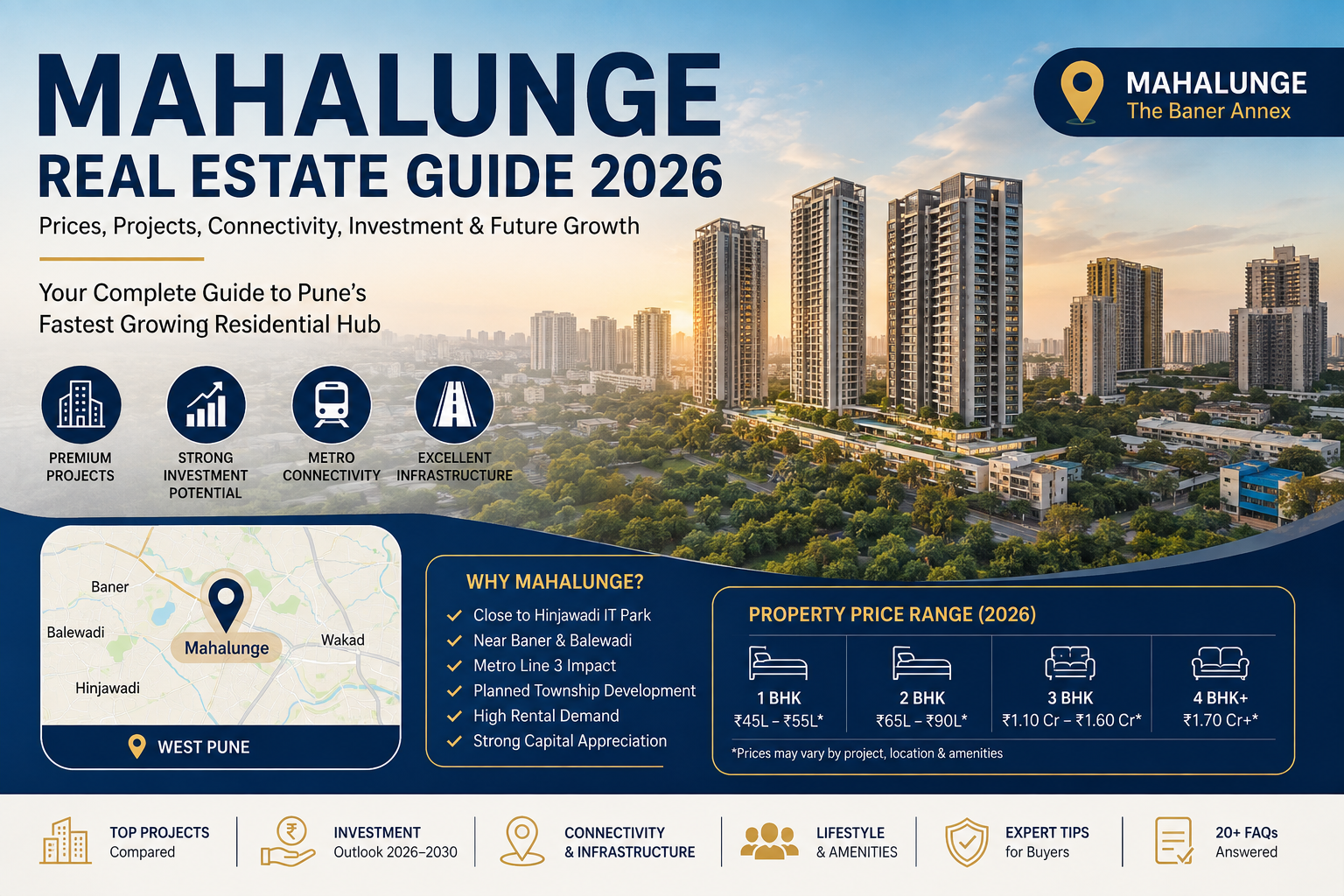
  • Mahalunge Real Estate Guide 2026: Property Prices, Best Projects, Investment Analysis & Future Growth

    Mahalunge Real Estate Guide 2026: Property Prices, Best Projects, Investment Analysis & Future Growth

    Introduction

    Mahalunge has rapidly emerged as one of the most promising real estate destinations in West Pune. Once known primarily as a village located between Baner and Hinjawadi, it is now transforming into a premium residential hub driven by modern infrastructure, improved connectivity, and proximity to Pune’s largest IT employment corridor.

    Its strategic location near Baner, Balewadi, Hinjawadi IT Park, and the Mumbai–Bengaluru Highway makes Mahalunge attractive for professionals, investors, and families seeking a balance between urban convenience and long-term investment potential.

    The area is also benefiting from large-scale infrastructure initiatives such as the Pune Metro Line 3, the PMRDA Town Planning Scheme, and expanding road networks. These developments are expected to improve accessibility and support planned urban growth over the coming years.

    Whether you’re a first-time homebuyer, an investor looking for appreciation, or an NRI exploring opportunities in Pune, this guide provides a detailed overview of Mahalunge’s real estate market in 2026.

    In this guide, you’ll learn about:

    Current property prices
    Investment opportunities
    Connectivity
    Infrastructure developments
    Rental market
    Price appreciation trends
    Lifestyle and social infrastructure
    Advantages and challenges
    Comparison with nearby localities
    Expert buying tips.

    Where is Mahalunge?

    Mahalunge is a rapidly developing residential locality in West Pune, strategically positioned between Baner, Balewadi, and Hinjawadi. Due to its close proximity to Baner and similar urban character, it is often referred to as “Baner Annex.”

    The locality falls under the planning jurisdiction of the Pune Metropolitan Region Development Authority (PMRDA) and has witnessed significant residential development over the past decade.

    Location Highlights
    Region: West Pune
    Administrative Authority: PMRDA
    PIN Code: 411045
    Popularly Known As: Baner Annex
    Nearby IT Hub: Hinjawadi
    Nearby Sports Hub: Balewadi Sports Complex
    Nearby Localities
    Baner
    Balewadi
    Hinjawadi
    Wakad
    Sus
    Maan
    Bavdhan
    Pashan
    Aundh
    Why is Mahalunge Called “Baner Annex”?

    Many developers market Mahalunge as Baner Annex because:

    It is adjacent to Baner.
    It offers larger land parcels for township developments.
    Property prices are generally lower than central Baner.
    Residents enjoy access to Baner’s commercial, dining, and entertainment options while benefiting from newer residential communities.

    Approximate Distance from Major Locations
    | Destination | Approx. Distance | Typical Travel Time* |
    | ——————– | —————: | ——————-: |
    | Baner | 3 km | 10–15 mins |
    | Balewadi | 2 km | 5–10 mins |
    | Hinjawadi Phase 1 | 7 km | 15–20 mins |
    | Wakad | 8 km | 20 mins |
    | Aundh | 8 km | 20–25 mins |
    | Shivajinagar | 13 km | 30–40 mins |
    | Pune Railway Station | 16 km | 40–50 mins |
    | Pune Airport | 22 km | 45–60 mins |
    *Travel times vary depending on traffic conditions.

    Google Maps Suggestion

    Search:

    “Mahalunge Pune Maharashtra”

    This provides an overview of the locality and nearby residential developments.

    Key Takeaways

    ✔ Prime West Pune location

    ✔ Close to Baner and Balewadi

    ✔ Near Hinjawadi IT Park

    ✔ Excellent long-term development potential

    ✔ Strong infrastructure pipeline

    Why Mahalunge is Becoming West Pune’s Fastest Growing Real Estate Destination

    Several interconnected factors have accelerated Mahalunge’s growth over the last few years.

    1. Proximity to Pune’s Largest IT Corridor

    One of Mahalunge’s strongest advantages is its location near the Hinjawadi IT Park, home to numerous multinational companies and technology firms.

    This proximity creates sustained housing demand from:

    Software engineers
    IT consultants
    Startup founders
    Project managers
    Global Capability Centre (GCC) employees
    Senior corporate professionals

    As employment in the Hinjawadi–Baner corridor grows, nearby residential markets such as Mahalunge are expected to benefit from increased demand.

    2. Metro Connectivity

    The planned Pune Metro Line 3 is expected to improve connectivity between Hinjawadi and Shivajinagar.

    Although Mahalunge does not currently have a station within the locality, its proximity to the corridor is expected to enhance accessibility for residents commuting to major employment and commercial hubs.

    Improved public transport typically supports residential demand over the long term, though actual market performance depends on project execution and broader economic conditions.

    3. PMRDA Town Planning Scheme

    One of the most significant developments for Mahalunge is the Mahalunge–Maan Town Planning Scheme.

    The initiative aims to enable more organized urban development by improving road networks, public amenities, and planned infrastructure.

    Potential benefits include:

    Better road connectivity
    Wider roads
    Improved utility planning
    Enhanced public spaces
    More systematic urban growth
    4. Premium Residential Development

    Unlike older Pune neighborhoods with fragmented layouts, Mahalunge features several large-scale residential communities offering:

    Clubhouses
    Swimming pools
    Landscaped gardens
    Co-working spaces
    Smart home features
    Children’s play areas
    Fitness facilities

    This has attracted both end-users and investors looking for modern living environments.

    5. Sports Ecosystem

    The nearby Shiv Chhatrapati Sports Complex in Balewadi hosts national and international sporting events.

    This enhances the locality’s appeal by providing access to:

    Stadiums
    Sports academies
    Fitness infrastructure
    Recreational facilities
    6. Baner’s Urban Spillover

    As property prices in Baner continue to rise, many buyers are exploring Mahalunge as an alternative that offers:

    Comparable connectivity
    Newer projects
    More spacious homes
    Competitive pricing
    Long-term appreciation potential
    7. Infrastructure Pipeline

    Ongoing and proposed developments include:

    Road widening
    Improved internal roads
    Metro connectivity
    Smart urban planning
    Commercial developments
    Retail spaces
    Township projects

    Collectively, these projects are contributing to Mahalunge’s transformation into a prominent residential destination.

    Mahalunge Property Prices 2026

    Disclaimer: The following price ranges are indicative market estimates based on prevailing trends in 2026. Actual prices vary depending on the developer, project stage, configuration, floor level, amenities, specifications, and market conditions.

    Average Apartment Prices
    | Configuration | Approximate Price Range |
    | ————- | ———————-: |
    | 1 BHK | ₹55–75 Lakhs |
    | 2 BHK | ₹85 Lakhs–₹1.35 Crore |
    | 3 BHK | ₹1.30–2.25 Crore |
    | 4 BHK | ₹2.20–4.00 Crore |

    Average Price per Sq. Ft.
    | Property Type | Approx. Rate |
    | ———————- | ———————: |
    | Mid-Segment Apartments | ₹9,500–11,500/sq.ft. |
    | Premium Projects | ₹11,500–14,500/sq.ft. |
    | Luxury Projects | ₹14,500–18,000+/sq.ft. |

    Luxury Apartments

    Premium developments generally offer:

    Smart home automation
    Concierge services
    Clubhouses
    Sky lounges
    Business centers
    Landscaped podiums
    EV charging
    Multi-tier security

    Approximate pricing:

    ₹1.75 Crore to ₹5 Crore+

    Villas

    Standalone villas are limited within Mahalunge due to increasing apartment-led development. Where available, pricing can vary significantly based on plot size, location, and specifications.

    Indicative range:

    ₹4 Crore onwards

    Commercial Property

    Commercial developments continue to expand alongside residential growth.

    Indicative pricing:
    | Type | Price Range |
    | ————- | ———————: |
    | Office Spaces | ₹10,000–16,000/sq.ft. |
    | Retail Shops | ₹18,000–30,000+/sq.ft. |

    Rental Market

    Rental demand is primarily driven by professionals working in:

    Hinjawadi
    Baner
    Balewadi
    Wakad
    Aundh

    | Configuration | Monthly Rent |
    | —————— | ————-: |
    | 1 BHK | ₹18,000–25,000 |
    | 2 BHK | ₹28,000–42,000 |
    | 3 BHK | ₹40,000–70,000 |
    | Premium Residences | ₹70,000+ |

    Rental Yield

    Average gross rental yields are typically in the range of:

    3.2%–4.2% annually, depending on the property’s location, configuration, occupancy, and rental demand.

    Factors Affecting Property Prices
    Builder reputation
    Construction quality
    RERA compliance
    Carpet area
    Amenities
    Floor level
    Road access
    Metro proximity
    Infrastructure developments
    Overall market demand

    Property Price Trends (2018–2026)
    | Year | Approx. Avg. Rate (₹/sq.ft.) | Trend |
    | —- | —————————: | ———————– |
    | 2018 | 5,800 | Emerging Market |
    | 2019 | 6,200 | Steady Growth |
    | 2020 | 6,500 | Stable |
    | 2021 | 7,000 | Recovery |
    | 2022 | 7,900 | Strong Demand |
    | 2023 | 8,700 | Infrastructure Boost |
    | 2024 | 9,500 | Premium Projects Launch |
    | 2025 | 10,300 | Sustained Growth |
    | 2026 | 10,500–12,500* | Continued Expansion |
    *Indicative range; actual project pricing varies.

    What Drove Appreciation?
    1. IT Expansion

    The continued growth of the Hinjawadi IT corridor increased housing demand.

    2. Baner’s Price Escalation

    As Baner became more expensive, buyers looked to Mahalunge for better value.

    3. Infrastructure

    Road improvements, metro plans, and planned urban development improved buyer confidence.

    4. Premium Developers

    The entry of reputed developers elevated both the quality of projects and buyer perception.

    5. Limited Land Availability in Established Areas

    As nearby localities matured, Mahalunge emerged as one of the few areas with scope for large township developments.

    Expert Insight

    From a long-term perspective, Mahalunge has transitioned from an emerging suburb to a developing urban micro-market. Its appeal lies not only in current connectivity but also in the scale of planned infrastructure and the concentration of new residential projects. However, buyers should evaluate each project individually, considering legal approvals, developer track record, construction progress, and infrastructure timelines rather than relying solely on locality-level trends.

    5. Infrastructure Driving Mahalunge’s Growth

    One of the biggest reasons behind Mahalunge’s rapid transformation is the scale of public infrastructure planned around the locality. Unlike many established areas that have limited scope for expansion, Mahalunge is benefiting from planned urban development through road upgrades, metro connectivity, and the Mahalunge–Maan Town Planning Scheme.

    Pune Metro Line 3

    The Hinjawadi–Shivajinagar Metro Line 3 is one of Pune’s most significant transport projects. It aims to improve connectivity between the city’s largest IT hub and central Pune, reducing travel times and easing road congestion. Mahalunge’s proximity to this corridor is expected to enhance commuter convenience once the line is fully operational.

    Expected Benefits
    Faster access to Hinjawadi IT Park
    Improved connectivity to Baner and Shivajinagar
    Reduced dependence on private vehicles
    Enhanced attractiveness for homebuyers and tenants
    Mahalunge–Maan Town Planning Scheme (TPS)

    A major catalyst for the locality’s growth is the Mahalunge–Maan Town Planning Scheme (TPS-1). The scheme focuses on structured urban development through planned roads, utilities, public amenities, and infrastructure. PMRDA has allocated funds for road works and proposed water and sewerage infrastructure under AMRUT 2.0. The Maharashtra Government approved the preliminary variation of the scheme in 2026, paving the way for more organized development, although implementation responsibilities continue to evolve following administrative changes.

    Expected Outcomes
    Wider internal roads
    Better drainage systems
    Organized land development
    Improved public infrastructure
    Higher long-term livability
    Mumbai–Bengaluru Highway

    The locality enjoys convenient access to NH-48 (Mumbai–Bengaluru Highway), providing connectivity to:

    Baner
    Wakad
    Hinjawadi
    Pimpri-Chinchwad
    Mumbai
    Hinjawadi IT Park

    Mahalunge is only a short drive from one of India’s largest IT employment hubs.

    Major sectors include:

    Information Technology
    Software Development
    Artificial Intelligence
    Global Capability Centres (GCCs)
    Engineering Services
    FinTech

    This employment ecosystem continues to support housing demand.

    Balewadi High Street

    One of West Pune’s most vibrant commercial destinations, Balewadi High Street offers:

    Fine dining
    Cafés
    Retail outlets
    Fitness centers
    Co-working spaces
    Entertainment venues

    Residents of Mahalunge benefit from easy access to these amenities.

    Shiv Chhatrapati Sports Complex

    Located nearby in Balewadi, this sports complex hosts:

    National tournaments
    International competitions
    Swimming facilities
    Tennis courts
    Athletics infrastructure
    Sports academies

    Its presence enhances the area’s appeal for families and sports enthusiasts.

    Education

    Popular schools within reasonable driving distance include:

    Orchid School
    Vibgyor High
    MITCON International School
    PICT Model School
    Global Indian International School
    Healthcare

    Leading hospitals nearby include:

    Jupiter Hospital
    Manipal Hospital Baner
    Surya Mother & Child Hospital
    Lifepoint Multispecialty Hospital
    Sahyadri Hospital
    Shopping & Entertainment

    Nearby retail destinations include:

    Westend Mall
    Balewadi High Street
    Xion Mall
    DMart
    Reliance Smart
    Local supermarkets and convenience stores

    Key Infrastructure Highlights
    | Infrastructure | Impact |
    | ——————– | ————————— |
    | Metro Line 3 | Better public transport |
    | PMRDA TPS | Planned urban growth |
    | NH-48 | Excellent road connectivity |
    | IT Corridor | Strong housing demand |
    | Sports Complex | Lifestyle enhancement |
    | Baner Commercial Hub | Daily convenience |

    6. Connectivity

    Connectivity remains one of Mahalunge’s strongest advantages.
    | Destination | Time |
    | ——————– | ————- |
    | Baner | 10 minutes |
    | Balewadi | 5–10 minutes |
    | Hinjawadi Phase 1 | 15–20 minutes |
    | Wakad | 20 minutes |
    | Pimpri | 25–30 minutes |
    | Shivajinagar | 30–40 minutes |
    | Pune Railway Station | 40–50 minutes |
    | Airport | 45–60 minutes |

    Public Transport
    Metro

    The upcoming Metro Line 3 is expected to improve connectivity between Hinjawadi and central Pune.

    PMPML Bus Services

    Regular buses connect Mahalunge with:

    Baner
    Aundh
    Shivajinagar
    Wakad
    Hinjawadi
    Railway

    Nearest stations include:

    Pune Junction
    Shivajinagar
    Khadki
    7. Lifestyle in Mahalunge

    Mahalunge has evolved from a quiet suburban locality into a well-connected residential neighbourhood with growing lifestyle amenities.

    Restaurants

    Popular dining destinations nearby include:

    Barbeque Nation
    Independence Brewing Company
    Malaka Spice
    Circuit House
    The Urban Foundry
    Cafés
    Starbucks
    Blue Tokai Coffee
    Third Wave Coffee
    Café Peter
    Irani Café
    Schools
    Orchid School
    Vibgyor High
    MITCON International School
    Global Indian International School
    Hospitals
    Jupiter Hospital
    Manipal Hospital Baner
    Lifepoint Hospital
    Sports & Fitness
    Balewadi Sports Complex
    Football academies
    Gyms
    Yoga studios
    Cycling groups
    Weekend Destinations
    Pashan Lake
    Mulshi
    Lavasa Road
    Sinhagad Fort
    Pawna Lake
    8. Top Residential Projects in Mahalunge

    Mahalunge features projects from several reputed developers.
    | Developer | Segment | Highlights |
    | ————– | ———– | ——————– |
    | Godrej | Premium | Modern amenities |
    | VTP Realty | Premium | Township planning |
    | Saarrthi Group | Mid-Premium | Value housing |
    | K Raheja Corp | Luxury | Premium lifestyle |
    | Rohan Builders | Premium | Sustainable design |
    | Puraniks | Mid Segment | Family-focused homes |

    Buyer Note: Always verify current inventory, pricing, MahaRERA registration, approvals, specifications, and possession timelines directly with the developer or an authorized channel partner before making a purchase decision.

    9. Who Should Buy in Mahalunge?
    IT Professionals

    Ideal due to proximity to Hinjawadi.

    Best For
    Daily commuters
    Hybrid workers
    Software professionals
    Families

    Suitable because of:

    Schools
    Hospitals
    Open spaces
    Modern gated communities
    Investors

    Potential advantages include:

    Planned infrastructure
    Growing rental demand
    Premium residential launches
    NRIs

    Mahalunge can be attractive for NRIs seeking long-term residential investment in West Pune, particularly when evaluating professionally managed projects from reputed developers.

    Retirees

    Those seeking quieter surroundings than central Pune while retaining access to healthcare and daily conveniences may find Mahalunge appealing.

    10. Advantages of Buying in Mahalunge

    ✔ Excellent connectivity

    ✔ Near Hinjawadi IT Park

    ✔ Close to Baner

    ✔ Premium residential projects

    ✔ Planned infrastructure

    ✔ Good rental demand

    ✔ Modern township developments

    ✔ Better long-term planning compared to many older suburbs

    11. Disadvantages

    A balanced view is important.

    Peak-hour traffic on approach roads
    Ongoing construction in some pockets
    Public infrastructure is still developing in certain areas
    Premium projects command higher prices
    Metro benefits depend on project completion and operational timelines
    Some civic works under the TPS are being implemented in phases.

    12. Mahalunge vs Baner
    | Parameter | Mahalunge | Baner |
    | ———————- | ———- | ———– |
    | Property Prices | Lower | Higher |
    | Infrastructure | Developing | Mature |
    | Appreciation Potential | High | Moderate |
    | Lifestyle | Growing | Excellent |
    | Rental Demand | Strong | Very Strong |
    | Inventory | New | Limited |

    Verdict: Buyers seeking newer developments and potential long-term appreciation may prefer Mahalunge, while those prioritizing an established urban ecosystem may lean toward Baner.

    13. Mahalunge vs Balewadi
    | Parameter | Mahalunge | Balewadi |
    | ———————- | ——— | ————- |
    | Price | Lower | Higher |
    | Commercial Development | Growing | Established |
    | Sports Facilities | Nearby | Excellent |
    | Investment Potential | High | Moderate–High |

    14. Mahalunge vs Hinjawadi
    | Parameter | Mahalunge | Hinjawadi |
    | ————— | ——————- | ———————– |
    | Lifestyle | Premium Residential | IT-centric |
    | Traffic | Moderate | Heavy during peak hours |
    | Rental Demand | High | Very High |
    | End-User Appeal | Strong | Strong |
    | Township Living | Growing | Mature |

    Key Takeaways
    Mahalunge combines strategic location with planned urban growth.
    Proximity to Baner, Balewadi, and Hinjawadi supports both end-use and investment demand.
    The Metro Line 3 corridor and the Mahalunge–Maan TPS are among the most important long-term growth drivers, though infrastructure timelines should be monitored.
    Buyers should evaluate projects individually based on legal approvals, developer reputation, pricing, and construction progress rather than relying only on locality-level trends.

    15. Investment Outlook (2026–2030)

    Mahalunge is no longer viewed as an emerging suburb—it is steadily evolving into one of West Pune’s most promising residential micro-markets. Over the next five years, its performance is likely to be shaped by infrastructure execution, employment growth, and the pace of residential and commercial development.

    While no investment can guarantee returns, several structural factors support a positive long-term outlook.

    Demand Outlook

    Demand is expected to remain healthy due to:

    Expansion of the Hinjawadi IT corridor
    Continued growth of Global Capability Centres (GCCs)
    Increasing migration of professionals to West Pune
    Preference for larger, amenity-rich gated communities
    Limited availability of large land parcels in mature localities like Baner
    Demand Drivers
    IT & technology workforce
    First-time homebuyers
    Families upgrading from older neighborhoods
    NRIs investing in Pune
    Investors seeking long-term appreciation
    Supply Outlook

    Mahalunge still has development potential compared to more saturated micro-markets.

    Upcoming supply includes:

    Integrated townships
    Premium apartment projects
    Luxury residences
    Mixed-use developments
    Commercial office spaces
    Retail developments

    A balanced supply pipeline can help sustain buyer choice while supporting orderly market growth.

    Infrastructure Impact

    The locality’s future depends significantly on infrastructure delivery.

    Key projects include:

    Metro Line 3
    Mahalunge–Maan Town Planning Scheme
    Internal road widening
    Utility upgrades
    Commercial hubs
    Better public amenities

    These improvements are expected to enhance accessibility and livability over time.

    Rental Market Outlook

    Rental demand is expected to remain supported by professionals employed in:

    Hinjawadi
    Baner
    Balewadi
    Wakad
    Aundh

    Estimated gross rental yields in the medium term may remain around 3–4.5%, depending on project quality, location, and market conditions.

    Capital Appreciation Outlook

    Although future price appreciation cannot be guaranteed, several factors could support long-term growth:

    Infrastructure completion
    Strong employment base
    Entry of reputed developers
    Limited supply in neighboring mature markets
    Demand for premium housing

    Expert Insight: Buyers should base investment decisions on project fundamentals, legal due diligence, and affordability rather than expecting short-term gains.

    16. Expert Tips Before Buying Property in Mahalunge
    1. Verify MahaRERA Registration
    Confirm the project’s MahaRERA registration.
    Review approvals and project details on the official portal.
    2. Research the Builder

    Evaluate:

    Delivery track record
    Construction quality
    Customer reviews
    Financial stability
    Past project timelines
    3. Understand Carpet Area

    Ask for:

    Carpet area
    Built-up area
    Saleable area

    Carpet area is the most reliable basis for comparing properties.

    4. Review Maintenance Costs

    Understand:

    Monthly maintenance charges
    Clubhouse fees
    Parking charges
    Corpus fund
    Future maintenance escalation
    5. Check Water & Utility Infrastructure

    Verify:

    Water source
    Backup arrangements
    Power backup
    Sewage treatment facilities
    6. Assess Road Connectivity

    Visit during:

    Weekday peak hours
    Weekend evenings

    This provides a realistic understanding of traffic conditions.

    7. Evaluate Future Development

    Look for:

    Proposed roads
    Metro connectivity
    Commercial developments
    Schools
    Hospitals
    Shopping centres
    8. Compare Multiple Projects

    Don’t decide after visiting only one project.

    Compare:

    Price per sq. ft.
    Amenities
    Developer reputation
    Floor plans
    Construction quality
    Possession timelines
    Key Takeaways
    Mahalunge is strategically located near Baner, Balewadi, and Hinjawadi.
    Planned infrastructure and township development are supporting long-term growth.
    The locality offers a mix of mid-segment, premium, and luxury housing.
    Buyers should verify legal approvals, MahaRERA status, and project-specific details before making a purchase.

    17. Frequently Asked Questions (FAQs)
    1. Is Mahalunge a good place to buy property in 2026?

    Yes, it offers strong connectivity, proximity to the IT corridor, and planned infrastructure, making it attractive for many homebuyers and investors.

    2. What is the average property price in Mahalunge?

    Indicative apartment prices generally range from ₹9,500–₹12,500 per sq. ft., depending on the project and specifications.

    3. Is Mahalunge better than Baner?

    Baner is more established, while Mahalunge offers newer developments and potentially greater scope for future appreciation.

    4. Is Mahalunge suitable for IT professionals?

    Yes. Its proximity to Hinjawadi, Baner, and Balewadi makes daily commuting more convenient.

    5. Is Mahalunge good for families?

    Yes. The locality has access to schools, hospitals, parks, and modern residential communities.

    6. Does Mahalunge have Metro connectivity?

    The locality is expected to benefit from the nearby Metro Line 3 corridor, improving regional connectivity.

    7. Is Mahalunge under PMC or PMRDA?

    Much of the area’s planning has been under PMRDA, though administrative arrangements can evolve over time.

    8. What are the rental prospects?

    Rental demand is supported by professionals working in nearby IT hubs.

    9. Are luxury projects available?

    Yes. Several developers offer premium and luxury residences with modern amenities.

    10. What is the expected rental yield?

    Typically around 3–4.5%, depending on the property.

    11. Is Mahalunge safe?

    Most gated communities offer security features. As with any locality, buyers should evaluate the specific neighborhood.

    12. Are there good schools nearby?

    Yes. Several reputed schools are located within a short driving distance.

    13. Which hospitals serve the area?

    Jupiter Hospital, Manipal Hospital Baner, Lifepoint Hospital, and others are nearby.

    14. Is it suitable for first-time buyers?

    Yes, particularly those seeking a modern residential environment in West Pune.

    15. Are commercial developments increasing?

    Yes. Retail and office spaces are gradually expanding alongside residential growth.

    16. How far is Hinjawadi from Mahalunge?

    Approximately 15–20 minutes by road, depending on traffic.

    17. Does Mahalunge have good appreciation potential?

    It has positive long-term drivers, but future appreciation depends on infrastructure delivery and market conditions.

    18. Should investors buy under-construction or ready homes?

    The decision depends on budget, possession requirements, and risk tolerance. Conduct thorough due diligence before investing.

    19. How can buyers compare projects effectively?

    Compare pricing, carpet area, amenities, developer reputation, construction quality, and legal approvals.

    20. Why work with VJ Real Estate?

    VJ Real Estate provides project comparisons, site visits, home loan assistance, investment consulting, resale support, builder inventory access, and price negotiation guidance.

    Conclusion

    Mahalunge has established itself as one of West Pune’s most dynamic residential destinations. Its proximity to major employment hubs, improving infrastructure, and growing selection of modern residential projects make it an attractive option for a wide range of buyers.

    Whether you’re purchasing your first home, upgrading to a larger residence, or investing for the future, a well-informed decision is essential. Always compare projects, verify legal documentation, and consider long-term infrastructure developments alongside your budget and lifestyle needs.

  • Sus Real Estate Guide 2026

    Sus Real Estate Guide 2026

    Sus Real Estate Guide 2026

    Sus has quietly evolved from a village on the western edge of Pune into one of the city’s most promising residential micro-markets. Located between Baner, Bavdhan, Pashan and Hinjawadi, the locality offers a rare combination of modern residential developments, improving infrastructure, proximity to major employment hubs and comparatively better value than many neighbouring premium areas.

    For homebuyers, Sus presents an opportunity to own a home close to Baner and Hinjawadi without paying the premium prices typically associated with those locations. For investors, the area’s long-term growth is supported by continued infrastructure development, expanding commercial activity, and sustained housing demand from IT professionals.

    Whether you are planning to buy your first apartment, upgrade to a larger home, invest in rental property, or simply understand the local market, this guide covers everything you need to know about Sus in 2026.

    Table of Contents
    Introduction
    Where is Sus?
    Why is Sus Becoming Popular?
    Property Prices in Sus (2026)
    Price Trends
    Rental Market Snapshot
    Market Outlook

    Where is Sus?

    Sus is located in West Pune, strategically positioned between Baner, Bavdhan, Pashan, Mahalunge and Hinjawadi. Over the last decade, it has transformed from a low-density residential area into a rapidly developing urban neighbourhood with modern residential projects, educational institutions, healthcare facilities and improving road infrastructure.

    Its location allows residents to enjoy relatively peaceful surroundings while remaining close to Pune’s largest employment centres.

    Unlike many fully developed localities where future appreciation has moderated, Sus still offers room for growth due to ongoing infrastructure expansion and increasing residential demand.

    Nearby Localities
    Baner
    Bavdhan
    Mahalunge
    Balewadi
    Pashan
    Aundh
    Hinjawadi
    Bhugaon
    Wakad

    | **Destination** | **Distance** | **Estimated Travel Time** |
    | :————————- | ———–: | ————————: |
    | Baner | 3 km | 10 minutes |
    | Balewadi High Street | 5 km | 15 minutes |
    | Bavdhan | 5 km | 15 minutes |
    | Pashan | 4 km | 10 minutes |
    | Aundh | 8 km | 20 minutes |
    | Hinjawadi Phase 1 | 10 km | 20 to 30 minutes |
    | Pune Railway Station | 16 km | 35 to 45 minutes |
    | Pune International Airport | 20 km | 45 to 60 minutes |

    *Travel times vary depending on traffic conditions.

    Strategic Location Advantage

    One of Sus’s biggest strengths is its central position between Pune’s established residential neighbourhoods and its major employment corridors.

    Residents can comfortably commute to:

    Rajiv Gandhi Infotech Park, Hinjawadi
    Baner Business District
    Balewadi High Street
    University Circle
    Senapati Bapat Road
    Shivajinagar
    Aundh

    This broad employment catchment supports both end-user demand and the rental market.

    Why is Sus Becoming Popular?

    Several structural factors have contributed to the area’s increasing popularity among homebuyers and investors.

    1. Excellent Connectivity

    Sus benefits from easy access to:

    Baner Road
    Pashan Road
    NH-48 (Mumbai–Bengaluru Highway)
    Hinjawadi IT Corridor
    Pune University Circle

    Improved road connectivity has significantly reduced travel times to key commercial destinations.

    2. Growing IT Workforce

    Thousands of professionals employed in:

    Infosys
    TCS
    Cognizant
    Accenture
    Capgemini
    Wipro
    Persistent Systems
    Tech Mahindra

    prefer to live within a short commute of Hinjawadi while enjoying the lifestyle offered by West Pune. Sus has become a practical choice for this demographic.

    3. Better Value Than Baner

    Many buyers compare Sus with Baner because of their proximity.

    While Baner remains one of Pune’s premium residential markets, Sus often offers:

    Larger apartments for the same budget
    Newer gated communities
    Lower entry prices
    Better appreciation potential over the long term

    This value proposition has attracted both first-time buyers and investors.

    4. Expanding Residential Supply

    Over the past few years, several reputed developers have launched residential projects in Sus, introducing:

    Modern amenities
    Clubhouses
    Landscaped open spaces
    Children’s play areas
    Co-working spaces
    Wellness facilities

    This has elevated the overall quality of housing stock in the locality.

    5. Lifestyle Improvements

    Residents now have access to:

    Schools
    Hospitals
    Cafés
    Supermarkets
    Fitness centres
    Restaurants
    Shopping destinations in Baner and Balewadi

    As supporting social infrastructure continues to mature, Sus is increasingly viewed as a self-sufficient residential neighbourhood.

    6. Infrastructure Growth

    Future infrastructure improvements in and around West Pune are expected to support long-term residential demand, including:

    Continued road upgrades
    Metro network expansion in nearby corridors
    Regional connectivity improvements
    Growth of commercial office developments
    Expansion of educational and healthcare facilities

    While not every project directly serves Sus, improved connectivity across West Pune can positively influence the locality’s attractiveness.

    Key Insight

    Sus is transitioning from an emerging suburb to a mature residential destination. Buyers entering the market today may benefit from ongoing infrastructure improvements and the locality’s strategic position between established and growing micro-markets.

    Property Prices in Sus (2026)

    Property prices in Sus have shown consistent growth over recent years, driven by steady end-user demand, improved infrastructure and the area’s proximity to major employment hubs.

    The market caters to a broad range of buyers, from first-time homeowners to luxury apartment seekers.

    Average Residential Property Prices (Indicative)
    | Property Type | Approximate Price Range |
    | ——————- | ——————————————–: |
    | Apartments | ₹8,500–₹12,500 per sq. ft. |
    | Premium Apartments | ₹12,500–₹15,500 per sq. ft. |
    | Luxury Developments | ₹15,500+ per sq. ft. |
    | Villas | Varies significantly by project and plot size |
    | Residential Plots | Limited supply; pricing varies considerably |
    Note: Prices are indicative and may vary based on the developer, project stage, floor level, amenities, views, and market conditions.

    Typical Apartment Budgets
    | Configuration | Approximate Budget |
    | ————- | ——————-: |
    | 1 BHK | ₹55–80 lakh |
    | 2 BHK | ₹80 lakh–₹1.35 crore |
    | 3 BHK | ₹1.20–2.25 crore |
    | 4 BHK | ₹2 crore and above |

    Premium Segment
    Demand for premium housing has increased as professionals and business owners seek larger homes with lifestyle amenities.

    Premium developments typically offer:

    Larger carpet areas
    Clubhouses
    Swimming pools
    Sports facilities
    Green open spaces
    Smart home features
    Enhanced security

    Five-Year Price Trend (Indicative)
    | Year | Approximate Average Price (₹/sq. ft.) |
    | —- | ————————————: |
    | 2021 | 6,200–7,000 |
    | 2022 | 6,800–7,700 |
    | 2023 | 7,300–8,500 |
    | 2024 | 7,900–9,500 |
    | 2025 | 8,200–10,800 |
    | 2026 | 8,500–12,500 |
    The upward trend reflects sustained buyer demand and the gradual positioning of Sus as a premium residential destination within West Pune.

    Rental Market Snapshot
    | Configuration | Approximate Monthly Rent |
    | ————- | ———————–: |
    | 1 BHK | ₹18,000–25,000 |
    | 2 BHK | ₹28,000–42,000 |
    | 3 BHK | ₹40,000–65,000+ |
    Rental demand is primarily driven by professionals working in Hinjawadi, Baner, Balewadi, Aundh and nearby business districts.

    Market Outlook
    The medium- to long-term outlook for Sus remains positive due to:

    Strong end-user demand
    Strategic location
    Limited land availability in neighbouring mature markets
    Continued infrastructure development across West Pune
    Proximity to established employment centres

    While all real estate investments carry market risks, Sus continues to attract attention from buyers looking for a balance of lifestyle, connectivity and growth potential.

    Best Residential Projects, Builders, Connectivity, Lifestyle & Social Infrastructure

    Note: Project details, indicative pricing, and possession timelines should always be verified from the respective developer and MahaRERA before making a purchase decision. MahaRERA has strengthened disclosure norms, making it easier for buyers to verify project information and timelines.

    Best Residential Projects in Sus

    Over the last few years, Sus has attracted several reputed developers, offering homes across affordable, premium, and luxury segments. Buyers can now choose from compact 2 BHK apartments to spacious luxury residences.

    Top Residential Projects in Sus (2026)
    | Project | Developer | Configuration | Indicative Price* | Possession | Ideal For | Investment Score |
    | ————————- | ——————- | ————————— | —————– | —————— | —————– | —————: |
    | VTP Verve | VTP Realty | 2 & 3 BHK | ₹75 L–1.40 Cr | Ready / Near Ready | End Users | ⭐⭐⭐⭐⭐ |
    | VTP Sierra | VTP Realty | 2 & 3 BHK | ₹79 L–95 L+ | Ready / Near Ready | First-time Buyers | ⭐⭐⭐⭐☆ |
    | Galaxy Orizzonte | Galaxy Ventures | 2, 3 & 4 BHK | ₹98 L–2.35 Cr | Under Construction | Premium Buyers | ⭐⭐⭐⭐⭐ |
    | Blueroof Sylva | Blueroof Developers | 2 BHK | ₹75 L onwards | Under Construction | Families | ⭐⭐⭐⭐☆ |
    | Atul Western Hills | Atul Projects | Premium Apartments & Villas | Premium Segment | Ready | Luxury Buyers | ⭐⭐⭐⭐⭐ |
    | Pinnacle Neelanchal | Pinnacle Group | 2 & 3 BHK | Mid Premium | Ready | Families | ⭐⭐⭐⭐☆ |
    | Rachana Bella Casa Royale | Rachana Lifestyle | 2 & 3 BHK | Premium | Ongoing | Professionals | ⭐⭐⭐⭐☆ |

    Best Builders in Sus

    Several established developers have strengthened buyer confidence in the locality.

    Notable Developers
    VTP Realty
    Atul Projects
    Galaxy Ventures
    Pinnacle Group
    Rachana Lifestyle
    Blueroof Developers
    Kiran Creators

    These developers have delivered or are developing multiple projects across West Pune. As with any purchase, buyers should independently verify construction quality, approvals, financial health, and delivery history before booking.

    Luxury Residential Projects

    For buyers seeking premium homes, Sus offers larger residences with lifestyle amenities.

    Popular premium developments include:

    Atul Western Hills
    Galaxy Orizzonte
    Select premium towers along Baner–Sus Road

    Typical features include:

    Large carpet areas
    Clubhouse
    Swimming pool
    Landscaped gardens
    Sports courts
    Business lounge
    Fitness centre
    Smart security systems
    Affordable Housing Options

    Homebuyers with budgets below ₹1 crore still have multiple choices.

    Typical options include:

    VTP Sierra
    VTP Verve
    Blueroof Sylva
    Selected resale apartments

    These projects generally appeal to:

    IT professionals
    First-home buyers
    Young families
    Investors seeking rental income
    Ready Possession Projects

    For buyers who prefer immediate occupancy and avoid construction risk, ready or near-ready options include projects such as:

    VTP Verve
    VTP Sierra
    Atul Western Hills
    Pinnacle Neelanchal
    Sukhwani Panorama

    Always verify:

    Occupancy Certificate (OC)
    Completion Certificate (CC)
    Society formation status
    Maintenance arrangements
    MahaRERA project status

    Upcoming & New Launch Projects

    Several new launches continue to enter the Sus market, reflecting sustained developer confidence.

    Examples include:

    Kiran Sora
    JN AA Aurora
    West Sahajeevan
    New phases within established townships

    These projects generally target buyers looking for lower entry prices and longer appreciation horizons.

    Metro Connectivity

    Sus does not currently have a Metro station within the locality.

    However, residents benefit from planned and nearby Metro connectivity across West Pune.

    The long-term advantages include:

    Improved access to Baner
    Better connectivity towards Hinjawadi
    Reduced dependence on private vehicles
    Potential positive impact on property values over time

    As metro infrastructure expands, accessibility for Sus is expected to improve further.

    Road Connectivity

    One of Sus’s strongest advantages is road connectivity.

    Major Roads
    Baner–Sus Road
    Pashan Road
    Baner Road
    NH-48 (Mumbai–Bengaluru Highway)
    Nearby Infrastructure
    Pune Ring Road (regional impact)
    Mumbai–Bengaluru Highway
    Balewadi High Street
    University Circle
    Public Transport

    Residents can access:

    PMPML bus services
    App-based taxis
    Auto-rickshaws
    Private buses
    Shared mobility services

    Although many residents rely on personal vehicles, public transport options continue to improve.

    Employment Hubs Nearby
    One of Sus’s greatest strengths is proximity to Pune’s largest employment centres.
    | Employment Hub | Approximate Travel Time |
    | ———————– | ———————-: |
    | Hinjawadi Phase 1 | 20–30 min |
    | Baner Business District | 10 min |
    | Balewadi High Street | 15 min |
    | Aundh IT Offices | 20 min |
    | University Circle | 20 min |
    | Shivajinagar | 30 min |
    This proximity supports both end-user demand and a healthy rental market.
    Schools Near Sus

    Families have access to a wide range of educational institutions.

    Notable schools include:

    Vidya Valley School
    Dhruv Global School
    VIBGYOR High
    Tree House High School
    Orchid School
    Banyan Tree International School

    Hospitals

    Healthcare access is another strength of the locality.

    Nearby hospitals include:

    Jupiter Hospital
    MediPoint Hospital
    Vitalife Clinic
    Prime Multispecialty Hospital
    Healing Hands Clinic

    Shopping & Retail

    Residents typically visit:

    Westside (Baner)
    Primrose Mall
    Westend Mall
    Balaji Super Market
    Local supermarkets and convenience stores

    The retail ecosystem continues to expand as residential density increases.

    Restaurants & Cafés

    Popular options around Sus include:

    Sunny’s World
    Farm Ville Garden Restaurant
    Patlacha Wada
    Western Pride
    Numerous cafés and restaurants in Baner and Balewadi High Street

    Lifestyle in Sus

    Sus appeals to buyers who value a quieter residential environment while remaining close to major commercial hubs.

    Lifestyle Highlights
    Gated communities
    Green surroundings
    Weekend cafés
    Fitness centres
    Cycling routes
    Family-friendly neighbourhoods
    Growing retail infrastructure

    Compared with Baner, Sus is generally less commercialized, which many families see as an advantage.

    Expert Observation (VJ Real Estate): Sus offers a strong balance between connectivity and liveability. Buyers looking for more space than Baner at a relatively lower entry price often shortlist Sus. At the same time, it’s important to evaluate each micro-location individually—some pockets have mature infrastructure, while others are still catching up. Independent verification of water availability, internal road conditions, and daily commute during peak hours is advisable before making a purchase decision. Community discussions also highlight these practical considerations alongside the locality’s long-term potential.

    Rental Market in Sus (2026)

    The rental market in Sus is primarily driven by professionals working in nearby employment hubs such as Hinjawadi, Baner, Balewadi, Aundh, and the Pune University area. Compared with Baner, Sus generally offers larger homes at a relatively lower rental cost, making it attractive to young families and IT professionals.

    Average Monthly Rent
    | Configuration | Approximate Rent |
    | —————— | —————-: |
    | 1 BHK | ₹18,000–25,000 |
    | 2 BHK | ₹28,000–40,000 |
    | 3 BHK | ₹40,000–65,000+ |
    | Premium Apartments | ₹60,000–1,00,000+ |
    Rental levels vary depending on the project’s age, amenities, furnishing, and proximity to Baner and Hinjawadi.

    Who Rents in Sus?

    The typical tenant profile includes:

    IT professionals
    Senior executives
    Startup founders
    Doctors
    University faculty
    Families relocating to West Pune
    NRIs returning to India for extended stays

    The area’s proximity to employment hubs supports steady rental demand, although yields are generally in line with Pune’s broader residential market rather than exceptionally high.

    Rental Yield

    Residential gross rental yields in Pune commonly fall in the 3–5% range depending on the locality, property type, and purchase price. Sus generally aligns with this pattern, with premium properties tending to prioritize capital appreciation over rental yield.

    Investment Analysis

    Overall Investment Rating
    | Parameter | Rating |
    | ——————- | :—-: |
    | Connectivity | ⭐⭐⭐⭐☆ |
    | Lifestyle | ⭐⭐⭐⭐⭐ |
    | Rental Demand | ⭐⭐⭐⭐☆ |
    | Future Appreciation | ⭐⭐⭐⭐☆ |
    | Infrastructure | ⭐⭐⭐⭐☆ |
    | End-user Demand | ⭐⭐⭐⭐⭐ |
    | Investment Risk | Medium |

    Why Investors are Looking at Sus
    1. Strategic Location

    Sus sits between several established micro-markets:

    Baner
    Bavdhan
    Pashan
    Mahalunge
    Balewadi
    Hinjawadi

    This positioning gives buyers access to major business districts without paying Baner’s highest entry prices.

    2. Employment-Driven Demand

    Rather than speculative demand, Sus benefits from genuine housing demand generated by nearby IT and commercial hubs. Employment-led demand generally provides greater market resilience over the long term.

    3. Better Value Than Baner

    Many buyers compare Sus with Baner because:

    Apartments are often more spacious for a similar budget.
    Several projects are newer.
    Long-term appreciation potential remains attractive if infrastructure continues improving.
    4. Lifestyle Appeal

    Compared with dense urban neighborhoods, Sus still retains:

    More open spaces
    Hillside surroundings
    Lower commercial congestion
    Family-oriented residential communities
    Risk Factors

    Every locality has trade-offs, and Sus is no exception.

    Potential buyers should evaluate:

    Peak-hour congestion on internal roads.
    Water availability in specific pockets.
    Construction activity in developing areas.
    Future road widening plans.
    Society maintenance quality.

    Community discussions frequently mention water supply and traffic as issues that vary by micro-location, reinforcing the importance of visiting the area at different times of day before purchasing.

    Advantages of Living in Sus

    ✅ Close to Baner

    ✅ Close to Hinjawadi

    ✅ Excellent schools nearby

    ✅ Premium gated communities

    ✅ Strong rental demand

    ✅ Good social infrastructure

    ✅ Growing commercial ecosystem

    ✅ Green surroundings

    ✅ Family-friendly environment

    Disadvantages

    ❌ Traffic during peak office hours

    ❌ Water supply can vary across neighborhoods

    ❌ Public transport is improving but still less comprehensive than in central Pune

    ❌ Ongoing construction in some parts

    ❌ Metro connectivity is indirect rather than within the locality itself

    Who Should Buy in Sus?
    First-Time Homebuyers

    Recommended if:

    Budget: ₹80 lakh–₹1.5 crore
    Working in Baner or Hinjawadi
    Planning a long-term residence
    Families

    Sus is suitable for families looking for:

    Reputed schools
    Larger apartments
    Modern amenities
    A quieter residential setting than Baner
    Investors

    Suitable for investors who:

    Have a 5–10 year investment horizon
    Value stable demand over speculation
    Prefer employment-driven residential markets
    NRIs

    Sus can appeal to NRIs seeking:

    Professionally managed gated communities
    Good connectivity
    Modern lifestyle amenities
    Long-term capital appreciation potential
    Retirees

    Retirees who prefer peaceful surroundings while staying connected to hospitals, shopping, and city services may also find Sus attractive, depending on the specific project and neighborhood.

    Sus vs Bavdhan
    | Parameter | Sus | Bavdhan |
    | ————— | ———————- | ——————— |
    | Connectivity | Excellent to Hinjawadi | Better toward Kothrud |
    | Lifestyle | Modern | Green & Established |
    | IT Access | Better | Good |
    | Premium Housing | High | High |
    | Future Growth | Strong | Stable |
    | Family Living | Excellent | Excellent |

    Sus vs Baner
    | Parameter | Sus | Baner |
    | ———————- | ———————— | —————————– |
    | Property Prices | Lower | Higher |
    | Commercial Development | Growing | Mature |
    | Nightlife | Limited | Excellent |
    | Appreciation Potential | Strong | Stable |
    | Traffic | Moderate | Higher |
    | Buyer Profile | Families & Professionals | Professionals & Luxury Buyers |

    Sus vs Mahalunge
    | Parameter | Sus | Mahalunge |
    | ——————— | ——————- | ——————————- |
    | Development | More Established | Emerging |
    | Social Infrastructure | Better Developed | Improving |
    | Price Point | Mid-Premium | Slightly Lower in Many Projects |
    | Rental Demand | Strong | Growing |
    | Investment Horizon | Medium to Long Term | Long Term |

    Future Infrastructure

    The long-term outlook for Sus is influenced by broader infrastructure improvements across West Pune rather than a single project.

    Key Growth Drivers
    Expansion of the road network
    Continued commercial development around Baner and Hinjawadi
    Ongoing Metro expansion in nearby corridors
    Employment growth in the IT sector
    Better regional connectivity

    These factors continue to support residential demand across West Pune.

    Expert Opinion (VJ Real Estate)

    From our experience working with buyers across West Pune, Sus has evolved from an emerging suburb into a location that attracts genuine end users.

    However, not every project—or even every pocket of Sus—is the same.

    Before purchasing, we recommend:

    Visiting the project during weekday peak hours.
    Checking actual commute times to your workplace.
    Verifying water sources and society maintenance.
    Reviewing the developer’s delivery track record.
    Confirming all approvals and MahaRERA details.

    A property should suit your lifestyle, commute, and long-term financial goals—not just today’s market trends.

    Home Buyer’s Checklist

    Before booking a property in Sus:

    □ Verify the MahaRERA registration.
    □ Review title and approval documents.
    □ Confirm Occupancy Certificate (if applicable).
    □ Understand maintenance charges.
    □ Inspect the construction quality.
    □ Visit the locality during the day and evening.
    □ Check school and hospital accessibility.
    □ Assess traffic during peak hours.
    □ Review resale demand in the project.
    □ Evaluate future infrastructure plans.

    Frequently Asked Questions
    1. Is Sus a good place to buy property in Pune?

    Yes. Sus is considered one of West Pune’s emerging residential destinations due to its proximity to Baner, Hinjawadi, Bavdhan, and Balewadi. It appeals to both end-users and long-term investors looking for modern housing and improving infrastructure.

    2. What is the average property price in Sus in 2026?

    Indicative apartment prices generally range from ₹8,500 to ₹12,500 per sq. ft., while premium developments may command higher rates depending on amenities and location.

    3. Is Sus better than Baner?

    Baner offers more mature commercial infrastructure, while Sus often provides newer projects, larger homes, and comparatively lower entry prices.

    4. Is Sus better than Bavdhan?

    It depends on your priorities. Sus is generally preferred for easier access to Hinjawadi, while Bavdhan offers stronger connectivity toward Kothrud and central Pune.

    5. Is Sus a good investment in 2026?

    For buyers with a 5–10 year investment horizon, Sus remains an attractive micro-market due to employment-driven demand and ongoing infrastructure improvements.

    6. Is Sus suitable for families?

    Yes. The locality offers schools, hospitals, gated communities, parks, and convenient access to Baner and Aundh.

    7. What are the best residential projects in Sus?

    Some well-known projects include developments by VTP Realty, Atul Projects, Galaxy Ventures, Blueroof Developers, Pinnacle Group, and Rachana Lifestyle.

    8. Which builders are active in Sus?

    Several reputed developers have projects in the area, including VTP Realty, Atul Projects, Galaxy Ventures, Pinnacle Group, Blueroof Developers, and Rachana Lifestyle.

    9. What configurations are available?

    Most projects offer:

    2 BHK
    3 BHK
    4 BHK
    Luxury residences
    Select villa developments
    10. What is the rental demand like?

    Rental demand is steady, supported by professionals working in Hinjawadi, Baner, Balewadi, Aundh, and nearby commercial hubs.

    11. What rental yield can investors expect?

    Residential properties in Sus generally align with Pune’s broader rental market, with gross yields commonly in the 3–5% range.

    12. How far is Sus from Hinjawadi?

    Approximately 20–30 minutes, depending on traffic.

    13. How far is Sus from Baner?

    Approximately 10 minutes by road.

    14. Is there Metro connectivity?

    There is no Metro station within Sus itself, but nearby Metro expansion is expected to improve connectivity across West Pune.

    15. Is Sus under PMC?

    Yes.

    16. Is Sus good for IT professionals?

    Yes. Its location offers convenient access to Hinjawadi, Baner, Balewadi, and Aundh.

    17. Are there good schools nearby?

    Yes. Families have access to several reputed schools in and around Sus.

    18. Are hospitals easily accessible?

    Yes. Multi-specialty hospitals are available in nearby Baner, Aundh, and surrounding areas.

    19. Is Sus a premium locality?

    Sus is increasingly positioned as a mid-premium to premium residential destination.

    20. Are luxury apartments available?

    Yes. Several projects cater to buyers seeking premium amenities and larger residences.

    21. Is Sus suitable for senior citizens?

    Many gated communities offer landscaped open spaces, lifts, security, and healthcare access, making them suitable for retirees.

    22. Does Sus have shopping malls?

    Residents typically use retail destinations in Baner, Balewadi, and Aundh.

    23. Are there good restaurants nearby?

    Yes. Baner and Balewadi provide a wide range of cafés, restaurants, and entertainment options.

    24. What is the future growth potential?

    Future growth depends on continued infrastructure development, commercial expansion, and employment growth across West Pune.

    25. Are ready-possession homes available?

    Yes. Buyers can choose from both ready-possession and under-construction projects.

    26. Is Sus suitable for first-time buyers?

    Yes. The locality offers a mix of housing options across different budget segments.

    27. What should buyers verify before booking?
    MahaRERA registration
    Title documents
    OC/CC (where applicable)
    Construction quality
    Developer track record
    Society maintenance
    28. Is water availability an issue?

    Water availability can vary by project and micro-location. Buyers should verify the water source and supply arrangements before purchasing.

    29. What are the biggest advantages of Sus?
    Strategic location
    Strong connectivity
    IT employment access
    Modern residential projects
    Family-friendly environment
    30. Who should avoid buying in Sus?

    Buyers seeking a highly commercial city-center lifestyle or those requiring direct Metro access today may prefer other locations.

    Conclusion

    Sus has established itself as one of West Pune’s most promising residential micro-markets. Its strategic location between Baner, Bavdhan, and Hinjawadi, combined with modern housing developments and improving infrastructure, makes it a compelling choice for many homebuyers.

    For families, Sus offers access to reputable schools, healthcare facilities, and gated communities in a comparatively quieter setting. For professionals, it provides a practical commute to major employment hubs. Investors may find long-term potential in the locality’s continued evolution, although investment decisions should always consider project-specific factors, market conditions, and personal financial goals.

    No locality is perfect. Traffic during peak hours, varying infrastructure across different pockets, and ongoing development are factors worth evaluating before making a purchase. Visiting shortlisted projects at different times of the day, verifying legal documentation, and comparing multiple options can help buyers make a more informed decision.

    If you’re considering buying a home in Sus, approach the decision with thorough research and a clear understanding of your lifestyle needs and long-term objectives. A well-chosen property should support both your current requirements and your future plans.

    | Destination | Distance | Estimated Travel Time | Connectivity |
    | ————————– | ——-: | ——————–: | —————————- |
    | Baner | 3 km | 10 minutes | Via Baner Road |
    | Balewadi High Street | 5 km | 15 minutes | Via Baner Road |
    | Bavdhan | 5 km | 15 minutes | Via NDA Road |
    | Pashan | 4 km | 10 minutes | Via Pashan Road |
    | Aundh | 8 km | 20 minutes | Via Baner Road |
    | Hinjawadi Phase 1 | 10 km | 20 to 30 minutes | Via Mumbai Bangalore Highway |
    | Pune Railway Station | 16 km | 35 to 45 minutes | Via University Road |
    | Pune International Airport | 20 km | 45 to 60 minutes | Via Nagar Road |

  • Bavdhan Real Estate Guide 2026: Property Prices, Best Projects, Connectivity, Lifestyle & Investment Analysis

    Bavdhan Real Estate Guide 2026: Property Prices, Best Projects, Connectivity, Lifestyle & Investment Analysis

    Introduction

    Choosing the right locality in Pune is no longer just about today’s property price—it’s about identifying where the city is expanding, where infrastructure is improving, and where long-term appreciation is most likely.

    Over the past few years, Bavdhan has quietly transformed from a suburban residential pocket into one of West Pune’s most promising real estate destinations. Its location between Kothrud, Baner, Bhugaon, and Chandni Chowk makes it attractive for professionals working in Hinjawadi, Baner, Balewadi, and central Pune.

    Unlike many rapidly developing suburbs, Bavdhan offers a unique combination of urban convenience and natural surroundings. The locality is bordered by green hills, enjoys better air quality than many dense city neighborhoods, and provides access to reputed schools, hospitals, shopping centers, and recreational spaces.

    For investors, Bavdhan presents an opportunity to enter a premium micro-market that continues to benefit from improving infrastructure, strong end-user demand, and a growing luxury housing segment.

    Whether you are:

    Buying your first home
    Looking for a luxury apartment
    Planning an investment
    Relocating to Pune
    Searching for better rental income

    this comprehensive guide will help you make an informed decision.

    Bavdhan at a Glance

    | Parameter | Details |
    | ———————– | ——————————————————————— |
    | Location | West Pune |
    | District | Pune |
    | Pincode | 411021 |
    | Locality Type | Premium Residential |
    | Average Property Price | ₹10,500–₹14,500 per sq. ft. (varies by project and configuration) |
    | Rental Yield | Approximately 3–4% annually |
    | Preferred By | IT Professionals, Families, NRIs, Doctors, Business Owners |
    | Connectivity | NH-48, Chandni Chowk, Kothrud, Baner |
    | Nearby IT Hubs | Hinjawadi, Baner, Balewadi |
    | Upcoming Growth Drivers | Ring Road connectivity, Metro network expansion, highway improvements |

    Why Bavdhan is Becoming Pune’s Premium Residential Destination

    Several factors have contributed to Bavdhan’s rapid rise in popularity among homebuyers and investors.

    1. Strategic Location

    Bavdhan sits at one of Pune’s most strategic junctions, connecting:

    Kothrud
    Baner
    Bhugaon
    Warje
    Chandni Chowk
    Hinjawadi
    Sus

    This location allows residents to enjoy quick access to both central Pune and the western IT corridor.

    2. Strong Connectivity

    One of Bavdhan’s biggest strengths is its excellent road connectivity.

    Residents can easily access:

    Mumbai–Bengaluru Highway (NH-48)
    Chandni Chowk Flyover
    Mumbai–Pune Expressway
    Paud Road
    Baner Road
    University Road

    Recent infrastructure upgrades at Chandni Chowk have also improved traffic flow and reduced congestion.

    3. Proximity to Major Employment Hubs

    Daily commute plays a major role in property buying decisions.

    Bavdhan offers convenient access to:

    Hinjawadi IT Park
    Baner Business District
    Balewadi High Street
    ICC Tech Park
    EON IT offices in West Pune
    Pune University area

    This makes it particularly attractive for IT professionals and corporate employees.

    4. Green Living Environment

    Unlike many high-density urban neighborhoods, Bavdhan retains a significant amount of greenery.

    Residents enjoy:

    Hillside views
    Cleaner air
    Open spaces
    Walking trails
    A quieter residential atmosphere

    This balance between urban convenience and natural surroundings has made Bavdhan a preferred choice for families and retirees.

    5. Premium Residential Developments

    Bavdhan has witnessed the launch of several high-quality residential projects by reputed developers, offering:

    Modern amenities
    Clubhouses
    Landscaped gardens
    Smart security systems
    Premium specifications
    Spacious layouts

    The locality caters to a wide range of buyers, from first-time homeowners to luxury home seekers.

    Where is Bavdhan Located?

    Bavdhan is situated in the western part of Pune, along the Mumbai–Bengaluru Highway (NH-48). It is broadly divided into two administrative areas:

    Bavdhan Budruk
    Larger residential developments
    Premium housing projects
    Better social infrastructure
    Wider road network
    Higher property values
    Bavdhan Khurd
    Older residential neighborhoods
    Smaller apartment complexes
    Independent homes
    Lower density
    Emerging redevelopment opportunities

    Together, these two areas form one of Pune’s fastest-growing residential markets.

    Nearby Localities

    | Locality | Approximate Distance |
    | —————– | ——————-: |
    | Kothrud | 5 km |
    | Baner | 6 km |
    | Pashan | 4 km |
    | Bhugaon | 4 km |
    | Sus | 7 km |
    | Balewadi | 9 km |
    | Hinjawadi Phase 1 | 15–18 km |
    | Chandni Chowk | 2 km |
    | Warje | 5 km |
    | Pune University | 8 km |

    Connectivity

    Excellent connectivity remains one of Bavdhan’s strongest advantages.

    Road Connectivity

    Major roads serving Bavdhan include:

    NH-48 (Mumbai–Bengaluru Highway)
    Chandni Chowk Junction
    Paud Road
    Baner Road
    Pashan Road
    NDA Road

    These roads provide smooth access to key parts of Pune and neighboring districts.

    Mumbai–Bengaluru Highway (NH-48)

    Being located close to NH-48 significantly enhances Bavdhan’s accessibility.

    Benefits include:

    Faster travel to Mumbai
    Improved logistics
    Better access to Hinjawadi
    Easy weekend travel
    Enhanced commercial growth
    Chandni Chowk Interchange

    The redevelopment of Chandni Chowk has improved traffic movement by introducing:

    New flyovers
    Grade separators
    Better signal management
    Reduced bottlenecks
    Improved access to Bavdhan

    This infrastructure upgrade has positively impacted commuting times and increased the locality’s appeal for homebuyers.

    Pune Metro Connectivity

    While Bavdhan does not currently have a dedicated Metro station within the locality, residents benefit from access to Pune’s expanding Metro network through nearby corridors. As the city’s metro infrastructure evolves, improved feeder connectivity and integration with western Pune are expected to enhance public transport options for Bavdhan residents.

    Airport Connectivity

    Pune International Airport is approximately 18–20 km from Bavdhan, depending on the route and traffic conditions.

    Travel time typically ranges from 35 to 50 minutes, making the locality suitable for frequent business travelers.

    Railway Connectivity

    Nearby railway stations include:

    Pune Junction
    Shivajinagar Railway Station
    Khadki Railway Station

    These stations provide connectivity to major cities across India.

    Public Transport

    Residents have access to:

    PMPML bus services
    Auto-rickshaws
    App-based cab services
    Shared mobility options

    Public transport continues to improve with ongoing investments in Pune’s transport infrastructure.

    Connectivity Score

    | Parameter | Rating |
    | ——————– | :——–: |
    | Road Connectivity | ⭐⭐⭐⭐⭐ |
    | Airport Access | ⭐⭐⭐⭐☆ |
    | Public Transport | ⭐⭐⭐⭐☆ |
    | Metro Potential | ⭐⭐⭐⭐☆ |
    | Overall Connectivity | 9.2/10 |

    Bavdhan Property Market Overview (2026)

    Bavdhan has evolved from a quiet suburban locality into one of West Pune’s most sought-after residential micro-markets. Its appeal lies in a combination of premium housing, proximity to employment hubs, and improving infrastructure.

    Unlike some areas that are driven mainly by investors, Bavdhan enjoys a healthy balance of end-user demand and investment interest, contributing to a more stable property market.

    Quick Market Snapshot

    | Parameter | 2026 Status |
    | ———————– | ————————————————————————————–: |
    | Market Segment | Mid-Premium to Luxury |
    | Buyer Profile | Families, IT Professionals, NRIs, Doctors |
    | Average Property Price | ₹9,700–₹12,000+ per sq. ft. (varies by project, age, and specifications)
    | Premium/Luxury Projects | ₹13,000–₹20,000+ per sq. ft.
    | Typical Rental Yield | Around 3–4% annually
    | Market Trend | Stable with gradual appreciation |
    | Dominant Housing | 2 & 3 BHK Apartments |

    Property prices vary depending on:

    Developer reputation
    Construction quality
    Road connectivity
    View (hill/green/open)
    Amenities
    Ready vs under-construction
    Carpet area efficiency

    Indicative Price Range

    | Property Type | Approximate Price |
    | ————————- | ————————————: |
    | Affordable Apartments | ₹8,500–₹10,000/sq.ft. |
    | Mid-Premium Projects | ₹10,000–₹12,500/sq.ft. |
    | Luxury Apartments | ₹12,500–₹18,000+/sq.ft. |
    | Boutique Premium Projects | ₹18,000+/sq.ft. (select developments) |

    Across the locality, average quoted prices generally fall close to ₹9,700–₹12,000 per sq. ft., though premium addresses command substantially higher rates.

    Estimated Apartment Budget

    | Configuration | Estimated Budget |
    | ————- | ——————–: |
    | 1 BHK | ₹55 Lakhs–₹90 Lakhs |
    | 2 BHK | ₹90 Lakhs–₹1.50 Crore |
    | 3 BHK | ₹1.40–₹2.50 Crore |
    | 4 BHK | ₹2.5 Crore+ |

    Actual pricing depends on project, floor, view, amenities, and possession stage.

    Property Price Trends

    Bavdhan has experienced consistent appreciation due to:

    Improved Chandni Chowk connectivity
    Premium residential launches
    Strong end-user demand
    Limited land supply in established pockets
    Spillover demand from Baner and Kothrud

    Recent market trackers indicate positive year-on-year price growth, reflecting continued buyer interest.

    Why Prices Continue to Rise
    1. Limited Land Availability

    Compared with developing suburbs farther west, Bavdhan has relatively limited land parcels available for large residential projects.

    Scarcity supports long-term pricing.

    2. Premium Buyer Profile

    Most buyers include:

    IT Professionals
    CXOs
    Doctors
    Entrepreneurs
    NRIs
    Business owners

    Premium buyers generally prioritize quality over the lowest price, supporting stronger market resilience.

    3. Excellent Connectivity

    Residents enjoy access to:

    Chandni Chowk
    NH-48
    Kothrud
    Baner
    Pashan
    Hinjawadi
    University area

    Infrastructure improvements continue to enhance accessibility.

    Rental Market in Bavdhan

    Rental demand remains healthy due to the locality’s proximity to:

    Hinjawadi IT Park
    Baner commercial district
    Balewadi
    Pune University
    Chandni Chowk
    Kothrud

    Professionals often choose Bavdhan because it offers a quieter residential environment while maintaining good connectivity.

    Typical Monthly Rentals

    | Configuration | Approximate Monthly Rent |
    | ————- | ———————–: |
    | 1 BHK | ₹16,000–₹22,000 |
    | 2 BHK | ₹25,000–₹40,000 |
    | 3 BHK | ₹38,000–₹60,000+ |

    Rental levels vary depending on furnishing, amenities, and project quality.

    Rental Yield

    Typical gross rental yields are around:

    3%–4% annually

    Luxury residences generally prioritize capital appreciation, while mid-premium apartments often provide a balanced combination of rental income and long-term value growth.

    Capital Appreciation Potential

    Several factors support long-term appreciation:

    ✅ Limited premium land

    ✅ Growing demand

    ✅ Infrastructure upgrades

    ✅ Improved highway connectivity

    ✅ Expansion of western Pune

    While future returns cannot be guaranteed, Bavdhan remains one of the stronger long-term residential markets in West Pune.

    Investment Scorecard

    | Parameter | Score (/10) |
    | ———————— | :———: |
    | Connectivity | 9.5 |
    | Livability | 9.3 |
    | Rental Demand | 8.7 |
    | Premium Housing | 9.2 |
    | Long-Term Appreciation | 9.1 |
    | End-User Demand | 9.4 |
    | Overall Investment Score | 9.2/10 |

    Price Comparison with Nearby Localities
    | Locality | Approximate Market Position |
    | ——— | ——————————- |
    | Kothrud | Premium, higher prices |
    | Baner | Premium, generally higher |
    | Balewadi | Premium, similar to higher |
    | Bavdhan | Mid-Premium to Luxury |
    | Sus | Moderately priced |
    | Bhugaon | More affordable in many pockets |
    | Mahalunge | Emerging premium market |

    This positioning makes Bavdhan attractive for buyers seeking a premium lifestyle at a price point that can still be more competitive than established luxury neighborhoods such as Baner or Kothrud.

    Who is Buying in Bavdhan?

    The buyer mix is increasingly diverse.

    IT Professionals
    Hinjawadi
    Baner
    Balewadi
    Aundh
    Families
    Good schools
    Green surroundings
    Larger apartments
    Lower congestion than central Pune
    Investors

    Seeking:

    Stable appreciation
    Strong resale demand
    Rental income
    NRIs

    Many overseas buyers favor Bavdhan because it combines established infrastructure with modern gated communities.

    Market Risks to Consider

    Every locality has challenges.

    Potential considerations include:

    Peak-hour congestion around Chandni Chowk despite major upgrades.
    Premium projects can have a higher entry cost than emerging suburbs.
    Ongoing infrastructure work may temporarily affect local traffic.
    Expert View – VJ Real Estate

    From an end-user perspective, Bavdhan remains one of the most balanced residential destinations in West Pune.

    It offers:

    Strong connectivity
    Premium housing
    Quality social infrastructure
    Attractive lifestyle
    Healthy rental demand
    Good long-term appreciation potential

    For buyers planning to hold property for 7–10 years, Bavdhan continues to be a compelling option, especially when selecting projects from reputed developers with good construction quality, efficient layouts, and strong resale potential.

    Best Residential Projects in Bavdhan (2026)

    Bavdhan has matured into a premium residential destination with projects ranging from boutique developments to luxury gated communities. Buyers can choose from ready-possession homes, under-construction developments, and premium residences offering modern amenities and excellent connectivity.

    When selecting a project, don’t focus only on the launch price. Consider:

    Developer credibility
    Construction quality
    Carpet area efficiency
    Maintenance costs
    Future resale demand
    Rental potential
    Proximity to schools, hospitals, and workplaces

    Popular Residential Projects in Bavdhan

    Note: Always verify the latest pricing, MahaRERA registration, possession timelines, and available inventory before making a purchase decision.

    | Project Category | Suitable For |
    | ————————— | ——————- |
    | Affordable Apartments | First-time buyers |
    | Mid-Premium Projects | Families |
    | Premium Gated Communities | Upgraders |
    | Luxury Apartments | HNIs & NRIs |
    | Ready Possession Projects | Immediate occupancy |
    | Under Construction Projects | Long-term investors |

    Several reputed developers have established a presence in Bavdhan, reflecting the locality’s growing popularity among end-users and investors.

    Premium Residential Projects Worth Exploring

    Some well-known developments in and around Bavdhan include:

    Kolte Patil 24K Stargaze
    Pebbles Urbania
    Puraniks Abitante
    Ganga Legend
    Nyati Abode
    Shapoorji Pallonji Vanaha (nearby Bhugaon)
    Excellaa Primarc
    Excellaa Polaris

    These projects cater to different budgets and lifestyle preferences, from modern family apartments to luxury residences.

    Ready Possession vs Under Construction
    Ready Possession

    Ideal for buyers who:

    Want immediate shifting
    Prefer no construction risk
    Need rental income immediately
    Want to inspect the actual apartment
    Advantages
    No GST (in applicable resale/ready cases)
    Immediate possession
    Established community
    Better rental potential
    Under Construction

    Suitable for:

    Investors
    Buyers planning for future possession
    Buyers looking for flexible payment plans
    Advantages
    Lower initial pricing
    Potential appreciation before possession
    Better unit selection
    New-age amenities
    Who Should Buy in Bavdhan?
    First-Time Home Buyers

    Bavdhan offers:

    Excellent connectivity
    Reputed schools
    Safe residential environment
    Long-term appreciation potential
    IT Professionals

    Major employment hubs nearby include:

    Hinjawadi IT Park
    Baner
    Balewadi
    Pune University area
    Aundh

    The locality offers a balance between commute convenience and a quieter residential setting.

    Families

    Families often prefer Bavdhan because of:

    Green surroundings
    Good educational institutions
    Hospitals nearby
    Parks
    Daily convenience
    Wide range of apartment configurations
    Senior Citizens

    Advantages include:

    Peaceful environment
    Less commercial congestion
    Healthcare access
    Good air quality
    Well-developed residential communities
    Lifestyle in Bavdhan

    One of Bavdhan’s biggest strengths is its lifestyle.

    Unlike dense commercial areas, Bavdhan offers:

    Green hills
    Open spaces
    Family-friendly neighborhoods
    Premium gated communities
    Cafés
    Fitness centres
    Walking trails

    Resident feedback consistently highlights the area’s balance of nature and connectivity.

    Education

    Bavdhan is surrounded by several reputed schools.

    Popular Schools

    | School | Approximate Distance |
    | ——————————– | ——————-: |
    | Suryadatta National School | Within locality |
    | SNBP Techno School | Nearby |
    | Periwinkle English Medium School | Nearby |
    | Sanskriti School | Short drive |
    | Orchids International School | Nearby catchment |
    | Ryan International School | Accessible |
    | The Orchid School (Baner) | Around 10–15 minutes |

    Families benefit from multiple CBSE, ICSE, IB, and State Board options within a short driving distance.

    Higher Education

    Nearby institutions include:

    MIT World Peace University
    Savitribai Phule Pune University
    Suryadatta Institute
    Bharati Vidyapeeth (within broader Pune)
    Various engineering and management institutes
    Healthcare

    Healthcare infrastructure is another strength of Bavdhan.

    Hospitals

    | Hospital | Accessibility |
    | —————————– | ————————– |
    | Chellaram Hospital | Nearby |
    | Om Hospital | Nearby |
    | Sahyadri Hospital (Kothrud) | Short drive |
    | Jupiter Hospital (Baner) | Easily accessible |
    | Deenanath Mangeshkar Hospital | Within reasonable distance |

    Residents have access to multi-specialty hospitals, clinics, diagnostic centres, and emergency medical services.

    Shopping & Retail

    Daily conveniences are easily available.

    Popular destinations include:

    D-Mart
    Aditya Shagun Mall
    Local supermarkets
    Reliance Smart
    Nature’s Basket
    Local grocery stores

    Larger shopping destinations in Baner, Aundh, and Kothrud are also within easy reach.

    Restaurants & Cafés

    Residents enjoy access to:

    Fine dining restaurants
    Cafés
    Bakeries
    Family restaurants
    Cloud kitchens
    Fast-food outlets

    Baner High Street and Kothrud further expand dining options within a short drive.

    Recreation

    Residents have access to:

    Gyms
    Yoga studios
    Sports academies
    Swimming pools
    Parks
    Children’s play areas
    Hiking routes toward nearby hills

    Employment Hubs

    One of Bavdhan’s biggest advantages is its proximity to employment centres.

    | Employment Hub | Approximate Drive Time* |
    | —————– | ———————-: |
    | Baner | 15–20 min |
    | Balewadi | 20–25 min |
    | Hinjawadi Phase 1 | 25–35 min |
    | Pune University | 20 min |
    | Aundh | 20 min |
    | Kothrud | 10–15 min |

    *Travel times vary depending on traffic conditions.

    Livability Score

    | Parameter | Rating |
    | ——————- | :——–: |
    | Education | ⭐⭐⭐⭐⭐ |
    | Healthcare | ⭐⭐⭐⭐⭐ |
    | Shopping | ⭐⭐⭐⭐☆ |
    | Restaurants | ⭐⭐⭐⭐☆ |
    | Safety | ⭐⭐⭐⭐☆ |
    | Greenery | ⭐⭐⭐⭐⭐ |
    | Family Friendliness | ⭐⭐⭐⭐⭐ |
    | Overall Livability | 9.4/10 |

    Why Buyers Choose Bavdhan

    According to local market observations and resident feedback, buyers consistently cite these reasons:

    Excellent connectivity
    Green surroundings
    Premium residential environment
    Good schools
    Healthcare access
    Strong long-term appreciation
    High-quality gated communities
    Better lifestyle compared with many densely developed localities.

    Bavdhan vs Baner: Which Locality is Better?

    Both Bavdhan and Baner are among West Pune’s most desirable residential destinations, but they cater to slightly different buyer profiles.

    | Parameter | Bavdhan | Baner |
    | ——————– | ———————— | ———————— |
    | Property Price | ₹9,700–₹12,000+ / sq.ft. | Higher average pricing |
    | Lifestyle | Peaceful, Green | Urban, Premium |
    | Commercial Activity | Moderate | High |
    | IT Connectivity | Excellent | Excellent |
    | Nightlife | Moderate | Excellent |
    | Traffic | Moderate | Higher during peak hours |
    | Investment Potential | High | High |
    | Luxury Housing | Growing | Well Established |
    | Family Living | Excellent | Excellent |

    Choose Bavdhan If You Want
    Better greenery
    Peaceful surroundings
    Premium living with less congestion
    Better value for money
    Larger apartment sizes
    Choose Baner If You Want
    Premium urban lifestyle
    Restaurants & nightlife
    Commercial activity
    Business proximity
    Higher resale liquidity

    Bavdhan vs Bhugaon

    | Parameter | Bavdhan | Bhugaon |
    | ——————- | ——— | ————– |
    | Development | Mature | Emerging |
    | Property Rates | Higher | Lower |
    | Schools | Excellent | Good |
    | Hospitals | Excellent | Good |
    | Shopping | Excellent | Moderate |
    | Investment Risk | Lower | Moderate |
    | Future Appreciation | Strong | High Potential |
    | Livability | Excellent | Very Good |

    Expert Opinion

    If your budget allows, Bavdhan is generally a stronger end-user market with more developed social infrastructure. Bhugaon offers attractive opportunities for buyers seeking lower entry prices and future growth potential.

    SWOT Analysis

    | Strengths | Weaknesses |
    | —————————- | —————————————- |
    | Excellent connectivity | Peak-hour congestion near Chandni Chowk |
    | Premium residential projects | Premium pricing in select developments |
    | Strong schools & hospitals | Limited large land parcels |
    | Green environment | Fewer metro stations within the locality |
    | High demand | Increasing traffic as development grows |

    Future Growth Drivers

    Several long-term developments are expected to support Bavdhan’s residential appeal:

    1. Pune Ring Road

    The proposed Ring Road is expected to improve regional connectivity and reduce travel times across Pune.

    Potential benefits include:

    Better accessibility
    Reduced congestion
    Increased commercial activity
    Improved property demand
    2. Metro Expansion

    As Pune’s Metro network expands, improved feeder connectivity is expected to enhance public transport access for Bavdhan residents.

    3. Chandni Chowk Redevelopment

    Recent improvements have already eased traffic movement.

    Benefits include:

    Faster commuting
    Better highway access
    Improved travel reliability
    4. West Pune Employment Growth

    Continued expansion of:

    Hinjawadi
    Baner
    Balewadi
    Pune University area

    is expected to support long-term housing demand.

    Advantages of Living in Bavdhan

    ✓ Excellent location

    ✓ Green surroundings

    ✓ Premium residential projects

    ✓ Good schools

    ✓ Hospitals nearby

    ✓ Easy access to Baner

    ✓ Easy access to Kothrud

    ✓ Good rental demand

    ✓ Family-friendly environment

    ✓ Strong long-term appreciation potential

    ✓ Access to NH-48

    ✓ Growing luxury housing market

    Disadvantages

    Every locality has limitations.

    Some considerations include:

    Traffic congestion during peak hours
    Higher prices than emerging suburbs
    Limited supply of large land parcels
    Ongoing infrastructure work in some stretches
    Premium maintenance charges in luxury projects
    Who Should Buy Property in Bavdhan?
    Ideal For

    ✅ IT Professionals

    ✅ Doctors

    ✅ Business Owners

    ✅ Families

    ✅ NRIs

    ✅ Luxury Buyers

    ✅ Long-Term Investors

    May Not Be Ideal For
    Buyers with very limited budgets
    Investors seeking very high short-term returns
    Those preferring dense commercial neighborhoods
    Home Buying Checklist

    Before booking a property, verify:

    MahaRERA registration
    Approved building plans
    Title documents
    Carpet area
    Maintenance charges
    Parking allocation
    Water supply
    Possession timeline
    Builder reputation
    Construction quality
    Loan approval from major banks
    Society formation status
    Legal Checklist

    Always confirm:

    MahaRERA registration
    Agreement for Sale
    Title clearance
    Occupancy Certificate (OC)
    Completion Certificate (CC)
    Property tax status
    Encumbrance status
    Approved layout
    Environmental approvals (if applicable)
    Home loan documentation

    Professional legal due diligence is recommended before finalizing any purchase.

    Frequently Asked Questions
    1. Is Bavdhan a good place to live?

    Yes. It offers strong connectivity, greenery, reputed schools, healthcare, and premium housing.

    2. Is Bavdhan good for investment?

    Many buyers consider it attractive because of steady end-user demand, established infrastructure, and long-term growth potential.

    3. What is the average property price in Bavdhan?

    It varies by project, but mid-premium developments generally fall around ₹9,700–₹12,000+ per sq. ft., with luxury projects commanding higher prices.

    4. Is Bavdhan expensive?

    It is positioned as a mid-premium to premium locality.

    5. Which is better: Baner or Bavdhan?

    It depends on your priorities. Baner offers a more urban lifestyle, while Bavdhan provides a greener residential environment.

    6. Is Bavdhan suitable for families?

    Yes.

    7. Are there good schools nearby?

    Yes.

    8. Are hospitals available?

    Yes.

    9. Is rental demand strong?

    Yes, supported by nearby employment hubs.

    10. Is Bavdhan safe?

    It is generally considered a preferred residential locality.

    11. Is Bavdhan connected to Hinjawadi?

    Yes.

    12. How far is Baner?

    Around 6 km.

    13. How far is Kothrud?

    Around 5 km.

    14. Is public transport available?

    Yes.

    15. Are luxury apartments available?

    Yes.

    16. Is Bavdhan suitable for NRIs?

    Yes.

    17. Is it suitable for retirement?

    Yes.

    18. Are gated communities available?

    Yes.

    19. Which developers have projects here?

    Several reputed developers have completed or launched projects in and around Bavdhan.

    20. Is there future appreciation potential?

    Many market observers believe long-term prospects remain positive, though appreciation is never guaranteed.

    21. Is Bavdhan close to Pune University?

    Yes.

    22. How is traffic?

    Improved after Chandni Chowk upgrades, but peak-hour congestion can still occur.

    23. What apartment sizes are common?

    1, 2, 3, and 4 BHK configurations.

    24. Is Bavdhan suitable for first-time buyers?

    Yes.

    25. Is it close to the Mumbai–Bengaluru Highway?

    Yes.

    26. Is parking generally available?

    Most modern projects provide dedicated parking.

    27. Are resale properties available?

    Yes.

    28. Are ready-possession homes available?

    Yes.

    29. What is the typical rental yield?

    Approximately 3–4%, depending on the property.

    30. Should I consult a real estate expert before buying?

    Yes. Professional guidance can help evaluate legal documentation, pricing, and project suitability.

    Final Verdict

    Bavdhan has established itself as one of West Pune’s most balanced residential destinations. It combines strategic connectivity, premium housing, strong social infrastructure, and a greener living environment, making it attractive for both end-users and long-term investors.

    While no real estate investment is risk-free, Bavdhan’s mature infrastructure and sustained buyer demand position it as a compelling choice for those seeking quality living with long-term value.

    Ready to Buy Property in Bavdhan?

    Whether you’re looking for:

    Your first home
    A premium apartment
    A luxury residence
    An investment opportunity
    Ready-possession properties
    Under-construction projects

    VJ Real Estate can help you compare projects, verify documentation, schedule site visits, and identify options that match your budget and goals.

    Contact VJ Real Estate today for a personalized property consultation and curated shortlist of the best homes in Bavdhan.

  • Pune Airport May Become Part of India’s Hub-and-Spoke Aviation Network: What It Means for Connectivity, Economy & Real Estate

    Pune Airport May Become Part of India’s Hub-and-Spoke Aviation Network: What It Means for Connectivity, Economy & Real Estate

    Introduction

    Cities rarely transform because of a single infrastructure project. Instead, long-term growth is driven by a combination of transportation networks, employment opportunities, industrial expansion, and government investment. Airports are among the most influential components of this ecosystem because they connect cities to national and global markets.

    Pune has steadily evolved from a traditional educational centre into one of India’s fastest-growing metropolitan economies. It is home to a thriving IT sector, a robust automobile manufacturing ecosystem, globally recognised educational institutions, defence establishments, and an expanding startup ecosystem. These strengths have attracted multinational corporations, skilled professionals, entrepreneurs, and investors over the past two decades.

    Against this backdrop, recent reports that Pune Airport has undergone a preliminary assessment for inclusion in India’s proposed Hub-and-Spoke Aviation Network have generated significant interest. While no official decision has been announced, the evaluation highlights Pune’s growing importance within India’s aviation strategy.

    For frequent flyers, enhanced connectivity could eventually mean smoother domestic and international journeys. For businesses, it could improve operational efficiency and strengthen Pune’s competitiveness. For the real estate sector, improved aviation infrastructure is another long-term growth catalyst that complements ongoing projects such as Pune Metro, the PMRDA Ring Road, the High Capacity Mass Transit Route (HCMTR), and regional road upgrades.

    However, it is equally important to separate confirmed developments from future possibilities. At present, the Hub-and-Spoke initiative remains under evaluation, and any long-term benefits will depend on policy decisions, infrastructure investments, airline participation, and operational readiness.

    This article explains what the proposal means, why Pune is being considered, and how it could influence the city’s economy, connectivity, and real estate market over the coming years.

    What Happened?

    According to reports, Pune Airport recently hosted a preliminary assessment to evaluate its readiness for participation in India’s proposed Hub-and-Spoke Aviation Network.

    The assessment involved representatives from multiple agencies, including:

    Ministry of Civil Aviation
    Airports Authority of India (AAI)
    Airport operators
    Immigration authorities
    Customs officials
    CISF
    Airline representatives
    Ground handling agencies
    Other operational stakeholders

    The purpose of this exercise was not to announce a new airport project or designate Pune as a hub. Instead, it was intended to evaluate whether the airport possesses—or could develop—the operational capabilities required to participate in a coordinated national aviation network.

    The assessment examined areas such as:

    Passenger processing
    Check-in procedures
    Security screening
    Immigration processes
    Baggage transfer systems
    Inter-agency coordination
    Terminal operations
    Infrastructure readiness
    Operational efficiency

    This evaluation is part of a broader effort to improve India’s aviation ecosystem as passenger traffic continues to grow.

    Current Status

    As of now:

    ✅ Preliminary assessment completed

    ✅ Operational evaluation conducted

    ✅ Stakeholder consultations held

    ❌ No final approval announced

    ❌ Pune has not officially become a Hub Airport

    ❌ No implementation timeline has been released

    This distinction is important because many news headlines can be interpreted as confirmation, whereas the current stage is an assessment rather than an approved rollout.

    What Is India’s Hub-and-Spoke Aviation Network?

    To understand why this assessment matters, it helps to understand how modern airline networks operate.

    There are two primary models used worldwide:

    | Point-to-Point | Hub-and-Spoke |
    | ———————————— | ————————————— |
    | Direct flights between cities | Passengers connect through central hubs |
    | More routes required | Fewer routes needed |
    | Efficient for high-demand city pairs | Efficient for serving many destinations |
    | Higher operational costs | Better aircraft utilisation |
    | Limited flexibility | Greater network connectivity |

    Passenger:

    Pune → Singapore

    The airline must operate a dedicated international route.

    If passenger demand is insufficient, the route may not be commercially viable.

    Hub-and-Spoke Model

    Passenger:

    Pune → Delhi → Singapore

    or

    Pune → Mumbai → London

    or

    Pune → Bengaluru → Tokyo

    Instead of launching direct international flights from every city, airlines consolidate passengers through major hubs before operating long-haul services.

    This allows airlines to optimise fleet utilisation, improve seat occupancy, and expand network coverage without introducing hundreds of direct routes.

    Why Airlines Prefer This Model

    The Hub-and-Spoke model offers several operational advantages:

    Better aircraft utilisation
    Higher passenger loads
    Lower operating costs
    Simplified scheduling
    Improved international connectivity
    Easier expansion into new markets

    Many of the world’s busiest airports—including Atlanta, Dubai, Doha, Frankfurt, Singapore, and Istanbul—operate on variations of this model.

    India is exploring similar approaches to enhance domestic connectivity while improving international transit efficiency.

    How Could It Benefit Passengers?

    If implemented effectively, passengers may eventually experience:

    Better flight connectivity
    Shorter overall travel times for certain routes
    More coordinated flight schedules
    Improved baggage transfer systems
    Smoother transit processes
    Better utilisation of connecting flights

    However, the exact passenger experience would depend on how the final model is implemented and which airports are formally integrated into the network.

    Why Was Pune Selected for Evaluation?

    Pune’s inclusion in the preliminary assessment reflects its growing strategic importance rather than a sudden policy shift.

    Several structural factors make the city a logical candidate for evaluation.

    1. One of India’s Largest IT Hubs

    Pune has emerged as one of India’s most significant technology destinations, hosting major IT parks in:

    Hinjawadi
    Baner
    Balewadi
    Kharadi
    Yerawada
    Magarpatta

    Thousands of professionals travel regularly for domestic and international business, creating sustained demand for reliable air connectivity.

    2. Manufacturing Powerhouse

    Pune is among India’s leading manufacturing centres.

    Industries include:

    Automobile manufacturing
    Engineering
    Precision manufacturing
    Electronics
    Industrial equipment
    Research & Development

    Companies operating in and around Pune depend heavily on efficient logistics and business travel.

    3. Defence Significance

    Unlike many metropolitan cities, Pune also hosts important defence establishments and military infrastructure.

    This strategic importance contributes to the city’s role within India’s broader transportation and logistics ecosystem.

    4. Education Capital

    Pune attracts students from across India and abroad.

    Its universities, research institutions, and professional colleges generate consistent passenger movement throughout the year, supporting steady airport demand.

    5. Growing Startup Ecosystem

    Pune has become one of India’s leading startup destinations, particularly in:

    SaaS
    Artificial Intelligence
    Manufacturing Technology
    FinTech
    Mobility
    Deep Technology

    Frequent investor meetings, conferences, and business travel further increase aviation demand.

    6. Rising Passenger Traffic

    Although Pune Airport operates under certain operational constraints due to its shared use with the Indian Air Force, passenger traffic has grown steadily over the years. This sustained demand underscores the need for continuous infrastructure improvements and more efficient operational models.

    As both leisure and business travel continue to recover and expand, aviation authorities are evaluating ways to optimise airport capacity and enhance connectivity without compromising safety or operational efficiency.

    Current Status of Pune Airport

    Pune Airport has undergone significant modernization in recent years, yet it continues to face capacity and operational limitations.

    Existing Strengths

    The airport serves:

    Major metropolitan cities across India
    Select international destinations
    Business travelers
    Tourists
    Students
    Defence personnel
    Corporate executives

    It functions as one of western India’s busiest airports outside Mumbai.

    Recent Improvements

    Recent infrastructure enhancements include:

    A new integrated terminal building with expanded passenger handling capacity.
    Modernized check-in, baggage handling, and security systems.
    Improved passenger amenities and circulation areas.
    Upgraded operational facilities designed to accommodate future growth.

    These investments have strengthened the airport’s ability to manage increasing passenger volumes, although operational constraints remain.

    Key Challenges

    Despite these upgrades, Pune Airport continues to face several structural limitations:

    Shared civil and military operations, which can affect scheduling flexibility.
    Limited runway and airspace capacity compared with major international hubs.
    Growing passenger demand that may outpace existing infrastructure over time.
    Dependence on future expansion and policy decisions to support larger-scale aviation ambitions.

    These factors are central to any assessment of Pune’s role in a broader hub-and-spoke network.

    What Could Change if Pune Joins the Hub-and-Spoke Aviation Network?

    It is important to reiterate that Pune has not yet been designated as a hub airport. The preliminary assessment is an early step in evaluating whether the airport can support specific operational functions within India’s proposed aviation network.

    If Pune is eventually integrated into the Hub-and-Spoke system, the impact could extend beyond aviation. Improved connectivity often influences business confidence, tourism, logistics, corporate expansion, and, over time, the real estate market.

    Below are the potential areas of impact, clearly distinguishing between confirmed objectives of the model and possible long-term outcomes.

    1. Better Passenger Connectivity

    One of the primary objectives of the Hub-and-Spoke model is to improve network efficiency.

    Potential benefits include:

    More convenient domestic connections.
    Better scheduling between domestic and international flights.
    Reduced transfer complexity.
    Improved baggage handling for connecting passengers.
    More seamless travel experiences.

    For Pune’s large population of IT professionals, consultants, entrepreneurs, students, and business travelers, these improvements could make air travel more efficient.

    2. Stronger Business Ecosystem

    Air connectivity is a major factor considered by multinational corporations when selecting locations for regional offices, research centres, and manufacturing facilities.

    Pune already hosts leading companies in:

    Information Technology
    Automobile Manufacturing
    Engineering
    Biotechnology
    Financial Services
    Artificial Intelligence
    Research & Development

    Improved aviation infrastructure supports faster business travel, client meetings, investor visits, and executive mobility.

    Although airport improvements alone do not determine investment decisions, they strengthen Pune’s overall competitiveness.

    3. Tourism Growth

    Pune serves as a gateway to several popular destinations, including:

    Lonavala
    Lavasa
    Mahabaleshwar
    Panchgani
    Mulshi
    Western Ghats
    Religious tourism circuits

    Enhanced aviation connectivity may increase tourist arrivals, supporting:

    Hotels
    Restaurants
    Retail
    Event venues
    Travel operators

    Tourism growth generally creates additional employment and stimulates local economic activity.

    4. Cargo & Logistics Opportunities

    Modern airports increasingly support cargo operations alongside passenger services.

    Improved airport efficiency may benefit:

    Pharmaceutical exports
    Engineering products
    Automobile components
    Electronics
    High-value manufacturing

    Pune already has a strong industrial base, making logistics improvements particularly relevant for exporters.

    5. Greater International Visibility

    Global investors often assess transportation infrastructure when evaluating cities for expansion.

    Improved aviation connectivity can enhance Pune’s profile as a destination for:

    Foreign Direct Investment (FDI)
    Global Capability Centres (GCCs)
    Corporate headquarters
    International conferences
    Startup investment
    Impact on Pune’s Economy

    Infrastructure investments typically create multiplier effects across multiple sectors.

    While the Hub-and-Spoke evaluation is still at an early stage, stronger airport connectivity could complement Pune’s ongoing economic growth.

    Employment Generation

    Improved airport operations can create employment in:

    Aviation
    Ground handling
    Security
    Hospitality
    Retail
    Logistics
    Maintenance
    Cargo
    Tourism

    Indirect employment often exceeds direct airport jobs through supporting industries.

    IT Industry

    Pune’s IT ecosystem depends heavily on domestic and international travel.

    Companies operating from:

    Hinjawadi
    Baner
    Balewadi
    Kharadi
    Yerawada

    frequently require executives and clients to travel across India and overseas.

    Improved connectivity enhances Pune’s attractiveness as an IT destination.

    Manufacturing Sector

    Pune is among India’s largest automobile and engineering clusters.

    Leading manufacturers require:

    Executive travel
    Supplier visits
    Technical collaboration
    International partnerships

    Efficient aviation networks contribute to faster business operations.

    Hospitality Industry

    Business travel directly benefits:

    Hotels
    Serviced apartments
    Restaurants
    Event venues
    Conference centres

    Cities with stronger connectivity generally experience higher business tourism.

    Startup Ecosystem

    Venture capital firms, investors, founders, and global partners travel frequently.

    Enhanced aviation infrastructure strengthens Pune’s appeal as a startup ecosystem.

    Impact on Pune Real Estate

    Transportation infrastructure has historically influenced real estate demand.

    Examples include:

    Metro corridors
    Expressways
    Ring Roads
    Railway upgrades
    Airport expansion

    However, it is important to understand that airport improvements alone do not guarantee property price appreciation. Property values are influenced by employment growth, housing supply, affordability, infrastructure integration, and broader economic conditions.

    Residential Real Estate

    Professionals often prefer locations with:

    Better connectivity
    Shorter commute times
    Access to employment hubs
    Quality social infrastructure

    As Pune strengthens its transportation network, demand may remain strong in well-connected residential corridors.

    Commercial Real Estate

    Businesses prioritize:

    Airport accessibility
    Metro connectivity
    Expressways
    Talent availability

    Commercial office demand generally increases in cities offering efficient transport infrastructure.

    Luxury Housing

    Senior executives, NRIs, and business owners often value proximity to airports for convenience.

    Premium residential developments in established neighborhoods may continue attracting this buyer segment.

    Rental Market

    Improved corporate activity can support rental demand from:

    IT professionals
    Consultants
    Expatriates
    Executives
    Students

    Rental growth depends on job creation and migration rather than airport development alone.

    Logistics & Warehousing

    Industrial and logistics assets could benefit if airport-linked cargo activity expands in the future.

    Potential beneficiaries include:

    Warehousing
    Industrial parks
    Distribution centres
    Last-mile logistics
    Which Areas Could Benefit?

    Every locality will not benefit equally.

    Areas with strong employment centres, existing infrastructure, and planned transport projects are generally better positioned.

    Baner
    Why it matters

    Baner is already one of Pune’s premier residential and commercial destinations.

    Advantages:

    Metro connectivity
    Mumbai-Bengaluru Highway
    High-quality office space
    Strong social infrastructure

    Investment Outlook:
    Excellent long-term potential.

    Balewadi

    Balewadi continues to attract premium residential developments alongside commercial growth.

    Key drivers:

    Sports infrastructure
    Corporate offices
    Metro access
    Highway connectivity

    Investment Outlook:
    Very Strong

    Hinjawadi

    The largest IT hub in western India.

    Growth drivers:

    Rajiv Gandhi Infotech Park
    Metro Line 3
    Thousands of IT jobs
    Large township developments

    Airport improvements would primarily benefit business travelers working in this corridor.

    Investment Outlook:
    Excellent

    Wakad

    One of Pune’s fastest-growing residential markets.

    Strengths:

    IT workforce
    Highway connectivity
    Metro accessibility
    Established retail ecosystem

    Investment Outlook:
    Excellent

    Punawale

    Punawale has transformed into an attractive destination for first-time buyers and investors.

    Drivers include:

    Ring Road influence
    Metro accessibility via adjoining corridors
    Affordable premium housing
    Township developments

    Investment Outlook:
    Very Good

    Tathawade

    Known for educational institutions and emerging residential projects.

    Suitable for:

    Families
    Investors
    Rental income

    Investment Outlook:
    Very Good

    Bavdhan

    Strategically located between Kothrud, Chandani Chowk, and the Mumbai Highway.

    Advantages:

    Premium residential developments
    Proximity to central Pune
    Access to western suburbs

    Investment Outlook:
    Strong

    Mahalunge

    An emerging high-growth corridor supported by:

    PMRDA planning
    Balewadi High Street proximity
    Township developments

    Investment Outlook:
    High Growth Potential

    Kharadi

    Eastern Pune’s largest commercial district.

    Major advantages:

    EON IT Park
    World Trade Center
    Corporate headquarters
    High rental demand

    Investment Outlook:
    Excellent

    Viman Nagar

    One of the biggest beneficiaries of airport-related activity.

    Advantages:

    Immediate airport proximity
    Business hotels
    Corporate offices
    Premium retail

    Investment Outlook:
    Excellent for premium residential and commercial assets

    Kalyani Nagar

    Established luxury market with excellent connectivity.

    Investment Outlook:
    Stable Premium Market

    Yerawada

    Benefits from:

    Central location
    Business connectivity
    Metro expansion

    Investment Outlook:
    Strong

    Lohegaon

    Located close to Pune Airport.

    Growth drivers:

    Residential expansion
    Airport accessibility
    Future infrastructure

    Investment Outlook:
    Good Long-Term Potential

    Wagholi

    A major residential growth corridor.

    Strengths:

    Affordable housing
    Large land availability
    Connectivity improvements

    Investment Outlook:
    Good

    Pune Airport vs Navi Mumbai International Airport

    | Factor | Pune Airport | Navi Mumbai International Airport |
    | ———————- | ————————————— | —————————————– |
    | Current Role | Regional business airport | New international mega hub |
    | Expansion Potential | Moderate due to operational constraints | Significant planned capacity |
    | Primary Strength | IT, manufacturing, education | International connectivity |
    | Real Estate Impact | Supports established urban growth | Drives development in surrounding regions |
    | Investment Perspective | Strong for existing corridors | Strong for emerging corridors |

    These airports are likely to play complementary rather than competing roles within Maharashtra’s broader aviation network.

    Challenges Ahead

    Before Pune can assume a larger role in a national hub-and-spoke system, several challenges would need to be addressed:

    Airspace coordination due to shared civil and military operations.
    Continued terminal and operational capacity upgrades.
    Expansion of passenger processing systems.
    Enhanced baggage transfer and interline facilities.
    Regulatory approvals from aviation authorities.
    Airline participation and route planning.
    Integration with national aviation policy and infrastructure investments.

    These factors will determine the pace and scale of any future implementation.

    Frequently Asked Questions (FAQs)
    1. Is Pune Airport officially becoming a hub airport?

    No. As of July 2026, Pune Airport has only undergone a preliminary assessment for inclusion in India’s proposed Hub-and-Spoke Aviation Network. No official approval or implementation timeline has been announced.

    2. What is a Hub-and-Spoke aviation network?

    It is an airline operating model where passengers travel from smaller cities (spokes) to a major airport (hub) before connecting to domestic or international destinations. This helps airlines improve efficiency and expand connectivity.

    3. Why was Pune selected for evaluation?

    Pune’s growing passenger demand, strong IT sector, manufacturing base, educational institutions, defence establishments, and business ecosystem make it an important city in India’s aviation network.

    4. Will Pune get more international flights?

    Possibly in the future, but there is no official announcement confirming additional international routes as part of this assessment.

    5. Will ticket prices become cheaper?

    Not necessarily. Airfares depend on airline competition, demand, fuel prices, airport charges, and route economics.

    6. How does airport infrastructure affect real estate?

    Improved airport connectivity can support business growth, tourism, and investment, which may strengthen long-term demand for residential and commercial property. However, airport development alone does not guarantee higher property prices.

    7. Which areas in Pune could benefit the most?

    Potential beneficiaries include:

    Baner
    Balewadi
    Hinjawadi
    Wakad
    Punawale
    Tathawade
    Bavdhan
    Mahalunge
    Kharadi
    Viman Nagar
    Kalyani Nagar
    Lohegaon
    Yerawada
    Wagholi

    The extent of any benefit will depend on employment growth, infrastructure integration, and market conditions.

    8. Is this good news for property investors?

    The assessment is a positive long-term indicator, but investment decisions should also consider location, infrastructure, employment, supply, and project quality.

    9. Does this mean Pune Airport will expand immediately?

    No. Any operational changes or expansion would require further studies, approvals, and infrastructure investments.

    10. What role does Pune Airport play today?

    Pune Airport serves domestic and limited international routes and is one of western India’s busiest business airports. It also operates under shared civil and military use.

    11. How is this different from a new airport project?

    This initiative relates to operational integration into a national aviation network, not the construction of a new airport.

    12. Could this improve business travel?

    Potentially yes. Better scheduling and connectivity can make travel more efficient for corporate passengers.

    13. Will logistics and cargo benefit?

    If airport capabilities expand over time, logistics, pharmaceuticals, engineering exports, and manufacturing could benefit from improved cargo handling.

    14. Does this affect Pune Metro or Ring Road projects?

    No. These projects are separate initiatives but collectively contribute to Pune’s overall infrastructure ecosystem.

    15. Could this attract more multinational companies?

    Efficient transportation infrastructure is one of several factors considered by multinational companies when evaluating business locations.

    16. Will this increase rental demand?

    If stronger connectivity supports employment and corporate activity, rental demand may benefit over the long term.

    17. Is Pune competing with Navi Mumbai Airport?

    Not directly. Both airports serve different strategic roles and are expected to complement Maharashtra’s aviation ecosystem.

    18. Should first-time homebuyers act immediately?

    Homebuyers should base decisions on affordability, project quality, developer reputation, and long-term needs rather than a single infrastructure announcement.

    19. What challenges remain?

    Airspace coordination, operational capacity, regulatory approvals, airline participation, and future infrastructure upgrades remain key considerations.

    20. Where can I stay updated on Pune infrastructure and property trends?

    Follow trusted government announcements and reliable real estate advisory platforms that focus on Pune’s infrastructure and market developments.

    Expert Analysis
    Confirmed Facts
    A preliminary assessment has been conducted.
    Multiple aviation stakeholders participated.
    Pune has not been officially designated as a hub airport.
    No implementation schedule has been announced.
    Long-Term Opportunities

    If Pune becomes part of the Hub-and-Spoke network, the city could strengthen its position as:

    A leading IT and innovation hub.
    A preferred destination for business travel.
    A more attractive location for global investment.
    A logistics and manufacturing centre with enhanced connectivity.
    Risks and Constraints

    Future outcomes depend on:

    Government approvals.
    Airport infrastructure upgrades.
    Airline participation.
    Airspace management.
    Passenger demand.
    Broader economic conditions.
    Final Verdict

    Pune’s inclusion in a preliminary assessment for India’s proposed Hub-and-Spoke Aviation Network reflects the city’s growing strategic importance rather than a confirmed operational change.

    The assessment itself is encouraging because it acknowledges Pune’s expanding role in technology, manufacturing, education, defence, and business. However, it should not be interpreted as confirmation that Pune has become an aviation hub.

    For homebuyers and investors, the bigger picture is more important. Pune is simultaneously benefiting from major infrastructure initiatives such as Metro expansion, the PMRDA Ring Road, highway upgrades, and continued employment growth. If airport connectivity also improves over time, it could reinforce the city’s long-term investment appeal.

    The most successful real estate investments are rarely driven by a single announcement. Instead, they result from identifying locations where employment, infrastructure, connectivity, and quality development converge. Pune continues to demonstrate many of these characteristics, making it one of India’s most closely watched property markets.

  • Pune Traffic Relief Plan 2026: Tunnel Project, HCMTR & Inner Ring Road – What It Means for Homebuyers and Property Investors

    Pune Traffic Relief Plan 2026: Tunnel Project, HCMTR & Inner Ring Road – What It Means for Homebuyers and Property Investors

    Introduction

    For years, Pune has been celebrated as one of India’s fastest-growing cities. It is home to thriving IT parks, globally recognized educational institutions, a vibrant startup ecosystem, and rapidly expanding residential corridors. However, alongside this growth has come one of the city’s biggest challenges—traffic congestion.

    Daily commuters travelling between Hinjawadi, Baner, Balewadi, Wakad, Kothrud, Aundh, Shivajinagar, and Pune Camp often spend significantly more time on the road than expected during peak hours. Increasing private vehicle ownership, expanding residential townships, and infrastructure struggling to keep pace have made congestion a routine part of life for many residents.

    Recognizing these challenges, the Maharashtra Government has announced a coordinated strategy aimed at improving mobility across the Pune Metropolitan Region (PMR). The plan focuses on three major infrastructure initiatives:

    Underground Tunnel Network
    High Capacity Mass Transit Route (HCMTR)
    Pune Inner Ring Road

    To accelerate decision-making and coordination, the state has constituted a high-level committee chaired by Chief Minister Devendra Fadnavis. The committee is expected to streamline planning across departments and help move these long-pending projects toward implementation.

    For homebuyers and property investors, these announcements are relevant not only because of transportation improvements but also because major infrastructure projects can reshape accessibility, influence commuting patterns, and affect the long-term attractiveness of different residential locations. The extent of any impact on property values will depend on execution, timelines, market conditions, and broader economic factors.

    This guide explains what has been announced, how each project fits into Pune’s broader transport strategy, and what it could mean for homebuyers, investors, and residents.

    Table of Contents
    Quick Overview
    What Has the Maharashtra Government Announced?
    Pune Tunnel Project Explained
    Understanding HCMTR
    Pune Inner Ring Road
    Why Pune Needs These Projects
    Expected Impact on Daily Commuting
    Real Estate Implications
    Opportunities and Risks
    Locality-wise Investment Outlook
    Frequently Asked Questions.

    Quick Summary

    | Project | Approx. Length | Current Stage (2026) | Expected Benefit | Lead Authority |
    | ——————– | ————-: | ————————————- | ——————————————————– | —————————- |
    | Pune Tunnel Network | ~64 km | Planning & alignment review | Reduce congestion and travel time | Maharashtra Government / PMC |
    | HCMTR | ~43.6 km | Proposed with implementation planning | High-capacity urban mobility integrated with Metro | PMC |
    | Pune Inner Ring Road | ~86 km | PMRDA planning & land acquisition | Divert through traffic and improve regional connectivity | PMRDA |

    Project lengths, timelines, and alignments are subject to revision as detailed project reports and government approvals progress.

    What Was Announced?

    The Maharashtra Government has decided to give higher priority to several long-pending transportation projects that are intended to improve mobility across Pune and Pimpri-Chinchwad.

    The announcement includes the formation of a high-level coordination committee under Chief Minister Devendra Fadnavis to facilitate planning and execution.

    Objectives

    The government’s stated goals include:

    Improving east-west connectivity.
    Reducing congestion on major arterial roads.
    Enhancing regional connectivity.
    Integrating future transport systems.
    Supporting Pune’s long-term urban growth.

    Rather than viewing these as standalone projects, the government is positioning them as complementary components of a broader transport network.

    Government Departments Involved

    Several agencies are expected to coordinate on these projects, including:

    Maharashtra Government
    Pune Municipal Corporation (PMC)
    Pimpri Chinchwad Municipal Corporation (PCMC)
    Pune Metropolitan Region Development Authority (PMRDA)
    Maharashtra Public Works Department (PWD)
    Maharashtra Metro Rail Corporation (where integration is required)

    This multi-agency coordination is important because delays in large infrastructure projects often arise from overlapping responsibilities, land acquisition, environmental approvals, and utility relocation.

    Pune Tunnel Project Explained
    What Is the Pune Tunnel Project?

    The proposed tunnel network aims to create underground road corridors that bypass heavily congested surface roads. By allowing traffic to travel beneath densely developed areas, the tunnels are intended to reduce bottlenecks and improve journey reliability.

    According to current planning, the network could extend approximately 64 kilometres across multiple corridors. Final alignments remain subject to technical studies and government approvals.

    Proposed Objectives

    The tunnel network is intended to:

    Reduce travel time.
    Ease congestion at key intersections.
    Improve connectivity between western Pune and central business districts.
    Lower pressure on existing road infrastructure.
    Provide alternative routes during peak traffic periods.
    Proposed Corridors

    Initial planning includes connectivity involving areas such as:

    Baner
    Aundh
    Pashan
    Bavdhan
    Kothrud
    Khadki
    Sangamwadi
    Sinhagad Road
    Jagtap Dairy

    The exact routes may change after detailed engineering surveys and environmental assessments.

    Engineering Challenges

    Urban tunnel construction involves complex engineering considerations, including:

    Geological investigations.
    Groundwater management.
    Utility relocation.
    Ventilation systems.
    Emergency exits.
    Fire safety infrastructure.
    Intelligent traffic management systems.

    Each of these elements must comply with national safety standards before construction can begin.

    Potential Benefits

    If completed as planned, the tunnel network may:

    Improve journey reliability.
    Reduce stop-and-go traffic.
    Support emergency vehicle movement.
    Reduce pressure on surface intersections.
    Improve connectivity between residential and employment hubs.

    However, these outcomes depend on successful implementation and integration with the broader road network.

    Understanding HCMTR (High Capacity Mass Transit Route)
    What Is HCMTR?

    The High Capacity Mass Transit Route (HCMTR) is a long-planned urban mobility corridor proposed by the Pune Municipal Corporation. It is designed to function as a high-capacity transport spine that connects different parts of the city while integrating with existing and future Metro lines.

    Unlike conventional roads that primarily serve mixed traffic, the HCMTR concept focuses on efficient movement across the city with dedicated planning for public transport and multimodal connectivity.

    Key Features
    Approximate length of 43.6 km
    Designed as an elevated mobility corridor in many sections
    Integration with Metro stations where feasible
    Intended to improve east-west and north-south connectivity
    Planned to reduce dependency on already congested arterial roads

    Difference Between HCMTR and Ring Road

    | HCMTR | Inner Ring Road |
    | —————————- | —————————- |
    | Urban mobility corridor | Regional traffic corridor |
    | Focuses on city connectivity | Diverts through traffic |
    | Metro integration | Road-based connectivity |
    | Supports intra-city movement | Supports inter-city movement |

    Both projects address different transportation challenges and are intended to complement each other.

    Expected Advantages

    Potential benefits include:

    Faster public transport integration.
    Improved connectivity between business districts.
    Better access to Metro stations.
    Reduced travel time for commuters.
    More efficient traffic distribution.
    Pune Inner Ring Road
    Purpose

    The proposed Inner Ring Road is intended to redistribute traffic moving across Pune without requiring vehicles to pass through already congested city centres.

    It complements the larger regional road network and is expected to improve connectivity between Pune and Pimpri-Chinchwad.

    Key Highlights
    Approximate length: 86 km
    Planned by PMRDA
    Intended to improve regional connectivity
    Designed to divert heavy through traffic
    Supports future urban expansion
    Why Is It Important?

    Currently, many vehicles travelling between different suburbs must use roads that also serve local neighbourhood traffic. The Inner Ring Road aims to reduce this overlap by providing alternative routes for longer-distance travel.

    Potential outcomes include:

    Reduced congestion on internal roads.
    Better freight movement.
    Improved travel reliability.
    Enhanced connectivity between emerging residential areas.
    Land Acquisition

    One of the most significant challenges will be land acquisition. The government has indicated that compensation mechanisms will be used, but timelines and execution will depend on negotiations, approvals, and administrative processes.

    Why These Projects Matter
    Pune’s Rapid Growth

    Pune has expanded significantly over the past two decades, driven by:

    Growth of the IT and technology sector.
    Expansion of higher education.
    Industrial development.
    Migration from other cities.
    Development of large residential townships.

    As employment centres have expanded, residential growth has followed, creating longer commuting distances for many households.

    Increasing Vehicle Ownership

    Like many growing metropolitan areas, Pune has experienced a steady rise in private vehicle ownership. This has increased pressure on intersections, arterial roads, and existing flyovers.

    While road widening has provided some relief in certain corridors, long-term congestion requires a combination of road infrastructure, public transport integration, and improved traffic management.

    Importance for Homebuyers and Investors

    Transport infrastructure often influences how accessible a location becomes over time. Better connectivity can improve convenience, support economic activity, and shape residential demand.

    However, infrastructure alone does not guarantee property appreciation. Factors such as employment growth, housing supply, civic amenities, and overall market conditions also play a significant role.

    For buyers evaluating locations such as Baner, Wakad, Hinjawadi, Punawale, Bavdhan, or Tathawade, monitoring the progress of these infrastructure projects can provide useful context alongside other investment considerations.

    Real Estate Impact: How the Tunnel Project, HCMTR & Inner Ring Road Could Influence Pune’s Property Market
    Why Infrastructure Matters in Real Estate

    Infrastructure has historically been one of the strongest long-term drivers of residential and commercial real estate demand. While infrastructure alone does not guarantee property appreciation, it often improves accessibility, expands employment catchments, and increases the attractiveness of emerging locations.

    Examples across India include:

    The Mumbai Metro improving accessibility across western suburbs.
    Hyderabad’s Outer Ring Road supporting growth in Gachibowli and Kokapet.
    Bengaluru’s metro expansion increasing interest in Whitefield and Electronic City.

    Pune is following a similar trajectory, with multiple transport projects planned alongside continued IT and residential expansion.

    Expert Note: Property appreciation depends on multiple factors, including project execution, employment growth, housing supply, interest rates, and broader economic conditions. The observations below are investment perspectives—not guarantees of future price growth.

    Locality-Wise Analysis
    1. Baner
    Current Market Snapshot (2026)

    | Factor | Overview |
    | ——————- | ——————————————- |
    | Residential Profile | Premium residential and commercial hub |
    | Buyer Segment | IT professionals, CXOs, investors, families |
    | Connectivity | Mumbai-Bengaluru Highway, Baner Road, Aundh |
    | Rental Demand | High |
    | Investment Horizon | Long-term |

    Infrastructure Impact

    Baner is likely to remain one of Pune’s most strategically connected locations if proposed tunnel corridors and HCMTR integration progress as planned. Improved connectivity toward Shivajinagar, Kothrud, and central Pune could further strengthen its appeal for professionals working in IT and corporate hubs.

    Who Should Consider Baner?
    End-users seeking premium urban living.
    Investors focused on rental demand.
    Professionals employed in Baner, Hinjawadi, or Aundh.
    2. Balewadi
    Market Position

    Balewadi has evolved from a sports-centric suburb into a mixed-use residential destination with strong demand for premium apartments.

    Potential Impact
    Better regional connectivity.
    Reduced travel times to Hinjawadi and central Pune.
    Continued demand from IT professionals.
    Investment Outlook

    Strong long-term fundamentals supported by existing social infrastructure, commercial growth, and proximity to Baner.

    3. Bavdhan
    Why Buyers Like Bavdhan
    Proximity to Kothrud and Chandani Chowk.
    Access to educational institutions.
    Green surroundings compared with denser urban areas.
    Infrastructure Influence

    If western tunnel connectivity improves, commuting from Bavdhan toward central Pune could become more efficient, increasing its attractiveness for homebuyers prioritizing a balance between accessibility and lifestyle.

    Ideal Buyers
    Families.
    First-time buyers upgrading from apartments in central Pune.
    Long-term investors.
    4. Pashan

    Pashan benefits from its location between Baner, Aundh, Bavdhan, and the university area.

    Potential advantages include:

    Better access to employment hubs.
    Strong rental demand from professionals.
    Improved east-west mobility if tunnel connectivity is implemented.

    Its established residential character may help sustain demand over the long term.

    5. Aundh
    Market Characteristics

    Aundh remains one of Pune’s mature premium residential locations.

    Strengths include:

    Established civic infrastructure.
    Schools and hospitals.
    Retail and lifestyle amenities.
    Strong resale market.
    Infrastructure Outlook

    Rather than creating a new market, improved transport is more likely to enhance convenience and reinforce Aundh’s existing desirability.

    6. Kothrud

    Kothrud is among Pune’s oldest planned residential areas and continues to attract families due to its social infrastructure and connectivity.

    Potential Benefits
    Reduced congestion toward western Pune.
    Faster access to Baner and Hinjawadi.
    Better integration with future transport corridors.
    Investor Perspective

    Limited new supply compared with emerging suburbs may support long-term demand, though pricing is already relatively mature.

    7. Wakad
    Why Wakad Continues to Grow

    Wakad has become one of Pune’s largest residential markets because of:

    Hinjawadi proximity.
    Strong apartment supply.
    Metro connectivity improvements.
    Good highway access.
    Impact of New Infrastructure

    Future road improvements could:

    Improve connectivity with Baner.
    Reduce bottlenecks.
    Enhance regional accessibility.
    Suitable Buyers
    IT professionals.
    First-home buyers.
    Investors seeking rental income.
    8. Hinjawadi
    Pune’s Largest IT Employment Hub

    Hinjawadi continues to be one of the city’s biggest employment generators.

    Demand comes from:

    Software professionals.
    Global capability centers.
    Technology companies.
    Start-ups.
    Infrastructure Relevance

    Improved road connectivity, HCMTR integration, and future Metro connectivity collectively have the potential to improve commuting options.

    However, because Hinjawadi’s traffic challenges stem from both infrastructure and employment concentration, benefits will depend on integrated planning rather than any single project.

    9. Punawale

    Punawale has transformed into a preferred destination for buyers seeking newer developments at comparatively competitive price points.

    Strengths
    Access to Mumbai Expressway.
    Connectivity to Wakad and Hinjawadi.
    Growing educational infrastructure.
    Expanding retail ecosystem.
    Long-Term Outlook

    Improved regional road infrastructure could further strengthen Punawale’s position as a residential growth corridor.

    10. Tathawade
    Emerging Education & IT Corridor

    Tathawade combines:

    Educational institutions.
    Residential townships.
    IT accessibility.
    Highway connectivity.

    Infrastructure improvements could support continued demand from first-time buyers and investors targeting professionals.

    11. Mamurdi

    Mamurdi has attracted attention due to:

    Township developments.
    Competitive pricing.
    Connectivity improvements.

    Future regional transport projects could improve accessibility, although investment outcomes will depend on execution and surrounding infrastructure.

    12. Mahalunge

    Mahalunge is strategically positioned between Baner, Balewadi, and Hinjawadi.

    Major advantages include:

    Proximity to commercial hubs.
    Planned urban development.
    Access to major road corridors.

    Improved connectivity may reinforce its position as a premium growth market over the coming years.

    13. Sus

    Sus has emerged as an attractive residential option for buyers seeking relatively quieter neighborhoods with access to western Pune.

    Potential infrastructure improvements could:

    Reduce travel times.
    Increase accessibility.
    Support gradual residential demand.

    Comparative Locality Snapshot

    | Locality | Connectivity | Rental Demand | Investment Outlook | Buyer Profile |
    | ——— | ———— | ————- | —————— | ————————- |
    | Baner | Excellent | High | Strong | Premium buyers, investors |
    | Balewadi | Excellent | High | Strong | Professionals, families |
    | Bavdhan | Good | Moderate | Positive | Families |
    | Aundh | Excellent | High | Stable | End-users |
    | Kothrud | Excellent | High | Stable | Premium families |
    | Wakad | Very Good | High | Strong | IT professionals |
    | Hinjawadi | Very Good | Very High | Strong | Investors, IT workforce |
    | Punawale | Good | Growing | Positive | First-home buyers |
    | Tathawade | Good | Growing | Positive | Young professionals |
    | Mamurdi | Moderate | Growing | Emerging | Budget buyers |
    | Mahalunge | Very Good | Growing | Strong | Long-term investors |
    | Sus | Good | Moderate | Positive | Families |

    Infrastructure Investment Scorecard

    | Factor | Rating |
    | ————————— | —— |
    | Connectivity Potential | ★★★★★ |
    | Metro Integration | ★★★★☆ |
    | Economic Impact | ★★★★★ |
    | Residential Demand | ★★★★☆ |
    | Commercial Growth | ★★★★★ |
    | Investment Opportunity | ★★★★☆ |
    | Execution Risk | ★★★☆☆ |
    | Land Acquisition Complexity | ★★★★☆ |
    | Environmental Approvals | ★★★☆☆ |
    | Long-Term Outlook | ★★★★★ |

    Opportunities for Homebuyers
    Better future connectivity.
    Larger choice of residential locations.
    Reduced dependence on a single employment corridor.
    Improved access to schools, hospitals, and business districts.
    Potential for stronger rental demand in well-connected areas.
    Risks and Challenges

    While the proposed projects are ambitious, several factors could influence their eventual impact:

    1. Land Acquisition

    Acquiring land in urban areas can be time-consuming and may affect project schedules.

    2. Funding

    Large-scale transport infrastructure requires sustained financial commitment over multiple years.

    3. Environmental Clearances

    Projects involving tunnels and new road corridors may require environmental studies and statutory approvals.

    4. Construction Timelines

    Complex engineering works often experience revisions in schedules due to technical, regulatory, or logistical factors.

    5. Coordination Across Agencies

    Successful implementation will depend on effective collaboration between the Maharashtra Government, PMRDA, PMC, PCMC, and other agencies.

    Comparing Pune with Other Indian Infrastructure Projects

    | City | Project | Key Outcome | Lesson for Pune |
    | ——— | ——————– | ————————————— | ——————————————- |
    | Mumbai | Coastal Road | Reduced travel time on western corridor | Integrate roads with public transport |
    | Hyderabad | Outer Ring Road | Catalyzed suburban growth | Plan growth alongside infrastructure |
    | Bengaluru | Peripheral Ring Road | Ongoing regional connectivity project | Ensure timely execution |
    | Delhi | Ring Road Network | Better traffic distribution | Manage freight and urban traffic separately |
    | Nagpur | Metro | Improved public transport integration | Strengthen multimodal connectivity |

    Frequently Asked Questions (FAQs)
    1. What is the Pune Traffic Relief Plan announced in 2026?

    The Pune Traffic Relief Plan is a coordinated infrastructure initiative by the Maharashtra Government focusing on three major transportation projects: the proposed underground tunnel network, the High Capacity Mass Transit Route (HCMTR), and the Pune Inner Ring Road. The objective is to improve connectivity, reduce congestion, and support long-term urban growth.

    2. What is the Pune Tunnel Project?

    The Pune Tunnel Project is a proposed network of underground road corridors intended to bypass heavily congested surface roads and improve travel between key parts of western and central Pune.

    3. How long is the proposed tunnel network?

    Current government planning refers to approximately 64 km of tunnel corridors. Final alignments and lengths remain subject to detailed project reports (DPRs) and statutory approvals.

    4. What is HCMTR?

    HCMTR (High Capacity Mass Transit Route) is a planned high-capacity urban mobility corridor designed to improve intra-city connectivity while integrating with Pune Metro and other transport systems.

    5. How long is the HCMTR?

    The proposed HCMTR is approximately 43.6 km long.

    6. What is the Pune Inner Ring Road?

    The Inner Ring Road is an approximately 86 km road network proposed by PMRDA to divert through traffic away from congested urban roads and improve regional connectivity.

    7. Which government agencies are involved?

    The projects involve multiple agencies, including:

    Maharashtra Government
    PMRDA
    Pune Municipal Corporation (PMC)
    Pimpri Chinchwad Municipal Corporation (PCMC)
    Public Works Department (PWD)
    Other relevant planning and transport authorities
    8. Why does Pune need these projects?

    Pune has experienced rapid population growth, expansion of IT employment hubs, increased vehicle ownership, and urban development, all of which have placed significant pressure on the city’s road network.

    9. Will these projects reduce traffic immediately?

    No. The announced projects are in various planning and implementation stages. Any measurable traffic benefits will depend on approvals, construction progress, and eventual completion.

    10. Will travel time reduce?

    The objective is to improve travel efficiency and reduce congestion. The extent of travel time savings will depend on completed alignments, traffic management, and integration with other transport systems.

    11. Which areas could benefit from improved connectivity?

    Potentially affected areas include:

    Baner
    Balewadi
    Bavdhan
    Aundh
    Kothrud
    Pashan
    Wakad
    Hinjawadi
    Punawale
    Tathawade
    Mahalunge
    Mamurdi
    Sus
    12. Will property prices increase?

    Improved infrastructure can enhance the attractiveness of an area, but property prices are influenced by multiple factors including housing supply, employment growth, interest rates, civic amenities, and overall market conditions. No appreciation is guaranteed.

    13. Is Baner a good investment after this announcement?

    Baner already benefits from strong demand, commercial activity, and established infrastructure. Improved connectivity may strengthen its long-term appeal, subject to project execution.

    14. Is Hinjawadi likely to benefit?

    Hinjawadi’s position as a major IT hub means better transport infrastructure could improve commuting options. However, traffic improvements will depend on coordinated implementation across multiple projects.

    15. Should first-time buyers consider Punawale or Tathawade?

    These locations continue to attract first-time buyers because of comparatively newer housing stock, improving connectivity, and proximity to employment corridors. Buyers should evaluate project quality, pricing, and personal requirements before making a decision.

    16. Will Metro connectivity improve alongside these projects?

    The HCMTR is intended to complement Pune Metro where feasible, supporting a more integrated transport network.

    17. What challenges could delay implementation?

    Key challenges include land acquisition, environmental clearances, utility relocation, funding, and coordination between multiple government agencies.

    18. Are these projects officially approved?

    The government has announced the initiative and established a coordination mechanism. Individual components will continue to require detailed planning, statutory approvals, and phased implementation.

    19. Is the Inner Ring Road different from the Pune Ring Road?

    Yes. The proposed Inner Ring Road is distinct from the larger regional Ring Road project. Each serves different mobility objectives.

    20. Will these projects improve connectivity to the Mumbai Expressway?

    Some western Pune corridors could experience improved connectivity depending on final alignments and integration with existing highways.

    21. Are these projects expected to support commercial development?

    Improved accessibility can encourage commercial investment over time, though outcomes depend on market demand and complementary infrastructure.

    22. Will rental demand increase?

    Areas with stronger employment connectivity and improved transport often attract sustained rental demand. Actual market performance varies by locality and economic conditions.

    23. How does this compare with infrastructure in other cities?

    Cities such as Mumbai, Hyderabad, Delhi, and Bengaluru have demonstrated that well-executed transport infrastructure can improve mobility and influence urban development patterns.

    24. Is now the right time to invest in Pune?

    Investment decisions should be based on individual financial goals, project quality, location fundamentals, and long-term market outlook rather than infrastructure announcements alone.

    25. Which Pune locations have the strongest long-term outlook?

    Locations with established employment access, social infrastructure, and planned connectivity—including Baner, Balewadi, Wakad, Hinjawadi, Bavdhan, Punawale, and Tathawade—continue to attract buyer interest. Future performance will depend on execution and market conditions.

    26. What should homebuyers verify before purchasing?
    MahaRERA registration
    Builder track record
    Legal title
    Construction progress
    Connectivity
    Civic infrastructure
    Maintenance costs
    27. How can infrastructure influence property appreciation?

    Improved transport can increase accessibility, reduce commuting time, and enhance demand, but appreciation also depends on supply-demand dynamics and broader economic factors.

    28. Are these projects beneficial for IT professionals?

    Yes. Better connectivity between residential areas and employment hubs may improve commuting convenience if the projects are completed as planned.

    29. Where can buyers track official updates?

    Refer to official notifications from the Maharashtra Government, PMRDA, PMC, and other relevant government agencies for the latest project information.

    30. How can VJ Real Estate help?

    VJ Real Estate helps buyers evaluate locations based on market trends, connectivity, developer reputation, budget, and long-term investment objectives, enabling informed property decisions.

    Conclusion

    Pune is entering another important phase of its urban development. The proposed tunnel network, HCMTR, and Inner Ring Road represent ambitious attempts to address long-standing transportation challenges while preparing the city for future growth.

    For residents, these projects have the potential to improve mobility, reduce travel bottlenecks, and create a more connected metropolitan region. For homebuyers and investors, enhanced infrastructure could make several western Pune micro-markets more attractive over the long term by improving accessibility and supporting broader economic activity.

    At the same time, it is important to separate confirmed announcements from future outcomes. Large infrastructure projects typically unfold over several years and are influenced by approvals, funding, engineering complexity, and execution timelines. Property appreciation should never be assumed solely because a project has been announced.

    The most resilient real estate investments are usually based on a combination of strong location fundamentals, employment growth, quality development, civic infrastructure, and improving connectivity. Buyers who evaluate these factors together—and stay informed through official project updates—are generally better positioned to make sound long-term decisions.

    As Pune continues to evolve into one of India’s leading metropolitan regions, infrastructure will remain a key driver of how people live, commute, and invest. Monitoring the progress of these projects alongside local market trends can help buyers and investors identify opportunities while managing expectations responsibly.

    Suggested Visual Content

    To enhance reader engagement and SEO, consider placing visuals at these points in the article:

    | Section | Recommended Visual |
    | —————– | —————————————————————- |
    | Introduction | Hero image of Pune skyline with major road corridors highlighted |
    | Quick Summary | Infrastructure comparison infographic |
    | Tunnel Project | Concept map showing proposed tunnel alignments |
    | HCMTR | Route diagram integrated with Pune Metro |
    | Inner Ring Road | PMRDA alignment map |
    | Locality Analysis | West Pune location map |
    | Property Market | Locality-wise property price comparison chart |
    | Expert Analysis | Opportunity vs. Risk infographic |
    | Timeline | Government planning and implementation roadmap |
    | Conclusion | Future vision illustration of connected Pune |

  • PCMC Mayor Asks Maha Metro to Revise DPRs: What It Means for Pune Real Estate & Future Property Investment

    PCMC Mayor Asks Maha Metro to Revise DPRs: What It Means for Pune Real Estate & Future Property Investment

    Introduction

    Infrastructure decisions rarely make headlines beyond the day they are announced. Yet, every once in a while, a planning decision has the potential to influence how an entire city grows for decades. The recent direction from the Mayor of the Pimpri Chinchwad Municipal Corporation (PCMC) asking Maha Metro to revise the Detailed Project Reports (DPRs) for proposed metro corridors is one such development.

    Unlike announcements focused on new stations, construction milestones, or funding approvals, this move shifts attention to something more fundamental: planning for the future rather than simply solving today’s transportation challenges.

    The Mayor has emphasized that metro corridors should not be designed solely around current travel demand. Instead, the revised DPRs should account for long-term population growth, expanding industrial zones, future residential development, and changing mobility patterns across Pimpri-Chinchwad. This forward-looking approach reflects a broader understanding that metro infrastructure built today will continue serving the city for the next 30 to 50 years.

    For homebuyers, investors, developers, and businesses, this is more than an infrastructure update. Metro alignments influence where people choose to live, where companies establish offices, how retail districts emerge, and how property values evolve over time.

    Cities that have successfully integrated transportation planning with urban development—such as Delhi, Hyderabad, Bengaluru, and several international metropolitan regions—demonstrate that well-planned metro systems can become catalysts for sustainable economic growth. Pune now has an opportunity to adopt similar long-term planning principles.

    In this article, we examine what the proposed DPR revision means, why it matters, and how it could shape the future of Pune’s real estate landscape.

    Key Takeaways

    Quick Summary

    PCMC has requested Maha Metro to revise metro DPRs with future urban growth in mind.
    The objective is to prevent capacity constraints decades after project completion.
    Metro planning now considers future population, employment hubs, and urban expansion rather than current demand alone.
    Better infrastructure planning often creates stronger long-term real estate fundamentals.
    Homebuyers should evaluate infrastructure alongside factors such as developer quality, legal approvals, employment growth, and neighborhood livability.

    Understanding the Bigger Picture

    Most public discussions around metro projects focus on construction progress, station announcements, or project costs. However, transportation planning begins many years before the first pillar is erected.

    Every metro corridor is expected to operate for several decades. Decisions made during the planning stage determine:

    Route alignment
    Number of stations
    Train capacity
    Passenger demand
    Land acquisition
    Future expansion possibilities
    Integration with roads, buses, railways, and other transport systems

    Once construction begins, modifying these decisions becomes significantly more expensive and technically challenging.

    That is why revisiting DPRs before final approvals can be one of the most valuable exercises in infrastructure planning.

    What Is a DPR?

    A Detailed Project Report (DPR) is the master planning document that forms the technical, financial, engineering, and operational blueprint for a large infrastructure project.

    Think of it as the complete business and engineering plan for an entire metro corridor.

    Without an approved DPR, large-scale public infrastructure projects cannot move forward through funding approvals and execution.

    What Does a Metro DPR Include?

    A comprehensive metro DPR typically covers multiple aspects of project planning.

    | Component | Purpose |
    | ———————— | ————————————————- |
    | Route Alignment | Determines where the metro line will run |
    | Station Planning | Identifies station locations and spacing |
    | Ridership Forecast | Estimates future passenger numbers |
    | Engineering Design | Covers viaducts, tunnels, depots, and structures |
    | Cost Estimates | Calculates project expenditure |
    | Financial Analysis | Assesses long-term financial viability |
    | Environmental Assessment | Evaluates environmental impact and mitigation |
    | Traffic Studies | Analyzes current and future travel demand |
    | Land Acquisition | Identifies required land parcels |
    | Utility Relocation | Plans shifting of pipelines, cables, and services |
    | Construction Methodology | Defines execution strategy |
    | Implementation Timeline | Provides project schedule and milestones |

    A DPR is therefore much more than a technical document—it determines how efficiently a metro system will function for decades.

    Why Revising a DPR Can Save Billions

    Large cities evolve rapidly. Population patterns, employment centers, and residential demand often change significantly within a decade.

    If metro infrastructure is designed only for today’s requirements, authorities may later face challenges such as:

    Overcrowded stations
    Insufficient train frequency
    Limited interchange capacity
    Inadequate parking
    Poor integration with future transport systems
    Costly expansion projects

    Retrofitting existing infrastructure is usually far more expensive than incorporating future requirements during the planning stage.

    For example, widening stations, adding new platforms, acquiring additional land after development, or redesigning interchanges can involve substantial costs and years of disruption.

    By revisiting DPRs before construction, planners have an opportunity to build flexibility into the system from the outset.

    What Did the PCMC Mayor Announce?

    The Mayor of PCMC has urged Maha Metro to revise the DPRs for proposed metro corridors with a stronger focus on long-term urban growth.

    Rather than limiting planning to existing traffic volumes and today’s commuter patterns, the revised studies are expected to consider broader development trends, including:

    Future population growth
    Expansion of residential townships
    Emerging industrial clusters
    Growth of IT and manufacturing employment
    Changing commuting patterns
    Future mobility demand
    Integration with upcoming regional infrastructure

    The emphasis is on creating a metro network that remains effective not just upon completion but throughout the coming decades.

    This reflects a shift from reactive infrastructure planning to proactive city development.

    Why This Decision Is Different from Routine Metro Announcements

    Infrastructure news often revolves around construction updates, new tenders, or inauguration dates.

    The current decision is different because it addresses the planning assumptions that shape the entire project.

    Instead of asking:

    “How quickly can we build?”

    The discussion becomes:

    “What kind of city will Pune become over the next 30 years, and how should today’s metro network support that future?”

    This distinction is significant because transportation infrastructure influences:

    Urban density
    Housing supply
    Commercial investment
    Employment distribution
    Environmental sustainability
    Public transport adoption
    Long-term economic productivity

    Planning for future demand can reduce the likelihood of infrastructure becoming obsolete or inadequate within a relatively short period.

    Why This Matters for Pune

    Pune has experienced rapid urbanization over the past two decades, driven by a combination of industrial growth, a thriving IT sector, educational institutions, and improved regional connectivity.

    The city continues to attract professionals, entrepreneurs, students, and businesses from across India.

    Several factors are expected to shape Pune’s future:

    Population Growth

    Pimpri-Chinchwad and the Pune Metropolitan Region continue to expand outward, with new residential developments emerging in peripheral areas.

    As urban populations increase, demand for efficient public transport also rises.

    Expansion of IT Employment

    Technology parks around Hinjawadi, Talawade, Baner, Balewadi, and other employment hubs continue to attract skilled professionals.

    Improved metro connectivity can reduce travel times and improve workforce mobility.

    Manufacturing Growth

    The Pimpri-Chinchwad region remains one of India’s important manufacturing centers.

    Industrial activity around Chakan, Bhosari, Talegaon, and surrounding areas generates significant commuter movement that future metro planning may need to accommodate.

    Housing Demand

    As land availability becomes constrained in established neighborhoods, residential growth increasingly shifts toward emerging suburbs.

    Well-planned metro connectivity can support these expanding communities while reducing dependence on private vehicles.

    Traffic Congestion

    Road infrastructure alone cannot indefinitely absorb rising traffic volumes.

    Metro systems provide high-capacity public transportation that can improve travel efficiency and reduce congestion on major corridors.

    Environmental Sustainability

    Public transportation contributes to reduced vehicle emissions and supports broader climate objectives by encouraging a shift away from private vehicle usage.

    Understanding Future Metro Planning

    One of the most important principles in transportation planning is distinguishing between current demand and future demand.

    Cities rarely remain static.

    A locality with moderate commuter volumes today may become a major employment center within a decade due to industrial investment or residential expansion.

    Consequently, metro planners rely on sophisticated forecasting techniques rather than present-day observations alone.

    Ridership Forecasting

    Ridership forecasting estimates how many passengers are expected to use a metro corridor over its operational lifespan.

    These forecasts consider:

    Population growth
    Employment projections
    Residential development
    Commercial expansion
    Travel behavior
    Vehicle ownership trends
    Economic growth
    Land-use planning

    Accurate forecasting helps determine train frequency, station size, platform length, and operational requirements.

    Station Spacing

    Station placement balances accessibility with travel efficiency.

    Stations located too close together may slow operations, while excessive spacing can reduce convenience for commuters.

    Planners analyze surrounding land use, population density, employment centers, and future development potential before finalizing station locations.

    Interchanges

    Modern metro systems increasingly function as integrated transportation networks rather than isolated corridors.

    Effective interchanges allow passengers to transfer seamlessly between:

    Metro lines
    Suburban rail
    Bus networks
    Airport transport
    Regional transit

    Such integration significantly enhances overall network efficiency.

    Capacity Planning

    Metro infrastructure must accommodate projected passenger growth over several decades.

    Capacity planning influences:

    Train lengths
    Platform dimensions
    Depot facilities
    Signaling systems
    Operational frequency

    Building for future demand helps avoid expensive upgrades later.

    Transit-Oriented Development (TOD)

    Transit-Oriented Development (TOD) is an urban planning strategy that encourages mixed-use, high-density development within walking distance of public transit stations.

    A well-executed TOD approach can:

    Increase public transport usage
    Reduce traffic congestion
    Encourage walkable neighborhoods
    Support local businesses
    Improve land utilization
    Create vibrant urban communities

    Many global cities have successfully used TOD to maximize the economic and social benefits of metro investments.

    Integrated Urban Mobility

    Future-ready metro planning extends beyond trains.

    An integrated mobility system includes:

    Bus connectivity
    Cycle tracks
    Pedestrian infrastructure
    Parking facilities
    Ride-sharing integration
    Last-mile connectivity solutions

    The goal is to create a seamless travel experience from origin to destination.

    How Metro Infrastructure Shapes Real Estate Markets

    Transport infrastructure has historically been one of the strongest catalysts for urban development. Whether it is a metro system, an expressway, or a new airport, improved accessibility changes how people choose where to live, work, and invest.

    However, infrastructure alone does not guarantee appreciation. The strongest-performing locations typically combine multiple growth drivers, including employment hubs, quality housing, educational institutions, healthcare facilities, retail ecosystems, and reliable civic infrastructure.

    The proposed PCMC Metro DPR Revision is important because it seeks to align metro planning with these broader urban development trends rather than focusing only on today’s commuter demand.

    How Metro Connectivity Can Influence Property Values

    While appreciation varies by location and market conditions, improved metro connectivity can contribute to:

    Better accessibility to employment centers
    Reduced daily commute times
    Increased residential demand
    Higher rental demand
    Greater interest from commercial occupiers
    Retail and hospitality growth
    Improved long-term market confidence
    More organized urban development through Transit-Oriented Development (TOD)

    Historically, many Indian cities have seen neighborhoods around operational metro stations outperform comparable areas without mass transit, although the magnitude depends on execution, local supply, and overall economic conditions.

    Metro Impact Across the Property Lifecycle

    | Stage | Typical Market Impact |
    | —————- | —————————————————— |
    | Announcement | Initial buyer and investor interest increases |
    | DPR & Planning | Long-term investment evaluation begins |
    | Construction | Infrastructure-led demand gradually rises |
    | Near Completion | End-user purchases accelerate |
    | Operations Begin | Rental demand and commercial activity strengthen |
    | Mature Network | Stable appreciation supported by improved connectivity |

    Area-Wise Real Estate Analysis
    Moshi
    Current Market

    Moshi has evolved from an affordable suburban market into one of the fastest-growing residential destinations in the Pimpri-Chinchwad region. Large integrated townships, improving road infrastructure, and proximity to industrial employment centers continue to attract first-time buyers and investors.

    Demand is driven by:

    Affordable and mid-segment housing
    Young working professionals
    Industrial workforce
    Families upgrading from older neighborhoods
    Potential Metro Influence

    Future metro connectivity could significantly improve accessibility between Moshi and established commercial centers.

    Potential benefits include:

    Reduced travel times
    Higher attractiveness for end users
    Better rental demand
    Increased mixed-use development
    Stronger retail ecosystem
    Investment Outlook

    Long-Term Rating: ★★★★★

    Moshi remains one of the stronger long-term residential growth markets, provided infrastructure projects progress as planned.

    Chakan
    Current Market

    Chakan is among Maharashtra’s most significant manufacturing hubs.

    It hosts automobile, engineering, logistics, and industrial facilities with continuous employment generation.

    Residential demand has historically been supported by industrial workers, engineers, and professionals.

    Metro Influence

    Although industrial corridors differ from residential corridors, improved public transport could enhance workforce mobility and support future mixed-use development.

    Potential impacts include:

    Better employee commuting
    Increased demand for workforce housing
    Improved commercial opportunities
    Enhanced logistics ecosystem
    Investment Outlook

    Chakan offers stronger potential for investors with a long-term horizon rather than those seeking immediate appreciation.

    Talawade

    Talawade occupies a strategic position between the industrial belt and emerging IT ecosystem.

    Growth drivers include:

    IT parks
    Educational institutions
    Manufacturing activity
    Residential townships

    Future metro connectivity may strengthen its role as a residential destination for professionals employed across both industrial and technology sectors.

    Market Strengths
    Competitive pricing
    Growing employment
    Expanding civic infrastructure
    Increasing developer interest
    Nigdi

    Nigdi is one of PCMC’s well-established residential localities.

    Unlike emerging suburbs, Nigdi benefits from mature infrastructure, schools, hospitals, shopping centers, and established communities.

    Metro Impact

    For developed neighborhoods, metro connectivity often improves convenience rather than creating entirely new demand.

    Benefits may include:

    Improved public transport
    Higher rental demand
    Better commercial footfall
    Improved connectivity for senior citizens and students

    Nigdi is likely to remain attractive for end users seeking stability rather than speculative appreciation.

    Bhosari

    Bhosari has long been recognized as one of Pune’s major industrial centers.

    Thousands of employees commute daily to industrial estates located here.

    Metro Benefits

    Improved public transport could:

    Reduce dependence on private vehicles
    Improve worker mobility
    Support redevelopment
    Encourage commercial investment

    Over time, better transport accessibility could also enhance residential demand in surrounding areas.

    Ravet

    Ravet has become one of West Pune’s fastest-growing residential micro-markets.

    Its location provides access to:

    Mumbai–Pune Expressway
    Old Mumbai Highway
    Hinjawadi
    Pimpri-Chinchwad
    Pune city
    Why Buyers Prefer Ravet
    Modern residential projects
    Good educational institutions
    Strong road connectivity
    Improving social infrastructure
    Metro Outlook

    If future metro corridors strengthen connectivity toward employment centers, Ravet could experience:

    Higher end-user demand
    Better rental occupancy
    Increased commercial activity
    Long-term capital appreciation
    Kiwale

    Kiwale continues benefiting from spillover demand from Ravet and Punawale.

    Compared with established markets, Kiwale still offers relatively affordable entry points.

    Growth Drivers
    Expressway connectivity
    Educational institutions
    Residential townships
    Improving civic infrastructure

    Metro integration could make Kiwale more attractive to IT professionals seeking larger homes outside central Pune.

    Akurdi

    Akurdi enjoys the advantage of being an established employment and educational hub.

    Major institutions, industries, and transportation infrastructure already support consistent demand.

    Metro Influence

    Metro connectivity could:

    Increase office demand
    Improve student mobility
    Support mixed-use redevelopment
    Strengthen rental housing demand
    Pimpri

    Pimpri functions as one of Pune Metropolitan Region’s primary commercial and administrative centers.

    Existing strengths include:

    Hospitals
    Government offices
    Retail centers
    Employment hubs
    Manufacturing ecosystem

    Future metro planning could reinforce Pimpri’s position as a regional business district.

    Commercial real estate may particularly benefit from improved commuter accessibility.

    Chinchwad

    Chinchwad combines residential neighborhoods, industrial activity, education, and retail into a balanced urban ecosystem.

    Metro expansion could improve regional integration while supporting redevelopment opportunities in selected pockets.

    As urban density increases, public transportation becomes increasingly important for sustaining quality of life.

    Area Comparison Table

    | Area | Current Growth | Metro Potential | Residential Demand | Investment Outlook |
    | ——— | ————– | ————— | —————— | ——————- |
    | Moshi | High | Very High | High | Excellent |
    | Chakan | High | Moderate-High | Moderate | Strong Long-Term |
    | Talawade | High | High | High | Excellent |
    | Nigdi | Stable | Moderate | High | Stable Appreciation |
    | Bhosari | Moderate | High | Moderate | Positive |
    | Ravet | Very High | Very High | Very High | Excellent |
    | Kiwale | High | High | Growing | Excellent |
    | Akurdi | Stable | High | High | Strong |
    | Pimpri | High | Very High | High | Excellent |
    | Chinchwad | Stable | High | High | Strong |

    Infrastructure Projects That Could Work Together

    Metro projects rarely operate in isolation. Their impact often increases when combined with other strategic infrastructure investments.

    Pune Ring Road

    The proposed Ring Road aims to improve regional connectivity while reducing congestion within the urban core.

    Combined with metro connectivity, it could support decentralized residential and commercial growth.

    Mumbai–Pune Missing Link

    The Missing Link project is expected to reduce travel time between Mumbai and Pune.

    Improved regional accessibility may increase interest from:

    Businesses
    Second-home buyers
    Investors
    Logistics companies
    Mumbai–Pune Expressway Upgrades

    Continuous upgrades to India’s busiest expressway continue strengthening Pune’s connectivity with Mumbai.

    This supports both residential and commercial investment.

    Hinjawadi Metro Corridor

    The Hinjawadi Metro corridor remains one of Pune’s most significant public transport projects due to its connection with the city’s largest IT employment cluster.

    Improved access could benefit residential markets across western Pune.

    Airport Connectivity

    Future integration between metro services and Pune Airport has the potential to improve mobility for:

    Business travelers
    IT professionals
    Corporate offices
    Hospitality sector
    PMRDA Infrastructure

    Regional planning initiatives by PMRDA continue supporting:

    Urban expansion
    New townships
    Road improvements
    Public utilities
    Regional transportation
    Industrial Corridors

    Industrial growth remains one of PCMC’s strongest economic drivers.

    Improved transportation infrastructure supports:

    Workforce mobility
    Business expansion
    Logistics efficiency
    Housing demand
    Why Infrastructure Drives Property Appreciation

    Infrastructure creates value because it reduces friction.

    When travel becomes easier:

    Businesses gain access to larger talent pools.
    Employees spend less time commuting.
    Retail businesses receive higher footfall.
    Developers gain confidence to launch new projects.
    Families gain better access to education and healthcare.

    These improvements strengthen the overall attractiveness of a location.

    However, appreciation is typically strongest when infrastructure is accompanied by sustained employment growth and sound urban planning.

    Lessons from Other Indian Cities
    Delhi Metro

    Delhi Metro transformed accessibility across the National Capital Region and influenced residential as well as commercial development around many stations. Areas with strong multimodal integration generally witnessed sustained long-term demand.

    Key Lesson

    A comprehensive network creates more value than isolated corridors.

    Hyderabad Metro

    Hyderabad demonstrated how metro connectivity can complement an expanding IT sector.

    Employment growth and metro infrastructure reinforced each other, benefiting markets such as HITEC City and surrounding residential areas.

    Key Lesson

    Metro investments perform best when aligned with major employment hubs.

    Bengaluru

    Despite traffic challenges, Bengaluru illustrates the importance of expanding metro capacity alongside rapid urban growth.

    Key Lesson

    Planning must anticipate future demand rather than reacting after congestion becomes severe.

    Mumbai Metro

    Mumbai’s expanding metro network highlights how improved connectivity can reshape commuting patterns across multiple business districts.

    Key Lesson

    Integrated transport networks often have a greater long-term impact than standalone infrastructure projects.

    Expert Perspective

    The request to revise metro DPRs reflects an understanding that infrastructure should be designed for the city Pune expects to become—not only the city that exists today.

    If revised plans successfully incorporate projected population growth, employment expansion, multimodal integration, and Transit-Oriented Development principles, they could contribute to a more resilient and efficient urban transport network over the coming decades.

    At the same time, property buyers and investors should distinguish between confirmed infrastructure plans and future projections. While improved connectivity can enhance long-term real estate fundamentals, investment decisions should always consider factors such as developer credibility, legal due diligence, social infrastructure, and the overall economic strength of the locality.

    Risks Investors Should Understand Before Buying Near a Proposed Metro Corridor

    Metro projects are among the most influential infrastructure investments in urban development, but they should never be the sole basis for a property purchase. Experienced investors evaluate the broader fundamentals of a location before making a decision.

    1. Project Timelines Can Change

    Metro projects often involve multiple stages, including DPR approval, funding, land acquisition, environmental clearances, tendering, and construction. Delays at any stage can affect the expected completion timeline.

    Investor Tip: Verify whether the corridor is proposed, approved, under construction, or operational before factoring it into your investment decision.

    2. Land Acquisition Challenges

    Acquiring land in densely populated urban areas can be complex. Changes to alignments or station locations may occur during the planning process.

    Investor Tip: Avoid assuming that a proposed station will remain in the exact location shown in preliminary plans.

    3. Price Speculation

    Real estate prices sometimes rise quickly following major infrastructure announcements, even before construction begins. In certain markets, this can lead to short-term speculative pricing.

    Investor Tip: Compare prevailing prices with historical trends, nearby localities, and the area’s long-term demand drivers.

    4. Connectivity Is Only One Factor

    A metro station improves accessibility, but it does not automatically compensate for weak civic infrastructure, poor project quality, or lack of employment opportunities.

    Evaluate:

    Developer reputation
    Construction quality
    Legal approvals
    Water and power infrastructure
    Schools and hospitals
    Employment accessibility
    Long-term neighborhood development
    5. Rental Demand Depends on Occupiers

    Metro connectivity can improve rental demand, but rental performance also depends on the profile of local tenants.

    Areas near:

    IT parks
    Industrial zones
    Educational institutions
    Commercial business districts

    typically generate stronger rental demand than locations with limited employment activity.

    Investment Scorecard

    | Factor | Importance | Weight |
    | ——————— | ———- | —–: |
    | Metro Connectivity | High | 20% |
    | Employment Growth | Very High | 25% |
    | Social Infrastructure | High | 15% |
    | Developer Reputation | Very High | 15% |
    | Legal Due Diligence | Essential | 15% |
    | Future Infrastructure | Moderate | 10% |

    Key Insight: Metro connectivity should be viewed as an important advantage—not the only investment criterion.

    Connectivity Comparison
    | Area | IT Connectivity | Industrial Connectivity | Metro Potential | Long-Term Outlook |
    | ——— | ————— | ———————– | ————— | —————– |
    | Moshi | Good | Excellent | High | Excellent |
    | Chakan | Moderate | Excellent | Moderate–High | Strong |
    | Talawade | Excellent | Good | High | Excellent |
    | Ravet | Excellent | Moderate | High | Excellent |
    | Kiwale | Good | Moderate | High | Strong |
    | Pimpri | Good | Excellent | Very High | Excellent |
    | Chinchwad | Good | Excellent | High | Strong |
    | Nigdi | Moderate | Good | Moderate | Stable |
    | Bhosari | Moderate | Excellent | High | Positive |
    | Akurdi | Good | Excellent | High | Strong |

    Indicative Infrastructure Timeline

    | Project Stage | Likely Outcome for the Market |
    | ——————- | ————————————————————————- |
    | DPR Revision | Planning refinement and technical reassessment |
    | Government Review | Administrative approvals and funding discussions |
    | Tendering | Contractor selection |
    | Construction Begins | Improved buyer confidence |
    | Major Civil Works | Growing residential and commercial interest |
    | Metro Operations | Enhanced connectivity, stronger rental demand, and improved accessibility |

    Note: Actual timelines depend on government approvals, funding, land acquisition, and execution progress.

    Metro Impact on Property Values

    | Distance from Metro | Typical Buyer Appeal | Potential Long-Term Effect* |
    | ——————- | ——————– | ——————————————— |
    | Within 500 m | Highest | Strong accessibility premium |
    | 500 m–1 km | High | Good balance of convenience and livability |
    | 1–2 km | Moderate | Benefits from feeder connectivity |
    | Beyond 2 km | Variable | Depends on road network and employment access |

    *Property performance varies based on market conditions, project quality, supply, and demand. Metro proximity alone does not guarantee appreciation.

    Who Should Consider Investing?
    First-Time Homebuyers

    A metro-connected locality can reduce commuting time and improve long-term convenience, especially for professionals working in Pune’s IT and industrial corridors.

    Suitable Areas: Ravet, Moshi, Talawade, Kiwale

    Long-Term Investors

    Investors with a five- to ten-year horizon may benefit from areas where infrastructure, employment, and housing demand are expected to grow together.

    Suitable Areas: Moshi, Talawade, Pimpri, Chinchwad

    Rental Investors

    Rental-focused buyers should prioritize locations with consistent employment demand rather than infrastructure announcements alone.

    Key Demand Drivers:

    IT parks
    Manufacturing hubs
    Educational institutions
    Hospitals
    Commercial centers
    Commercial Investors

    Retail, office, and mixed-use developments often benefit from improved pedestrian movement and commuter accessibility around major transit corridors.

    Commercial investors should evaluate:

    Station footfall
    Office absorption
    Retail catchment
    Parking infrastructure
    Future commercial zoning
    NRIs

    For overseas buyers, metro connectivity can enhance the long-term appeal of a location, but investments should be based on verified approvals, reputable developers, and strong local fundamentals.

    VJ Real Estate Expert Opinion

    At VJ Real Estate, we view transportation infrastructure as one of the most important long-term drivers of urban growth—but not the only one.

    The proposed revision of metro DPRs reflects a more strategic approach to city planning. Designing a transport network around projected population growth, future employment hubs, and integrated mobility can create a stronger foundation for sustainable development.

    However, successful property investment requires a balanced evaluation of multiple factors.

    Before purchasing a property, buyers should assess:

    The developer’s track record and delivery history
    Legal approvals and regulatory compliance
    Construction quality and project specifications
    Existing and planned road connectivity
    Access to schools, healthcare, and daily conveniences
    Employment opportunities within commuting distance
    Long-term livability of the neighborhood

    Infrastructure enhances the potential of a location, but enduring wealth creation comes from choosing quality properties in fundamentally strong micro-markets.

    Conclusion

    The request by the PCMC Mayor for Maha Metro to revise Detailed Project Reports is more than an administrative exercise—it represents an opportunity to align today’s infrastructure planning with tomorrow’s urban realities.

    If future metro corridors are designed using realistic population forecasts, integrated transport planning, and Transit-Oriented Development principles, Pune could build a public transport network capable of supporting decades of economic and residential growth.

    For homebuyers, this development highlights the importance of looking beyond current market conditions. Areas expected to benefit from improved connectivity may become increasingly attractive over time, particularly when supported by employment growth, social infrastructure, and responsible urban planning.

    For investors, the key takeaway is clear: infrastructure matters, but disciplined due diligence matters even more. Metro connectivity should strengthen an investment thesis—not replace it.

    As Pune continues to evolve into one of India’s leading metropolitan regions, informed decisions based on verified information, long-term fundamentals, and balanced analysis are likely to deliver the most sustainable outcomes.

    Frequently Asked Questions (FAQs)
    1. What is a Detailed Project Report (DPR)?

    A DPR is a comprehensive planning document that outlines the technical, financial, engineering, environmental, and operational details required to execute a metro project.

    2. Why has the PCMC Mayor asked Maha Metro to revise the DPRs?

    The objective is to ensure future metro corridors account for projected population growth, urban expansion, and long-term transportation demand rather than only current travel patterns.

    3. Does a DPR revision mean construction will begin immediately?

    No. Revising a DPR is part of the planning process and typically precedes approvals, funding, and construction.

    4. Will property prices increase because of the proposed metro corridors?

    Metro connectivity can support long-term demand, but property values also depend on employment, supply, developer quality, and market conditions.

    5. Which PCMC areas could benefit from future metro expansion?

    Areas such as Moshi, Ravet, Talawade, Pimpri, Chinchwad, Akurdi, Bhosari, Kiwale, Nigdi, and Chakan may benefit, depending on final alignments and supporting infrastructure.

    6. Should I buy property before metro construction starts?

    Early investments may offer advantages, but buyers should verify approvals, timelines, and overall project fundamentals before purchasing.

    7. How does metro connectivity affect rental demand?

    Improved accessibility can attract tenants, particularly in areas close to employment hubs and educational institutions.

    8. Is every proposed metro corridor guaranteed to be built?

    No. Proposed projects may change based on technical studies, funding, approvals, and policy decisions.

    9. What is Transit-Oriented Development (TOD)?

    TOD is an urban planning approach that promotes higher-density, mixed-use development around public transport stations to create walkable, well-connected communities.

    10. How does metro connectivity influence commercial real estate?

    It can improve accessibility, increase footfall, expand labor catchments, and make office and retail locations more attractive.

    11. What is ridership forecasting in metro planning?

    It estimates future passenger demand using population, employment, land use, and travel behavior projections.

    12. Why are station locations important?

    Station placement affects accessibility, land use, development patterns, and the economic impact of a metro corridor.

    13. Can metro planning reduce traffic congestion?

    Efficient public transport can encourage a shift from private vehicles, helping reduce road congestion over time.

    14. How does metro infrastructure support sustainable urban growth?

    By improving public transport, reducing emissions, supporting compact development, and encouraging multimodal mobility.

    15. What are the biggest risks when investing near a proposed metro line?

    Execution delays, alignment changes, land acquisition issues, speculative pricing, and policy revisions.

    16. Are commercial properties near metro stations a good investment?

    They can perform well when supported by strong office demand, retail activity, and consistent commuter footfall.

    17. Does every metro station increase nearby property values?

    Not necessarily. Market performance depends on the overall attractiveness of the location and broader economic conditions.

    18. How should homebuyers evaluate a metro-linked project?

    Consider legal approvals, builder reputation, social infrastructure, employment access, connectivity, and long-term livability.

    19. Why is long-term planning important for metro systems?

    Metro infrastructure typically serves cities for several decades, making future demand forecasting essential.

    20. How can VJ Real Estate help buyers evaluate metro-linked investments?

    VJ Real Estate provides market insights, location analysis, project comparisons, and guidance based on infrastructure trends, legal due diligence, and long-term investment fundamentals.

  • Balewadi Real Estate Guide 2026: Property Prices, Best Projects, Metro Connectivity & Investment Analysis

    Balewadi Real Estate Guide 2026: Property Prices, Best Projects, Metro Connectivity & Investment Analysis

    Balewadi Real Estate Guide 2026: Property Prices, Best Projects, Metro Connectivity, Lifestyle & Investment Analysis
    TL;DR

    Balewadi has evolved into one of West Pune’s most premium residential destinations, attracting homebuyers, IT professionals, investors, and luxury home seekers alike. Strategically located between Baner, Wakad, Aundh, and Hinjawadi, it combines excellent connectivity, premium social infrastructure, modern residential developments, and strong long-term appreciation potential.

    Key Highlights:

    | Factor | Summary |
    | ———————— | ————————————————————————- |
    | Location | West Pune |
    | Property Segment | Mid Premium to Luxury |
    | Average Price | Approximately ₹11,500–₹15,500 per sq.ft. (varies by project and location) |
    | Rental Yield | Around 3–4% annually |
    | Demand | Very High |
    | Metro Impact | Positive long-term appreciation potential |
    | Investment Rating | ⭐⭐⭐⭐⭐ (9.4/10) |
    | Family Friendly | Excellent |
    | IT Professional Friendly | Excellent |

    Balewadi at a Glance

    Balewadi is no longer just known for the Shree Shiv Chhatrapati Sports Complex. Over the last decade, it has transformed into one of Pune’s most desirable residential neighborhoods. Excellent road connectivity, proximity to Hinjawadi IT Park, premium schools, hospitals, shopping destinations, and upcoming metro connectivity have made it a preferred choice for professionals and families seeking both convenience and quality of life.

    Unlike many rapidly developing suburbs, Balewadi offers a mature urban environment with established infrastructure while still benefiting from ongoing growth. The result is a locality that balances residential comfort, commercial activity, and long-term investment potential.

    Featured Snippet
    What is Balewadi famous for?

    Balewadi is famous for its premium residential projects, excellent connectivity to Hinjawadi IT Park, Balewadi High Street, Shree Shiv Chhatrapati Sports Complex, quality educational institutions, healthcare facilities, and strong investment potential. It is widely regarded as one of the most desirable residential locations in West Pune.

    Is Balewadi a good place to invest in property?

    Yes. Balewadi offers strong long-term investment potential due to its strategic location, premium residential developments, proximity to major employment hubs, improving metro connectivity, and consistently high housing demand from IT professionals and families.

    What is the average property price in Balewadi?

    In 2026, residential property prices in Balewadi generally range between ₹11,500 and ₹15,500 per sq.ft., depending on the developer, project quality, configuration, and exact micro-location.

    Introduction

    Finding the right property in Pune is becoming increasingly challenging as infrastructure expands and new residential destinations emerge across the city. Among these, Balewadi has consistently remained one of the strongest performers for both end-users and investors.

    Located in the western corridor of Pune, Balewadi enjoys a strategic position between Baner, Wakad, Aundh, Pashan, and Hinjawadi. This unique location provides residents with quick access to major IT parks, business districts, educational institutions, healthcare centers, entertainment zones, and national highways.

    The locality has witnessed remarkable growth over the past decade. What was once primarily known for sporting infrastructure has evolved into a premium residential ecosystem featuring luxury apartments, integrated communities, commercial developments, and lifestyle destinations.

    For IT professionals working in Hinjawadi, Baner, or Aundh, Balewadi significantly reduces daily commuting time while offering a higher standard of living compared to many other emerging suburbs. Families appreciate the area’s established schools, hospitals, recreational spaces, and organized urban planning. Investors, meanwhile, are drawn to its resilient demand, limited premium land availability, and infrastructure-led appreciation potential.

    This comprehensive guide explores every aspect of Balewadi—from property prices and connectivity to investment prospects and lifestyle—helping you make an informed decision before purchasing a home.

    Where is Balewadi?

    Balewadi is situated in West Pune, within the Pune Municipal Corporation (PMC) limits. It forms part of one of Pune’s fastest-growing residential and commercial corridors.

    Nearby Localities
    Baner
    Wakad
    Hinjawadi
    Mahalunge
    Pashan
    Aundh
    Sus
    Tathawade

    Its central position makes Balewadi an ideal residential choice for professionals working across Pune’s western employment hubs.

    Strategic Location Advantages

    One of Balewadi’s greatest strengths is its connectivity.

    Residents enjoy seamless access to:

    Mumbai–Bengaluru Highway (NH-48)
    Baner Road
    Hinjawadi IT Park
    Aundh
    University Circle
    Pune–Mumbai Expressway
    Pune Ring Road (future impact)
    Metro expansion corridors

    Unlike peripheral suburbs, Balewadi already benefits from developed civic infrastructure, reducing dependency on future projects alone.

    Approximate Distances

    | Destination | Distance |
    | ————————– | ——– |
    | Baner | 2 km |
    | Wakad | 4 km |
    | Hinjawadi Phase 1 | 8 km |
    | Aundh | 6 km |
    | Pashan | 5 km |
    | Shivajinagar | 12 km |
    | Pune Railway Station | 15 km |
    | Pune International Airport | 20 km |
    | Mumbai–Bengaluru Highway | 2 km |

    Actual travel time varies depending on traffic conditions.

    Why Homebuyers Prefer Balewadi
    1. Close to Pune’s Largest Employment Hub

    Thousands of professionals employed in Rajiv Gandhi Infotech Park at Hinjawadi choose Balewadi because it offers relatively shorter commutes while maintaining a premium residential environment.

    2. Premium Lifestyle

    Balewadi has evolved into a lifestyle destination rather than just a residential locality.

    Residents enjoy:

    Fine dining restaurants
    Specialty cafés
    Fitness studios
    Sports facilities
    Modern retail outlets
    Wellness centers
    Entertainment venues

    The vibrant atmosphere around Balewadi High Street has become a significant lifestyle attraction.

    3. Strong Social Infrastructure

    Unlike newly developing suburbs that rely on future amenities, Balewadi already has access to:

    Reputed schools
    Multi-specialty hospitals
    Banks
    Shopping destinations
    Daily convenience stores
    Recreational facilities

    This makes everyday living more convenient for families.

    4. Premium Residential Communities

    The locality offers a mix of:

    Luxury apartments
    Premium gated communities
    High-rise residential towers
    Ready-possession homes
    Under-construction developments

    Many projects emphasize landscaped open spaces, clubhouse facilities, fitness amenities, children’s play areas, and security features.

    5. Balanced Urban Living

    Balewadi combines the advantages of city life with comparatively better planning, wider roads, and access to green spaces, making it attractive for long-term residential living.

    Balewadi Property Prices (2026)

    Property values in Balewadi have shown consistent growth over the years, supported by strong end-user demand, infrastructure improvements, and limited availability of premium residential land.

    Indicative Price Ranges

    | Segment | Approximate Price |
    | —————— | ———————-: |
    | Affordable Premium | ₹11,500–₹12,500/sq.ft. |
    | Mid Premium | ₹12,500–₹14,000/sq.ft. |
    | Luxury | ₹14,000–₹15,500+/sq.ft. |

    Actual prices vary by developer, project specifications, floor level, views, and possession status.

    Configuration-Wise Price Snapshot

    | Configuration | Typical Starting Range |
    | ————- | ———————: |
    | 2 BHK | ₹1.10 Cr–₹1.60 Cr |
    | 3 BHK | ₹1.70 Cr–₹2.80 Cr |
    | 4 BHK Luxury | ₹3 Cr and above |

    Historical Market Trend

    Over the past decade, Balewadi has transitioned from an emerging residential suburb to an established premium micro-market. Price appreciation has been driven by:

    Growth of the Hinjawadi IT corridor
    Improved road infrastructure
    Rising preference for West Pune
    Premium residential launches
    Expanding commercial ecosystem
    Lifestyle-focused development

    While future appreciation is not guaranteed, these structural drivers continue to support long-term demand.

    Investment Snapshot

    | Parameter | Rating |
    | ———————- | :—-: |
    | Appreciation Potential | ⭐⭐⭐⭐⭐ |
    | Rental Demand | ⭐⭐⭐⭐⭐ |
    | Infrastructure | ⭐⭐⭐⭐⭐ |
    | Livability | ⭐⭐⭐⭐⭐ |
    | Family Suitability | ⭐⭐⭐⭐⭐ |
    | IT Professional Demand | ⭐⭐⭐⭐⭐ |
    | Long-term Investment | 9.4/10 |

    Connectivity

    Connectivity remains one of Balewadi’s strongest advantages.

    Road Network

    Residents benefit from access to:

    NH-48 (Mumbai–Bengaluru Highway)
    Baner Road
    Balewadi High Street
    Baner–Balewadi Link Road
    Wakad Junction
    University Road

    These corridors provide efficient links to major commercial and residential destinations across Pune.

    Public Transport

    Balewadi is served by:

    PMPML bus routes
    Ride-hailing services
    Auto-rickshaws
    Private shuttle services operated by several IT companies

    Public transport options continue to improve as the locality grows.

    Metro Impact

    The expansion of Pune Metro is expected to enhance connectivity across the western corridor. Improved public transport accessibility may strengthen Balewadi’s appeal for commuters and could support long-term residential demand, although the extent of future price appreciation will depend on project execution, connectivity, and broader market conditions.

    Connectivity Scorecard

    | Category | Rating |
    | ——————– | :—-: |
    | Road Connectivity | ⭐⭐⭐⭐⭐ |
    | Highway Access | ⭐⭐⭐⭐⭐ |
    | Airport Connectivity | ⭐⭐⭐⭐☆ |
    | Railway Connectivity | ⭐⭐⭐⭐☆ |
    | Metro Potential | ⭐⭐⭐⭐☆ |
    | Public Transport | ⭐⭐⭐⭐☆ |

    Key Takeaways
    Balewadi has established itself as one of West Pune’s most sought-after residential destinations.
    Its strategic location between Baner, Wakad, and Hinjawadi supports strong end-user demand.
    The locality offers premium housing, mature social infrastructure, and a vibrant lifestyle.
    Property prices reflect its premium positioning but continue to attract buyers seeking long-term value.
    Connectivity via major roads and planned metro improvements strengthens its future outlook.

    Best Residential Projects in Balewadi (2026)

    Balewadi has evolved into one of Pune’s premium residential micro-markets, attracting some of India’s most reputed developers. The locality offers a mix of ready-possession homes, under-construction developments, boutique luxury residences, and gated communities catering to first-time buyers, upgrade buyers, and investors.

    When evaluating a project, buyers should consider not only the developer’s reputation but also construction quality, floor plan efficiency, maintenance standards, location within Balewadi, and long-term resale potential.

    Premium Residential Projects Comparison

    | Project | Developer | Configuration | Category | Suitable For | Investment Rating | Lifestyle Rating |
    | —————————– | —————– | ————- | ———– | —————- | —————– | —————- |
    | Kasturi The Balmoral Hillside | Kasturi Housing | 3 & 4 BHK | Luxury | Premium families | ⭐⭐⭐⭐⭐ | ⭐⭐⭐⭐⭐ |
    | ANP Atlantis | ANP Corp | 2, 3 & 4 BHK | Premium | IT Professionals | ⭐⭐⭐⭐⭐ | ⭐⭐⭐⭐⭐ |
    | Mantra Monarch | Mantra Properties | 2 & 3 BHK | Premium | End Users | ⭐⭐⭐⭐☆ | ⭐⭐⭐⭐☆ |
    | Gagan Klara | Gagan Developers | 2 & 3 BHK | Mid Premium | Families | ⭐⭐⭐⭐☆ | ⭐⭐⭐⭐☆ |
    | Park Xpress | Pride Group | 2 & 3 BHK | Mid Premium | Investors | ⭐⭐⭐⭐☆ | ⭐⭐⭐⭐☆ |

    Configurations, pricing, and availability may change over time. Buyers should verify current information before making a purchase.

    How to Choose the Right Project

    Rather than selecting a property solely based on amenities or marketing brochures, evaluate the following:

    Construction Quality
    Structural design
    Finishing standards
    Waterproofing
    Common area quality
    Ventilation
    Developer Track Record

    Consider:

    Previous deliveries
    Project completion timelines
    Customer reviews
    Maintenance quality
    Financial credibility
    Floor Plan Efficiency

    An efficient apartment should maximize usable carpet area while minimizing wasted circulation space.

    Look for:

    Larger living areas
    Well-planned kitchens
    Cross ventilation
    Adequate storage
    Spacious balconies
    Future Appreciation Potential

    Projects located near:

    Metro influence zones
    Commercial developments
    Wide roads
    Established residential neighborhoods

    typically demonstrate stronger long-term demand.

    Luxury Living in Balewadi

    Balewadi has become one of Pune’s preferred destinations for luxury apartments.

    Luxury developments generally offer:

    Grand entrance lobbies
    Premium clubhouse facilities
    Swimming pools
    Business lounges
    Co-working spaces
    Concierge services
    Landscaped gardens
    Smart home features
    Multi-level security

    The growing presence of senior professionals, entrepreneurs, startup founders, and NRIs has strengthened demand in this segment.

    Social Infrastructure

    One of Balewadi’s biggest strengths is its well-developed ecosystem.

    Unlike newly emerging suburbs, residents enjoy access to essential services within a short drive.

    Schools Near Balewadi

    Families often prioritize educational institutions before purchasing a home.

    Popular schools in and around Balewadi include:

    | School | Approximate Distance |
    | —————————————- | ——————– |
    | Orchids The International School | Nearby |
    | Vibgyor High | Nearby |
    | NICMAR School of Construction Management | Nearby |
    | Indira National School | Short Drive |
    | MITCON International School | Short Drive |
    | The Orchid School | Within West Pune |

    These institutions offer CBSE, ICSE, and international curricula, providing diverse options for families.

    Higher Education

    Nearby educational institutions include:

    Symbiosis campuses
    Savitribai Phule Pune University
    MIT World Peace University
    NICMAR University

    This proximity is beneficial for students and professionals pursuing higher education.

    Hospitals

    Healthcare accessibility is a major advantage.

    Leading hospitals nearby include:

    | Hospital | Distance |
    | ————————- | ———– |
    | Jupiter Hospital | Nearby |
    | Surya Mother & Child Care | Nearby |
    | Manipal Hospital Baner | Short Drive |
    | LifePoint Hospital | Nearby |
    | Oyster & Pearl Hospital | Nearby |

    Residents have access to multi-specialty healthcare facilities offering emergency care, diagnostics, maternity services, and specialty treatments.

    Shopping & Retail

    Balewadi residents enjoy convenient access to:

    Balewadi High Street
    Westend Mall
    Reliance Smart
    D-Mart
    Local supermarkets
    Boutique retail stores

    Daily necessities and premium shopping options are both readily available.

    Restaurants & Cafés

    Balewadi has emerged as one of Pune’s vibrant dining destinations.

    Popular options include:

    Fine dining restaurants
    Rooftop lounges
    Specialty coffee cafés
    International cuisine
    Family restaurants
    Fast-casual eateries

    The locality’s café culture appeals to young professionals and entrepreneurs.

    Fitness & Wellness

    Residents benefit from:

    Modern gyms
    Yoga studios
    CrossFit centers
    Swimming facilities
    Sports academies
    Cycling routes
    Running tracks

    The proximity to the Shree Shiv Chhatrapati Sports Complex further enhances recreational opportunities.

    Sports Infrastructure

    Balewadi is synonymous with sports excellence in Pune.

    The area hosts:

    National-level sporting events
    Tennis facilities
    Badminton courts
    Football grounds
    Athletic tracks
    Indoor sports complexes

    This unique advantage distinguishes Balewadi from many other residential localities.

    Lifestyle Score

    | Category | Rating |
    | —————- | —— |
    | Family Lifestyle | ⭐⭐⭐⭐⭐ |
    | Dining | ⭐⭐⭐⭐⭐ |
    | Shopping | ⭐⭐⭐⭐☆ |
    | Healthcare | ⭐⭐⭐⭐⭐ |
    | Education | ⭐⭐⭐⭐⭐ |
    | Recreation | ⭐⭐⭐⭐⭐ |
    | Walkability | ⭐⭐⭐⭐☆ |

    Rental Market

    Balewadi consistently attracts tenants due to its proximity to employment hubs and high-quality residential developments.

    Primary tenant profiles include:

    IT professionals
    Senior managers
    Startup employees
    Consultants
    Doctors
    Entrepreneurs
    Corporate executives
    Typical Rental Demand

    The locality experiences relatively stable demand throughout the year, supported by the nearby IT and commercial ecosystem.

    Approximate monthly rental ranges (subject to project, size, furnishing, and market conditions):

    | Configuration | Typical Range |
    | ————– | ————— |
    | 2 BHK | ₹30,000–₹45,000 |
    | 3 BHK | ₹45,000–₹70,000 |
    | Luxury 3/4 BHK | ₹70,000+ |

    Rental Yield

    Compared with several premium micro-markets, Balewadi offers balanced rental yields combined with the potential for long-term capital appreciation.

    Typical gross rental yields are often observed in the range of 3–4% annually, though actual returns vary by purchase price, rental income, maintenance costs, and occupancy.

    Why IT Professionals Prefer Balewadi

    Several factors make Balewadi particularly attractive for professionals working in Pune’s western IT corridor:

    Shorter Commute

    Easy access to:

    Hinjawadi IT Park
    Baner commercial district
    Aundh
    Wakad
    Better Lifestyle

    Residents enjoy:

    Premium cafés
    Modern restaurants
    Fitness centers
    Sports facilities
    Shopping destinations
    Premium Housing Options

    Professionals can choose from:

    Ready-possession apartments
    New launches
    Luxury residences
    Gated communities
    Smart-home developments
    Should You Buy or Rent?

    Buying may be more suitable if you:

    Plan to stay in Pune for the long term
    Want to build equity
    Prefer stable housing costs
    Seek potential capital appreciation

    Renting may be preferable if you:

    Expect frequent job relocations
    Have short-term work assignments
    Are still evaluating different Pune localities
    Prefer greater flexibility

    The right decision depends on individual financial goals, lifestyle needs, and investment horizon.

    Pros of Living in Balewadi
    Excellent connectivity to major IT hubs
    Premium residential developments
    Strong social infrastructure
    Reputed schools and hospitals
    Vibrant dining and café culture
    High-quality sports facilities
    Strong long-term housing demand
    Well-established neighborhood
    Good resale liquidity
    Suitable for both families and professionals
    Key Takeaways
    Balewadi offers a diverse range of premium residential projects catering to different buyer profiles.
    Established educational institutions, healthcare facilities, retail, and recreational amenities contribute to a high quality of life.
    The locality’s rental market is supported by sustained demand from IT professionals and corporate employees.
    Its combination of lifestyle, connectivity, and infrastructure makes Balewadi a compelling option for both end-users and long-term investors.

    Investment Analysis: Is Balewadi a Good Place to Buy Property in 2026?
    Quick Answer

    Yes—for many buyers, Balewadi remains one of the strongest residential micro-markets in West Pune. Its appeal comes from a combination of established social infrastructure, proximity to major employment hubs, premium housing stock, and improving regional connectivity. However, it is also a mature market with premium pricing, so buyers should align purchases with their financial goals rather than assuming guaranteed appreciation.

    Why Investors Continue to Prefer Balewadi

    Unlike emerging suburbs that depend heavily on future infrastructure, Balewadi already benefits from:

    Established residential communities
    Strong demand from end-users
    Access to Baner and Hinjawadi employment hubs
    Mature retail and hospitality ecosystem
    Premium schools and hospitals
    Good resale liquidity
    Limited availability of large undeveloped land parcels

    These characteristics help create a more resilient market than locations driven primarily by speculative buying.

    Demand Drivers
    1. Employment

    Balewadi benefits from multiple employment corridors rather than relying on a single destination.

    Major employment hubs include:

    Hinjawadi IT Park
    Baner Commercial District
    Aundh
    University Road
    Shivajinagar
    Wakad
    Pune’s western startup ecosystem

    This diversification supports both end-user purchases and rental demand.

    2. Lifestyle Demand

    Modern buyers increasingly prioritize:

    Cafés
    Walkability
    Premium retail
    Fitness
    Green spaces
    Entertainment
    Dining

    Balewadi performs well across these categories, making it attractive to professionals and families.

    3. Limited Premium Supply

    As land availability becomes more constrained in established western Pune neighborhoods, future supply is expected to come increasingly from redevelopment and a smaller number of remaining parcels rather than large greenfield projects. This dynamic can support pricing over the long term, although market conditions and policy changes also influence outcomes.

    Demand vs Supply

    | Parameter | Assessment |
    | ————— | ————— |
    | End-user Demand | Very Strong |
    | Investor Demand | Strong |
    | Rental Demand | Strong |
    | New Supply | Moderate |
    | Luxury Demand | High |
    | Vacancy Risk | Low to Moderate |

    Risk Analysis

    No property market is without risk.

    Prospective buyers should consider:

    Higher Entry Cost

    Balewadi commands a premium compared with several nearby localities, which can limit affordability for first-time buyers.

    Traffic Congestion

    Peak-hour traffic on Baner Road, Balewadi High Street, and surrounding junctions remains a challenge. Residents have also highlighted the need for faster completion of metro-related and civic infrastructure works.

    Premium Maintenance Costs

    Luxury developments typically have higher monthly maintenance charges because of extensive amenities and larger common areas.

    Market Cycles

    Property prices do not move upward every year. Interest rates, economic conditions, employment trends, and housing supply all affect demand. Buyers should plan with a medium- to long-term horizon rather than expecting short-term gains.

    Infrastructure Pipeline

    Several infrastructure initiatives continue to influence sentiment in the western Pune corridor.

    These include:

    Hinjawadi–Shivajinagar Metro Line 3
    Road improvements
    Regional connectivity enhancements
    Ongoing commercial development
    Continued expansion of employment hubs

    Recent updates indicate that phased operations on Metro Line 3 have progressed significantly, with Balewadi forming an important section of the corridor.

    Investment Scorecard

    | Factor | Score (10) |
    | ———————- | ———: |
    | Connectivity | 9.5 |
    | Lifestyle | 9.6 |
    | Rental Demand | 9.2 |
    | Schools | 9.4 |
    | Hospitals | 9.3 |
    | Appreciation Potential | 9.0 |
    | Livability | 9.5 |
    | Overall Investment | **9.4** |

    Advantages of Buying in Balewadi
    Premium residential address
    Excellent connectivity
    Established social infrastructure
    Strong rental demand
    High-quality residential projects
    Good resale market
    Active retail and dining scene
    Access to reputed schools
    Proximity to healthcare facilities
    Close to Hinjawadi IT Park
    Attractive for both end-users and investors
    Balanced work-life environment
    Things Buyers Should Consider
    Premium pricing compared with several neighboring localities
    Peak-hour congestion on key roads
    Limited availability of large affordable projects
    Higher maintenance costs in luxury communities
    Future returns depend on broader market conditions, not only infrastructure announcements
    Who Should Buy in Balewadi?
    First-Time Buyers

    Suitable if:

    Stable income
    Long-term residence planned
    Preference for established neighborhoods
    Budget aligns with premium pricing
    IT Professionals

    Balewadi is particularly attractive because of:

    Shorter commute
    Lifestyle amenities
    Premium housing
    Strong rental market
    Good connectivity to western employment hubs
    Families

    Balewadi offers:

    Schools
    Hospitals
    Parks
    Sports infrastructure
    Restaurants
    Shopping
    Secure gated communities
    Investors

    Well-suited for investors seeking:

    Stable rental demand
    Established micro-market
    Long-term capital preservation
    Premium tenant profile
    NRIs

    Balewadi appeals to NRIs because of:

    Professional tenant base
    Premium developments
    Modern amenities
    Strong location recognition
    Ease of property management through established societies

    Balewadi vs Baner

    | Factor | Balewadi | Baner |
    | ——————- | —————————- | —————- |
    | Property Prices | Slightly lower to comparable | Generally higher |
    | Lifestyle | Excellent | Excellent |
    | Premium Projects | Excellent | Excellent |
    | Commercial Activity | High | Very High |
    | Traffic | High | High |
    | Schools | Excellent | Excellent |
    | Restaurants | Excellent | Excellent |
    | Investment Outlook | Strong | Strong |

    Who should choose Balewadi?

    Buyers seeking premium living with slightly broader project choices and proximity to sports infrastructure.

    Balewadi vs Wakad

    | Factor | Balewadi | Wakad |
    | ——————- | ——– | ————— |
    | Pricing | Higher | More affordable |
    | Lifestyle | Premium | Developing |
    | Rental Demand | Strong | Strong |
    | Luxury Projects | More | Moderate |
    | Commercial Activity | Higher | Growing |
    | Investment Risk | Lower | Moderate |

    Who should choose Wakad?

    Buyers with tighter budgets who still want strong connectivity.

    Balewadi vs Hinjawadi

    | Factor | Balewadi | Hinjawadi |
    | ———————- | —————- | ————- |
    | Lifestyle | Premium | IT-centric |
    | Employment | Nearby | Within IT hub |
    | Traffic | Moderate to High | High |
    | Rental Demand | Strong | Very Strong |
    | Family Living | Excellent | Good |
    | Commercial Development | Mature | Expanding |

    Who should choose Hinjawadi?

    Professionals working inside the IT park who prioritize the shortest possible commute.

    Future Outlook (2026–2035)

    The western Pune corridor is expected to remain one of the city’s most important residential and commercial growth regions. Continued infrastructure investment, commercial expansion, and demand from the technology sector are likely to support long-term interest in established localities such as Balewadi, Baner, and Wakad, although future price movements cannot be guaranteed.

    Areas expected to influence Balewadi’s outlook include:

    Metro integration
    Commercial office expansion
    Redevelopment opportunities
    Improved regional connectivity
    Growth in premium housing demand
    Expert Opinion from VJ Real Estate

    At VJ Real Estate, we view Balewadi as a mature, premium residential market rather than a speculative investment destination.

    For end-users, its greatest strengths are quality of life, connectivity, and established infrastructure. Buyers planning to live in the area for many years are likely to value these attributes regardless of short-term market fluctuations.

    For investors, the focus should be on selecting projects with:

    Reputed developers
    Efficient floor plans
    Good society management
    Strong rental appeal
    Strategic micro-locations within Balewadi

    Rather than chasing the lowest entry price, prioritize long-term livability and resale potential.

    Final Verdict
    Buy if:
    You want a premium residential address.
    You work in West Pune.
    You are buying for long-term self-use.
    You value established infrastructure.
    You prefer a balanced lifestyle over speculative growth.
    Consider Alternatives if:
    Your budget is limited.
    You prioritize maximum appreciation potential over immediate livability.
    You are comfortable with developing infrastructure in emerging suburbs.

    Overall Rating

    | Category | Score |
    | ——————— | ———: |
    | Connectivity | ⭐⭐⭐⭐⭐ |
    | Lifestyle | ⭐⭐⭐⭐⭐ |
    | Family Friendly | ⭐⭐⭐⭐⭐ |
    | Investment Potential | ⭐⭐⭐⭐⭐ |
    | Rental Demand | ⭐⭐⭐⭐⭐ |
    | Social Infrastructure | ⭐⭐⭐⭐⭐ |
    | Overall | 9.4/10 |

    1. Is Balewadi a good place to buy property in Pune?

    Yes. Balewadi is considered one of West Pune’s premium residential locations due to its connectivity, established social infrastructure, proximity to IT hubs, and strong end-user demand.

    2. What is the average property price in Balewadi in 2026?

    Premium apartments generally range between ₹11,500 and ₹15,500 per sq.ft., depending on the project, builder, amenities, and exact location.

    3. Is Balewadi better than Baner?

    Baner offers a more established commercial ecosystem, while Balewadi provides comparable lifestyle benefits and premium residential communities. The right choice depends on budget, commuting needs, and lifestyle preferences.

    4. Is Balewadi better than Wakad?

    Balewadi generally commands higher property prices but offers a more premium residential environment. Wakad provides relatively more affordable options.

    5. Is Balewadi suitable for families?

    Yes. Schools, hospitals, parks, sports facilities, restaurants, and shopping destinations make it attractive for families.

    6. Is Balewadi good for IT professionals?

    Yes. The locality provides convenient access to Hinjawadi, Baner, Aundh, and other western Pune employment hubs.

    7. What are the best residential projects in Balewadi?

    Projects vary by budget and preferences. Buyers should compare developer reputation, construction quality, location, amenities, and maintenance before making a decision.

    8. What rental yield can investors expect?

    Typical gross rental yields are often in the 3–4% range, depending on purchase price, rental income, occupancy, and maintenance costs.

    9. Does Balewadi have metro connectivity?

    The locality is expected to benefit from the Hinjawadi–Shivajinagar Metro corridor, improving regional connectivity over time.

    10. Is Balewadi a luxury locality?

    It is widely regarded as one of West Pune’s premium residential destinations, with a mix of mid-premium and luxury developments.

  • UDCPR 2026 Explained: The Complete Guide to Unified Development Control and Promotion Regulations in Maharashtra

    UDCPR 2026 Explained: The Complete Guide to Unified Development Control and Promotion Regulations in Maharashtra

    UDCPR 2026 Explained: The Complete Guide to Unified Development Control and Promotion Regulations in Maharashtra
    Introduction

    Whether you’re buying your first apartment in Pune, investing in land, planning a redevelopment project, or developing a residential township, understanding the Unified Development Control and Promotion Regulations (UDCPR) is essential.

    Most homebuyers focus on the property’s location, price, amenities, or developer reputation. However, one of the most important aspects is often overlooked: the regulations that determine what can legally be built on a plot of land.

    These regulations affect:

    Building height
    Floor Space Index (FSI)
    Parking requirements
    Open spaces
    Setbacks
    Road access
    Redevelopment potential
    Construction approvals
    Property value

    A project that complies with UDCPR is generally more likely to receive the necessary planning approvals and follow standardized development norms. Conversely, overlooking applicable regulations can lead to delays, redesigns, or legal complications.

    This guide explains UDCPR in straightforward language for:

    Homebuyers
    Investors
    Developers
    Builders
    Architects
    Civil Engineers
    Landowners
    Housing Society Committees
    Redevelopment Consultants
    Students of Urban Planning
    NRIs investing in Maharashtra

    By the end of this guide, you’ll understand not only what UDCPR is, but also how it influences property values, project feasibility, redevelopment opportunities, and the future of urban growth across Maharashtra.

    Quick Summary
    What is UDCPR?

    The Unified Development Control and Promotion Regulations (UDCPR) are a standardized framework issued by the Government of Maharashtra to regulate urban development, construction, land use, and building permissions across many planning authorities in the state.

    Why was UDCPR introduced?

    Before UDCPR, different cities and planning authorities followed different Development Control Regulations (DCRs). This created inconsistencies and complexity. UDCPR was introduced to provide greater uniformity and streamline the planning process.

    Who should understand UDCPR?
    Anyone buying property
    Landowners
    Developers
    Architects
    Housing societies considering redevelopment
    Real estate investors
    What is UDCPR?
    Definition

    UDCPR stands for Unified Development Control and Promotion Regulations.

    It is a comprehensive regulatory framework that guides how land can be developed and how buildings are planned, approved, and constructed in many urban areas of Maharashtra.

    In simple terms, UDCPR answers questions such as:

    How much can be built on a plot?
    How many floors are permissible?
    How much parking is required?
    What setbacks must be maintained?
    What approvals are needed before construction?
    How can additional development rights such as Premium FSI or TDR be used, where permitted?
    Why is UDCPR Important?

    Urban development involves balancing multiple priorities:

    Housing demand
    Transportation
    Infrastructure
    Safety
    Environmental considerations
    Public amenities
    Sustainable growth

    Without consistent planning regulations, cities may experience:

    Congestion
    Insufficient parking
    Unsafe buildings
    Poor road access
    Inadequate open spaces
    Unplanned growth

    UDCPR provides a structured framework to help planning authorities manage development while supporting orderly urban expansion.

    Full Form of UDCPR

    U – Unified

    D – Development

    C – Control

    P – Promotion

    R – Regulations

    The term “Unified” reflects the objective of creating a common regulatory framework across many planning authorities, rather than each authority maintaining significantly different development regulations.

    Why Maharashtra Introduced UDCPR

    Before UDCPR, each city or planning authority often had its own Development Control Regulations.

    For example:

    One authority might permit a particular FSI.
    Another authority could have different setback requirements.
    Parking standards might vary.
    Approval procedures differed between jurisdictions.

    This variation made planning more complex for developers, architects, and investors working across multiple regions.

    The Government of Maharashtra introduced UDCPR to:

    Promote greater consistency in planning norms.
    Simplify approval processes.
    Encourage planned urban growth.
    Support affordable housing initiatives.
    Improve transparency.
    Facilitate infrastructure-led development.
    Enhance the ease of doing business in the real estate sector.
    Problems Before UDCPR

    Before the introduction of a unified framework, stakeholders commonly faced:

    1. Different Rules Across Cities

    Developers had to adapt to different regulations in every jurisdiction.

    2. Longer Approval Timelines

    Variations in requirements often increased the time needed to obtain approvals.

    3. Uncertainty for Investors

    Different planning standards made project feasibility harder to assess.

    4. Challenges for Architects

    Architects working in multiple cities needed to interpret different regulatory frameworks.

    5. Inconsistent Development Patterns

    Neighbouring jurisdictions sometimes evolved under substantially different planning norms.

    Benefits of UDCPR

    The introduction of UDCPR offers several advantages.

    1. Greater Uniformity

    Planning authorities can operate under a more standardized regulatory framework.

    2. Improved Transparency

    Developers and property buyers can better understand applicable planning provisions.

    3. More Predictable Development

    Common rules can make project planning more efficient.

    4. Better Infrastructure Planning

    Development norms can be aligned with roads, transit, utilities, and public infrastructure.

    5. Support for Affordable Housing

    Certain provisions are designed to encourage housing supply and redevelopment, subject to applicable regulations.

    6. Enhanced Redevelopment Opportunities

    Housing societies may benefit from redevelopment incentives where permitted by law.

    Evolution of Development Control Regulations in Maharashtra

    Urban planning in Maharashtra has evolved over several decades.

    Early Planning Era

    Initially, individual municipal corporations framed their own development control regulations based on local needs.

    While this approach addressed regional priorities, it also led to wide differences between planning authorities.

    Growing Urbanization

    Rapid urban growth increased the need for:

    Better infrastructure
    More housing
    Efficient land use
    Consistent planning standards
    Need for Reform

    As development expanded beyond traditional municipal limits into metropolitan regions, a more coordinated regulatory approach became necessary.

    This eventually led to the adoption of the Unified Development Control and Promotion Regulations.

    Timeline of Development Regulations in Maharashtra

    | Period | Key Development |
    | ——————— | ————————————————————————- |
    | Earlier decades | Local Development Control Regulations adopted by individual authorities |
    | Rapid urban growth | Increasing demand for consistent planning norms |
    | Government reforms | Work toward harmonizing regulations across planning authorities |
    | UDCPR introduced | Unified framework implemented for applicable authorities |
    | Subsequent amendments | Periodic updates to address evolving planning needs and government policy |

    Note: UDCPR is amended from time to time. Readers should always refer to the latest Government of Maharashtra notifications and the relevant planning authority for current provisions.

    Where Does UDCPR Apply?

    UDCPR generally applies to many planning authorities across Maharashtra, including various municipal corporations, municipal councils, and special planning authorities where adopted or made applicable by the Government.

    Examples include areas governed by authorities such as:

    Pune Municipal Corporation (PMC)
    Pimpri Chinchwad Municipal Corporation (PCMC)
    Pune Metropolitan Region Development Authority (PMRDA)
    Various municipal councils and nagar panchayats
    Certain special planning authorities

    However, not every area in Maharashtra follows UDCPR in the same manner.

    Some authorities may have separate statutory regulations, special provisions, or authority-specific modifications.

    Areas That May Have Separate Frameworks

    Depending on applicable law, separate regulations or special provisions may exist for:

    Greater Mumbai
    CIDCO-administered areas
    MIDC industrial areas
    Cantonment areas
    Special Planning Authorities
    Environmentally sensitive or protected zones
    Heritage precincts

    Always verify the applicable regulations with the relevant planning authority before making development or investment decisions.

    Objectives of UDCPR

    Urban planning is much more than deciding how many floors a building can have. A good planning framework must balance housing demand, infrastructure, transportation, public safety, environmental protection, and future growth.

    The Government of Maharashtra introduced UDCPR with several long-term objectives.

    1. Uniform Development Regulations

    Earlier, different planning authorities had different Development Control Regulations (DCRs), creating uncertainty for developers, architects, and buyers.

    UDCPR introduced a common framework for most planning authorities across Maharashtra (subject to notified exceptions and authority-specific provisions).

    2. Faster Approval Process

    Although every project still requires statutory scrutiny and approvals, standardized regulations help reduce ambiguity and improve consistency in the approval process.

    Benefits include:

    Standardized terminology
    Better digital approval systems
    Easier compliance
    Improved coordination among authorities
    3. Promote Planned Urban Growth

    Cities like Pune are expanding rapidly.

    Without proper planning, urban areas can face:

    Traffic congestion
    Narrow roads
    Water shortages
    Parking problems
    Lack of public amenities

    UDCPR seeks to align development with infrastructure capacity.

    4. Encourage Affordable Housing

    Certain provisions encourage housing development by providing incentives for eligible projects, helping improve housing supply where permitted under applicable regulations.

    5. Encourage Redevelopment

    Older housing societies often require redevelopment due to:

    Structural deterioration
    Limited parking
    Outdated amenities
    Lower FSI utilization

    UDCPR provides redevelopment-related provisions and incentives in applicable cases, subject to authority approval.

    6. Improve Ease of Doing Business

    Developers working across multiple cities benefit from greater regulatory consistency, reducing the need to interpret entirely different rulebooks for each jurisdiction.

    Important UDCPR Terminology Explained

    One of the biggest challenges for homebuyers is understanding technical planning terminology.

    Let’s simplify the most important concepts.

    1. Floor Space Index (FSI)
    Definition

    FSI is the ratio between the total built-up floor area and the plot area.

    Formula

    FSI = Total Built-up Area ÷ Plot Area

    Example

    Plot Area = 1,000 sq. m.

    Permissible FSI = 2.0

    Maximum Buildable Area =

    1,000 × 2.0 = 2,000 sq. m.

    Think of FSI as the “construction potential” of a plot. Higher permissible FSI generally allows more floor area to be constructed, subject to all other applicable regulations.

    Suggested diagram: Plot area on one side and stacked floors illustrating how FSI increases total permissible built-up area.

    2. Basic FSI

    Basic FSI is the development potential available under the applicable regulations before considering additional entitlements such as Premium FSI or TDR (where permitted).

    3. Premium FSI

    Premium FSI is additional development potential that may be available upon payment of prescribed charges and subject to eligibility and planning authority approval.

    It is commonly used in:

    High-demand urban areas
    Redevelopment projects
    Mixed-use developments
    Transit-influenced corridors
    4. Transferable Development Rights (TDR)

    TDR is a planning mechanism that allows eligible development rights from one property to be transferred and utilized on another property, subject to regulatory conditions.

    It helps governments implement reservations and infrastructure projects while compensating landowners through transferable development rights.

    5. Plot Area

    Plot Area means the total land area considered for development as per applicable regulations.

    Example:

    40 m × 25 m plot

    = 1,000 sq. m.

    6. Setback

    A setback is the mandatory open distance that must be maintained between the building and the plot boundary.

    Typical categories include:

    Front setback
    Rear setback
    Side setbacks

    These spaces improve:

    Fire safety
    Ventilation
    Natural lighting
    Access for emergency services

    Suggested diagram: Building footprint showing front, rear, and side setbacks.

    7. Margins

    Margins are the open spaces required around a building in accordance with applicable regulations.

    They are influenced by factors such as:

    Building height
    Plot size
    Road width
    Building category
    8. Ground Coverage

    Ground Coverage refers to the portion of the plot occupied by the building footprint at ground level.

    Example:

    Plot Area = 1,000 sq. m.

    Ground Coverage = 400 sq. m.

    The remaining area may be used for circulation, landscaping, parking, and mandatory open spaces, depending on applicable norms.

    9. Carpet Area

    Carpet Area is the usable floor area within the apartment measured to the inner surfaces of external walls, excluding certain common and structural areas, as defined under applicable regulations.

    This is the area most buyers should compare while evaluating homes.

    10. Built-up Area

    Built-up Area generally includes:

    Carpet Area
    Internal walls
    Balcony areas (as applicable)
    Certain enclosed usable spaces
    11. Super Built-up Area

    Super Built-up Area typically includes the built-up area plus a proportionate share of common areas such as:

    Lobby
    Lift
    Staircase
    Clubhouse access (where applicable)

    Developers may use this measurement for marketing, but buyers should always understand the corresponding carpet area.

    Carpet Area vs Built-up Area vs Super Built-up Area

    | Parameter | Carpet Area | Built-up Area | Super Built-up Area |
    | ————————– | ——————————– | —————- | ——————- |
    | Usable living space | ✔ | Partial | Partial |
    | Internal walls | ✖ | ✔ | ✔ |
    | Balcony | Depends on applicable definition | Usually included | Included |
    | Common areas | ✖ | ✖ | ✔ |
    | Best comparison for buyers | ✔ | No | No |

    12. Road Width

    Road width significantly influences planning parameters in many development scenarios.

    It may affect:

    Development potential
    Access requirements
    Building planning
    Fire safety compliance
    Parking access

    Always refer to the applicable UDCPR provisions and planning authority requirements for specific entitlements.

    13. Building Height

    Permissible building height depends on multiple factors, including:

    Road width
    Fire safety regulations
    Aviation restrictions (where applicable)
    Local planning norms
    Special zone requirements

    Height is not determined by FSI alone.

    14. Basement

    A basement is the portion of a building located below ground level and is generally used for purposes permitted by applicable regulations, such as parking, building services, or storage.

    15. Stilt Parking

    Stilt parking is an open parking level provided beneath the occupied floors of a building.

    Benefits include:

    Improved parking efficiency
    Better ventilation
    More landscaped open space
    Reduced surface parking demand
    16. Podium Parking

    Podium parking consists of one or more parking levels constructed above the ground or stilt level, with residential or commercial floors above.

    This approach is common in dense urban developments.

    17. Amenity Space

    Amenity Space refers to areas reserved for facilities that improve the quality of life within a development.

    Examples include:

    Children’s play areas
    Gardens
    Community halls
    Sports facilities
    Clubhouses
    18. Open Space

    Open spaces are mandatory areas intended to provide:

    Natural light
    Air circulation
    Recreation
    Landscaping
    Environmental balance
    19. Refuge Area

    Refuge Areas are designated safe spaces within high-rise buildings to assist occupants during emergencies.

    Their design and provision are governed by applicable building and fire safety regulations.

    20. Green Building

    Green buildings incorporate sustainable practices such as:

    Rainwater harvesting
    Solar energy
    Energy-efficient systems
    Water conservation
    Waste management
    Native landscaping

    These features can reduce long-term operating costs and environmental impact.

    Key Takeaways
    FSI determines how much floor area can generally be constructed.
    Setbacks and margins define where construction can occur on the plot.
    Road width can influence development permissions and planning standards.
    Carpet Area is the most useful metric for comparing residential units.
    Premium FSI and TDR can increase development potential in eligible cases.
    Every project remains subject to approval by the competent planning authority and compliance with applicable regulations.

    How FSI Works – The Complete Guide

    Among all the concepts in UDCPR, Floor Space Index (FSI) is the most important. It directly influences:

    How many apartments can be built
    Building height (along with other regulations)
    Project feasibility
    Land value
    Developer profitability
    Redevelopment potential
    Property prices

    If you understand FSI, you’ll better understand why some plots command significantly higher values than others.

    What is FSI?

    FSI (Floor Space Index) is the ratio between the total permissible built-up floor area and the plot area.

    Formula

    FSI = Total Permissible Built-up Area ÷ Plot Area

    Or,

    Permissible Built-up Area = Plot Area × Permissible FSI

    Example 1: Basic FSI

    Plot Area: 1,000 sq. m.
    Permissible FSI: 2.0

    Calculation:

    1,000 × 2.0 = 2,000 sq. m.

    This means the project can have up to 2,000 sq. m. of permissible built-up floor area, subject to all other applicable planning requirements.

    Example 2: Larger Plot

    | Plot Area | FSI | Maximum Built-up Area |
    | ———— | –: | ——————–: |
    | 500 sq. m. | 2.0 | 1,000 sq. m. |
    | 1,000 sq. m. | 2.0 | 2,000 sq. m. |
    | 2,000 sq. m. | 2.0 | 4,000 sq. m. |
    | 5,000 sq. m. | 2.0 | 10,000 sq. m. |

    This illustrates that larger plots can support greater development potential when the same FSI applies.

    Why FSI Matters

    For buyers, FSI can influence:

    Project density
    Open spaces
    Parking planning
    Future redevelopment potential
    Long-term property value

    For developers, FSI affects:

    Number of saleable units
    Construction economics
    Project viability
    Land acquisition strategy

    For landowners:

    Higher development potential can make land more attractive for redevelopment or joint development, depending on location and applicable regulations.

    Does Higher FSI Always Mean Better?

    Not necessarily.

    A higher FSI can allow more floor area, but it may also result in:

    Higher population density
    Greater infrastructure demand
    Increased traffic
    More parking requirements

    A well-designed project balances FSI with:

    Adequate open space
    Natural ventilation
    Amenities
    Landscape planning
    Infrastructure capacity
    Factors That Influence Permissible Development

    Permissible development is determined by more than FSI alone. It can also depend on:

    Applicable planning authority
    Road width
    Plot size
    Zoning and land use
    Fire safety regulations
    Environmental restrictions
    Airport height limitations
    Heritage regulations
    Transit-oriented development provisions (where applicable)
    Premium FSI and TDR eligibility

    Residential vs Commercial Development

    Although FSI is a common planning concept, different land uses may be governed by different development standards.

    | Parameter | Residential | Commercial |
    | ——————— | —————– | —————- |
    | Occupancy | Homes | Offices/Shops |
    | Parking Demand | Moderate | Higher |
    | Visitor Traffic | Lower | Higher |
    | Infrastructure Demand | Moderate | Higher |
    | Planning Requirements | Residential norms | Commercial norms |

    Always refer to the applicable planning authority for the specific regulations governing the intended land use.

    Mixed-Use Development

    Modern townships often combine:

    Residential towers
    Retail spaces
    Offices
    Restaurants
    Recreational facilities

    Mixed-use developments require careful planning to balance circulation, parking, and public amenities.

    Road Width and Development

    Road width plays an important role in urban planning.

    It may influence:

    Access requirements
    Fire tender movement
    Parking arrangements
    Development potential
    Building design

    However, road width alone does not determine permissible construction. All applicable planning provisions must be considered together.

    Example: Comparing Two Plots
    Plot A
    Area: 1,000 sq. m.
    Wide access road
    Regular shape

    Generally, this type of plot is easier to plan and develop.

    Plot B
    Area: 1,000 sq. m.
    Narrow access
    Irregular shape

    Although the area is the same, design flexibility may be reduced because of planning constraints.

    This demonstrates why two plots with identical areas may have different practical development potential.

    Premium FSI Explained
    What is Premium FSI?

    Premium FSI is additional permissible development potential that may be obtained by paying prescribed charges and meeting applicable regulatory conditions.

    It is intended to support planned urban development while generating revenue for public infrastructure.

    Why Was Premium FSI Introduced?

    Urban land is scarce, particularly in metropolitan regions.

    Instead of expanding cities outward indefinitely, governments may allow additional development potential in suitable locations where infrastructure can support increased density.

    This approach can:

    Encourage compact development
    Improve land utilization
    Support infrastructure investment
    Benefits of Premium FSI

    For Developers

    Increased development potential
    Better project feasibility
    More flexibility in design

    For Cities

    Revenue generation
    Efficient land use
    Support for infrastructure projects

    For Buyers

    Potential for additional amenities in well-planned projects
    Increased housing supply in eligible locations
    Things to Consider

    Premium FSI is not automatically available.

    Its use depends on:

    Applicable regulations
    Location
    Planning authority
    Payment of prescribed charges
    Project eligibility
    Necessary approvals
    Transferable Development Rights (TDR)
    What is TDR?

    Transferable Development Rights (TDR) are development rights that may be transferred from one property to another in accordance with applicable regulations.

    This mechanism is commonly used when land is reserved for public purposes such as roads, parks, or public infrastructure.

    How TDR Works (Simplified)

    Imagine:

    A landowner’s property is reserved for a road.

    Instead of only receiving monetary compensation, the authority may issue eligible development rights that can potentially be used or transferred for development elsewhere, subject to regulatory conditions.

    Benefits of TDR

    For Government

    Facilitates land acquisition for public projects
    Reduces immediate financial burden

    For Landowners

    Compensation through transferable development rights
    Opportunity to monetize development potential

    For Developers

    Additional development potential in eligible receiving zones

    Premium FSI vs TDR

    | Feature | Premium FSI | TDR |
    | —————– | ——————————– | —————————————————– |
    | Obtained by | Payment of prescribed premium | Transfer of eligible development rights |
    | Purpose | Additional development potential | Compensation and redistribution of development rights |
    | Availability | Subject to regulations | Subject to regulations |
    | Approval Required | Yes | Yes |

    Illustrative Case Study
    Residential Project

    Plot Size: 2,000 sq. m.

    Base Development Potential: As permitted under applicable FSI.

    If eligible and approved, the developer may be able to increase permissible development through Premium FSI and/or TDR, subject to regulatory limits.

    This additional potential could allow:

    More residential units
    Larger project scale
    Improved financial feasibility

    Actual entitlements depend on the specific planning authority and prevailing regulations.

    Common Misconceptions About FSI
    Myth 1

    Higher FSI always means taller buildings.

    Reality: Building height is also influenced by setbacks, fire safety, aviation restrictions, and other planning controls.

    Myth 2

    Every city in Maharashtra has identical FSI rules.

    Reality: UDCPR provides a common framework, but authority-specific provisions, special regulations, and notified modifications may apply.

    Myth 3

    Premium FSI is free.

    Reality: Premium FSI generally involves payment of prescribed charges and regulatory approval.

    Myth 4

    TDR can be used anywhere.

    Reality: TDR usage is governed by specific regulations regarding receiving zones, limits, and approvals.

    Expert Tip

    When evaluating a property, don’t focus solely on the apartment size or amenities. Ask the developer or your consultant:

    What is the applicable FSI?
    Has Premium FSI been utilized?
    Has TDR been used?
    Are all planning approvals in place?
    Is the project compliant with the applicable development regulations?

    Understanding these aspects can help you make a more informed purchasing decision.

    Transit-Oriented Development (TOD)
    What is Transit-Oriented Development?

    Transit-Oriented Development (TOD) is an urban planning approach that encourages residential, commercial, and mixed-use development near mass transit systems.

    The objective is simple:

    Bring homes, workplaces, shopping, and recreation closer to public transport so that people rely less on private vehicles.

    TOD helps create:

    Walkable neighborhoods
    Reduced traffic congestion
    Better public transport usage
    Sustainable urban growth
    Higher infrastructure efficiency
    Why TOD Matters

    Cities such as Pune are experiencing rapid population growth.

    Without integrated planning, cities face:

    Long commute times
    Heavy traffic congestion
    Increased pollution
    Urban sprawl
    Higher infrastructure costs

    TOD aims to address these challenges by concentrating development around transport corridors.

    Typical Characteristics of TOD
    Higher development density (where permitted)
    Mixed residential and commercial uses
    Wide footpaths
    Cycling infrastructure
    Public plazas
    Green spaces
    Easy access to metro stations
    Reduced dependence on private vehicles
    TOD and Pune’s Growth

    Pune is one of India’s fastest-growing metropolitan regions.

    Major infrastructure projects are reshaping development patterns, including:

    Pune Metro
    Hinjawadi–Shivajinagar Metro
    Pune Ring Road
    Mumbai–Pune Expressway connectivity
    Pune–Bengaluru Highway
    Proposed multimodal transport improvements

    These projects are influencing demand in locations such as:

    Hinjawadi
    Wakad
    Baner
    Balewadi
    Tathawade
    Punawale
    Mahalunge
    Kharadi
    Ravet
    Pimpri-Chinchwad

    Properties located near high-capacity transport corridors often attract greater buyer interest due to improved connectivity, although price appreciation depends on multiple market factors.

    Advantages of TOD

    For Homebuyers

    Better connectivity
    Reduced travel time
    Improved lifestyle
    Access to public transport

    For Developers

    Opportunity for integrated projects
    Increased buyer demand
    Efficient land utilization (subject to regulations)

    For Government

    Reduced traffic congestion
    Better infrastructure utilization
    Sustainable urban expansion
    Section 10: Redevelopment Rules
    What is Redevelopment?

    Redevelopment involves demolishing an old building and constructing a new one on the same land in accordance with applicable regulations.

    It is commonly undertaken when:

    Buildings become structurally old
    Maintenance costs increase
    Existing FSI is underutilized
    Residents seek modern amenities
    Infrastructure upgrades are required
    Why Redevelopment is Increasing

    Many residential societies built decades ago have:

    Limited parking
    No lifts
    Small apartments
    Poor structural condition
    Inadequate fire safety
    Lack of amenities

    Redevelopment offers an opportunity to replace these with modern buildings.

    Benefits of Redevelopment

    Residents may receive:

    Larger apartments (subject to the redevelopment agreement)
    Modern amenities
    Better security
    Improved parking
    Enhanced building safety
    Increased property value

    Developers may benefit from:

    Additional development potential where permitted
    Better project feasibility
    Strong market demand
    Key Considerations Before Redevelopment

    Residents should evaluate:

    Developer’s track record
    Financial capacity
    Legal documentation
    Project timeline
    Rehabilitation agreement
    Temporary accommodation provisions
    Bank guarantees (where applicable)
    Society approvals

    Engaging experienced legal and technical advisors is strongly recommended.

    Section 11: Building Permission Process

    One of the most important aspects of any real estate project is obtaining statutory approvals.

    Buying in a project that lacks required approvals can expose purchasers to legal and financial risks.

    Step 1: Land Verification

    Before planning begins, professionals verify:

    Ownership records
    Title
    Zoning
    Land use
    Reservations
    Encumbrances
    Access rights
    Step 2: Site Survey

    A licensed survey is conducted to determine:

    Plot dimensions
    Existing structures
    Road access
    Levels and contours
    Utilities
    Step 3: Architectural Planning

    The architect prepares:

    Site layout
    Floor plans
    Elevations
    Parking layout
    Landscape plan
    Fire safety provisions

    The design must comply with applicable planning regulations.

    Step 4: Submission to Planning Authority

    Depending on the jurisdiction, the proposal is submitted to the competent planning authority for scrutiny.

    The authority examines compliance with:

    Development regulations
    Zoning
    Road requirements
    Fire norms
    Environmental requirements (where applicable)
    Step 5: Required NOCs

    Depending on project type and location, approvals may be required from various departments, such as:

    Fire Department
    Airport Authority (where applicable)
    Environmental authorities (where applicable)
    Water supply agencies
    Sewerage authorities
    Electricity utilities
    Traffic authorities (where applicable)

    Requirements vary by project and location.

    Step 6: Commencement Certificate (CC)
    What is a Commencement Certificate?

    A Commencement Certificate authorizes construction to begin after specified planning conditions have been satisfied.

    Construction should not commence without the necessary statutory permissions.

    Construction Phase

    After obtaining required approvals:

    Excavation begins
    Foundation work
    Structural construction
    Services installation
    Finishing works
    Quality inspections

    Authorities may conduct inspections during construction.

    Completion Certificate

    After construction is complete, the developer applies for a Completion Certificate.

    The competent authority verifies whether the building has been constructed substantially in accordance with approved plans and applicable regulations.

    Occupancy Certificate (OC)
    What is an Occupancy Certificate?

    An Occupancy Certificate confirms that the building is fit for occupation from the perspective of applicable planning and safety requirements, subject to the authority’s certification.

    This is one of the most important documents for buyers.

    Why OC Matters

    An Occupancy Certificate indicates that the competent authority has certified the building for occupation in accordance with applicable requirements.

    Without an OC, buyers may face practical or legal issues depending on the circumstances.

    Important Documents Every Buyer Should Verify

    Before purchasing a property, ask for copies of relevant documents such as:

    Approved building plan
    Commencement Certificate (CC)
    Occupancy Certificate (OC), if applicable
    RERA registration (where applicable)
    Title documents
    Land ownership records
    Approved layout plan
    Sanction letter from the planning authority

    Review these documents carefully or seek professional advice.

    Building Approval Flowchart

    Land Identification


    Title Verification


    Land Survey


    Architectural Design


    Submission to Planning Authority


    Scrutiny & Required NOCs


    Commencement Certificate (CC)


    Construction


    Inspection


    Completion Certificate


    Occupancy Certificate (OC)


    Possession

    Common Mistakes Buyers Make

    ❌ Assuming all projects have the same approvals.

    ❌ Not checking the Occupancy Certificate.

    ❌ Ignoring approved plans.

    ❌ Believing verbal assurances without documentation.

    ❌ Confusing booking with statutory approval.

    ❌ Failing to verify RERA registration where applicable.

    Expert Tips

    ✔ Always request copies of statutory approvals.

    ✔ Verify documents independently if investing significant amounts.

    ✔ Check the project’s status on the relevant planning authority and MahaRERA portals where applicable.

    ✔ Understand whether the project is being developed under applicable UDCPR provisions and whether any authority-specific regulations apply.

    ✔ Consult a qualified architect, town planner, or legal professional before purchasing land or undertaking redevelopment.

    How UDCPR Impacts Homebuyers

    Many buyers believe UDCPR is only relevant for architects or developers. In reality, it affects nearly every aspect of a property purchase.

    1. Better Planned Projects

    Projects designed in accordance with applicable planning regulations are generally more likely to provide:

    Better ventilation
    Adequate setbacks
    Proper parking
    Open spaces
    Fire safety compliance
    Organized internal roads

    This contributes to a more comfortable living environment.

    2. Greater Transparency

    Understanding UDCPR enables buyers to ask informed questions such as:

    Has the project received the required approvals?
    What is the permissible development potential?
    Are the approved plans being followed?
    Does the project have the required statutory certificates?

    Informed buyers are better positioned to evaluate a project’s compliance and long-term suitability.

    3. Future Redevelopment Potential

    For buyers purchasing in older societies, redevelopment potential can significantly influence long-term value.

    A society with favorable redevelopment prospects may benefit from:

    New apartments
    Modern amenities
    Enhanced safety
    Improved common facilities

    However, redevelopment depends on multiple legal, technical, and commercial factors.

    4. Reduced Legal Risk

    A project developed with proper approvals is less likely to encounter planning-related issues compared with unauthorized construction.

    Buyers should still independently verify all statutory documents before purchasing.

    5. Better Long-Term Appreciation

    Properties located in well-planned neighborhoods with adequate infrastructure, transportation, and civic amenities often demonstrate stronger long-term demand.

    Market appreciation depends on numerous economic and local factors, but planning quality plays an important role.

    Section 13: How UDCPR Impacts Developers

    UDCPR has also changed how developers evaluate and execute projects.

    1. Standardized Planning Framework

    Developers operating across multiple cities benefit from greater consistency in planning regulations, reducing uncertainty during project design.

    2. Improved Project Planning

    With standardized development provisions, developers can better estimate:

    Construction potential
    Infrastructure requirements
    Parking demand
    Project feasibility
    3. Redevelopment Opportunities

    Redevelopment has become a major segment of Maharashtra’s real estate market.

    Many developers now focus on:

    Housing society redevelopment
    Urban renewal
    Mixed-use projects
    Transit-oriented developments
    4. Infrastructure-Led Growth

    Infrastructure investments often create new development opportunities.

    Examples include:

    Metro corridors
    Ring roads
    New highways
    Business districts
    Industrial corridors

    Developers typically assess these factors while selecting land for future projects.

    Section 14: UDCPR and Pune Real Estate

    Pune has become one of India’s fastest-growing real estate markets.

    Several factors support this growth:

    IT industry expansion
    Educational institutions
    Manufacturing sector
    Metro development
    Ring Road project
    Strong employment generation
    Continued migration

    UDCPR provides a planning framework that supports this expanding metropolitan region.

    PMRDA

    The Pune Metropolitan Region Development Authority (PMRDA) oversees planning across many rapidly developing suburban and peri-urban areas surrounding Pune.

    Key characteristics include:

    Integrated township planning
    Large residential developments
    Logistics parks
    Industrial zones
    Future infrastructure corridors

    Many emerging investment destinations fall within or are influenced by PMRDA planning.

    PMC

    The Pune Municipal Corporation governs the established urban core of Pune.

    Typical characteristics include:

    Redevelopment projects
    High-density residential areas
    Commercial districts
    Metro connectivity
    Urban infrastructure upgrades
    PCMC

    Pimpri Chinchwad Municipal Corporation has evolved into a major employment and residential hub.

    Strengths include:

    Manufacturing base
    IT and engineering sectors
    Metro connectivity
    Wide road network
    Planned urban expansion
    Pune Locations Benefiting from Infrastructure
    Hinjawadi

    Known as Pune’s largest IT hub, Hinjawadi continues to attract professionals due to employment opportunities and expanding infrastructure.

    Baner

    Baner combines premium residential developments with commercial growth and excellent connectivity.

    Balewadi

    Balewadi benefits from proximity to Baner, sports infrastructure, and improving road networks.

    Wakad

    Wakad remains popular among IT professionals because of its connectivity to Hinjawadi and established residential communities.

    Tathawade

    Tathawade has witnessed rapid residential growth, supported by educational institutions and improved transport links.

    Punawale

    Punawale is emerging as an affordable yet well-connected residential destination, attracting first-time buyers and investors.

    Mahalunge

    Mahalunge is expected to benefit from planned infrastructure and its strategic location near Baner and Hinjawadi.

    Bavdhan

    Bavdhan offers a blend of urban convenience and access to green spaces, making it attractive for families.

    Sus

    Sus continues to grow as an extension of Baner, offering residential options close to major employment centers.

    Kharadi

    Kharadi has become a major IT and commercial destination, supported by business parks and improving connectivity.

    Ravet

    Ravet attracts buyers seeking relatively affordable housing with access to highways and industrial employment centers.

    Mamurdi

    Mamurdi is emerging as a residential micro-market due to improving infrastructure and proximity to educational institutions and expressways.

    How Metro Projects Influence Property

    Metro connectivity can enhance accessibility and reduce travel times.

    Areas near operational or upcoming metro stations often experience:

    Increased buyer interest
    Improved commercial activity
    Better public transport access

    However, property values depend on a combination of factors, including location, supply, demand, and infrastructure delivery.

    Pune Ring Road

    The proposed Pune Ring Road is expected to improve regional connectivity by linking multiple growth corridors.

    Potential benefits include:

    Reduced travel time
    Better logistics
    Improved connectivity between suburbs
    New development opportunities

    Actual market impact will vary based on project implementation and local conditions.

    Investment Checklist for Buyers

    Before investing, consider:

    ✔ Verify statutory approvals.
    ✔ Check MahaRERA registration where applicable.
    ✔ Review the approved layout plan.
    ✔ Understand infrastructure developments in the area.
    ✔ Evaluate the developer’s track record.
    ✔ Assess connectivity, schools, hospitals, and employment hubs.
    ✔ Consider future redevelopment potential.
    Expert Insight

    Planning regulations do not determine investment success on their own. A good investment combines:

    Legal compliance
    Quality construction
    Strong location
    Reliable developer
    Sound infrastructure
    Sustainable urban planning

    Understanding UDCPR helps buyers evaluate these factors more effectively.

    Section 15: Top 25 UDCPR Rules Every Property Buyer Should Know

    Understanding these rules can help you evaluate a property more confidently. Actual applicability depends on the planning authority, project type, zoning, and the latest government notifications.

    1. Verify Approved Building Plans

    Never purchase solely based on brochures or marketing material. Ask for the sanctioned building plan.

    2. Check MahaRERA Registration

    For projects required to be registered, verify details on the official MahaRERA website.

    3. Verify the Occupancy Certificate (OC)

    For ready-to-move properties, confirm that the Occupancy Certificate has been issued where required.

    4. Understand Carpet Area

    Compare homes based on carpet area, not just super built-up area.

    5. Check Parking Allocation

    Ensure parking rights and allocation are clearly documented.

    6. Verify Road Access

    Access roads affect convenience, emergency access, and future development.

    7. Review Open Spaces

    Adequate open space contributes to better ventilation, safety, and quality of life.

    8. Understand FSI Utilization

    Projects may utilize different levels of permissible development potential.

    9. Ask About Premium FSI

    If Premium FSI has been used, understand how it affects the project.

    10. Ask About TDR

    Where applicable, understand whether TDR has been utilized.

    11. Verify Fire Safety Compliance

    Especially important for high-rise developments.

    12. Confirm Land Title

    A clear and marketable title is essential.

    13. Check Encumbrances

    Verify whether the property is free from legal or financial encumbrances.

    14. Verify Zoning

    Ensure the proposed use is permitted under the applicable zoning regulations.

    15. Understand Setbacks

    Setbacks affect building layout, ventilation, and safety.

    16. Review Building Height Compliance

    Building height must comply with applicable planning and safety regulations.

    17. Understand Amenity Provisions

    Review what amenities are promised and whether they are part of the approved plans.

    18. Verify Utility Connections

    Confirm availability of water, electricity, sewerage, and other essential services.

    19. Check Environmental Clearances (where applicable)

    Large or sensitive projects may require environmental approvals.

    20. Review Society Formation Process

    Understand how and when the housing society or association will be formed.

    21. Check Conveyance Status

    Confirm how and when land and common areas will be conveyed to the society, where applicable.

    22. Verify Completion Status

    For under-construction projects, monitor progress against approvals and RERA disclosures.

    23. Understand Future Development Nearby

    Upcoming infrastructure or neighboring developments can influence long-term value.

    24. Review Builder Documentation

    Examine agreements, specifications, and disclosure documents carefully.

    25. Consult Professionals

    Before making a major investment, seek advice from qualified architects, legal experts, or property consultants.

    Section 16: Common Mistakes Buyers Make

    Many property-related issues arise because buyers skip basic due diligence.

    Common Mistakes

    ❌ Buying solely because of a low price.

    ❌ Ignoring statutory approvals.

    ❌ Not checking the Occupancy Certificate.

    ❌ Comparing projects only on super built-up area.

    ❌ Assuming every project follows the same regulations.

    ❌ Ignoring future infrastructure plans.

    ❌ Relying only on verbal assurances.

    ❌ Not reading the agreement carefully.

    ❌ Overlooking maintenance and common-area provisions.

    ❌ Failing to verify developer credentials.

    1. What is UDCPR?

    UDCPR stands for Unified Development Control and Promotion Regulations, a planning framework governing development in many areas of Maharashtra.

    2. What is the full form of UDCPR?

    Unified Development Control and Promotion Regulations.

    3. Why was UDCPR introduced?

    To provide greater uniformity and transparency in development regulations across many planning authorities.

    4. Does UDCPR apply across all of Maharashtra?

    It applies to many planning authorities, but some areas have separate or modified regulations.

    5. Does UDCPR apply in Mumbai?

    Greater Mumbai has its own Development Control and Promotion Regulations (DCPR), so readers should refer to the applicable regulations for Mumbai.

    6. What is FSI?

    Floor Space Index is the ratio of permissible built-up area to plot area.

    7. How is FSI calculated?

    FSI = Total permissible built-up area ÷ Plot area.

    8. What is Premium FSI?

    Additional development potential available in eligible cases upon payment of prescribed charges and compliance with regulations.

    9. What is TDR?

    Transferable Development Rights allow eligible development rights to be transferred under applicable regulations.

    10. What is TOD?

    Transit-Oriented Development encourages higher-density development near public transport corridors.

    11. What is Carpet Area?

    The usable floor area within an apartment as defined by applicable regulations.

    12. What is Built-up Area?

    Built-up Area generally includes carpet area plus internal walls and certain additional areas.

    13. What is Super Built-up Area?

    Super Built-up Area includes built-up area plus a proportionate share of common spaces.

    14. What is an Occupancy Certificate?

    A certificate indicating that the building is fit for occupation from the perspective of applicable planning and safety requirements.

    15. What is a Commencement Certificate?

    Permission issued by the competent authority allowing construction to begin after required conditions are met.

    16. What is a Completion Certificate?

    A certificate issued after verifying that construction substantially conforms to approved plans.

    17. Can FSI be increased?

    Additional development potential may be available through mechanisms such as Premium FSI or TDR, subject to applicable regulations and approvals.

    18. What is redevelopment?

    Redevelopment involves replacing an old building with a new one in accordance with applicable regulations.

    19. Why are setbacks important?

    They improve safety, ventilation, natural light, and emergency access.

    20. Why should buyers understand UDCPR?

    It helps them evaluate approvals, project planning, redevelopment potential, and legal compliance.

    Latest Updates (2026)

    UDCPR is periodically amended by the Government of Maharashtra.

    The 2026 reference editions generally consolidate amendments notified up to 2025. However:

    Government notifications take precedence.
    Authority-specific circulars may modify implementation.
    Readers should always verify the latest notifications before making investment or development decisions.

    20 Expert Recommendations
    Verify all statutory approvals.
    Compare projects using carpet area.
    Check MahaRERA registration where applicable.
    Review sanctioned plans.
    Evaluate infrastructure, not just location.
    Understand redevelopment potential.
    Verify road connectivity.
    Review parking provisions.
    Assess future infrastructure projects.
    Examine developer history.
    Understand maintenance obligations.
    Verify fire safety compliance.
    Check environmental approvals when applicable.
    Review title documents.
    Understand zoning.
    Confirm utility availability.
    Read agreements carefully.
    Consult qualified professionals.
    Monitor government notifications.
    Make decisions based on documentation rather than marketing claims.
    Section 20: Case Studies
    Case Study 1: Residential Apartment Purchase

    A buyer compares two projects. One has all statutory approvals, better planning, and adequate open space. Although slightly more expensive, it offers greater confidence regarding compliance and long-term usability.

    Lesson: Price alone should not drive the purchase decision.

    Case Study 2: Commercial Development

    A developer evaluates a site near a growing business district. Infrastructure, road access, and planning regulations make the location suitable for a mixed-use commercial project.

    Lesson: Planning regulations and infrastructure must be assessed together.

    Case Study 3: Housing Society Redevelopment

    An aging residential society evaluates redevelopment to improve safety, parking, and amenities. Professional technical, legal, and financial advice helps residents negotiate a stronger redevelopment agreement.

    Lesson: Redevelopment requires careful planning and due diligence.

    Case Study 4: Metro Corridor Investment

    A buyer invests near an upcoming metro corridor after reviewing connectivity, approvals, and long-term infrastructure plans.

    Lesson: Infrastructure can improve accessibility, but investment decisions should consider multiple market factors.

    Buyer Checklist
    □ Verify title documents.
    □ Check MahaRERA registration.
    □ Review sanctioned plans.
    □ Verify Commencement Certificate.
    □ Verify Occupancy Certificate (if applicable).
    □ Compare carpet area.
    □ Confirm parking allocation.
    □ Review payment schedule.
    □ Assess location and infrastructure.
    □ Consult professionals before purchase.
    Developer Checklist
    □ Verify land title.
    □ Complete statutory approvals.
    □ Ensure planning compliance.
    □ Prepare documentation.
    □ Follow approved plans.
    □ Maintain regulatory records.
    Architect Checklist
    □ Confirm zoning.
    □ Check development regulations.
    □ Prepare compliant plans.
    □ Coordinate required NOCs.
    □ Ensure fire and safety compliance.
    Landowner Checklist
    □ Verify ownership records.
    □ Understand development potential.
    □ Assess redevelopment options.
    □ Consult technical and legal experts.
    □ Review proposed agreements carefully.

    Conclusion

    The Unified Development Control and Promotion Regulations (UDCPR) have transformed the way urban development is planned across many parts of Maharashtra. By providing a more consistent regulatory framework, UDCPR helps support orderly growth, improve transparency, and align development with infrastructure and public safety objectives.

    For homebuyers, understanding concepts such as FSI, Premium FSI, TDR, setbacks, parking norms, redevelopment provisions, and statutory approvals can lead to more informed purchasing decisions. For developers, architects, and landowners, UDCPR offers a structured foundation for planning projects that comply with applicable regulations.

    Remember that planning regulations evolve over time. Always refer to the latest Government of Maharashtra notifications and the relevant planning authority before making any investment or development decision.

    Need Expert Guidance in Pune?

    Whether you’re buying your first home, investing in property, evaluating redevelopment opportunities, or comparing projects across Pune, Baner, Hinjawadi, Wakad, Tathawade, Punawale, Bavdhan, or other key micro-markets, VJ Real Estate can help you make informed decisions with local market knowledge and professional guidance.

  • Hinjewadi Buyer Guide 2026: Property Prices, Best Projects, Investment, Metro & Everything Homebuyers Need to Know

    Hinjewadi Buyer Guide 2026: Property Prices, Best Projects, Investment, Metro & Everything Homebuyers Need to Know

    Hinjewadi Buyer Guide 2026: Everything You Need to Know Before Buying Property in Hinjewadi, Pune

    Planning to buy a home or invest in Hinjewadi in 2026? This comprehensive buyer’s guide covers property prices, infrastructure, Metro connectivity, IT employment, top residential projects, investment potential, legal checks, and expert buying advice to help you make an informed decision.

    Quick Summary
    | Feature | Details |
    | ———————- | —————————————————— |
    | Location | West Pune |
    | Pincode | 411057 |
    | Known For | Rajiv Gandhi Infotech Park |
    | Employment Base | 3+ lakh professionals (approx.) |
    | Property Type | Apartments, Townships, Villas, Commercial Offices |
    | Buyer Profile | IT Professionals, Investors, Families |
    | Connectivity | Mumbai-Pune Expressway, NH-48, Metro Line 3, Ring Road |
    | Investment Rating | ★★★★★ |
    | Rental Demand | Very High |
    | Appreciation Potential | High (Long-term) |

    Table of Contents
    Introduction
    Why Hinjewadi Is Pune’s Biggest Growth Corridor
    History of Hinjewadi
    Evolution of Rajiv Gandhi Infotech Park
    Location Overview
    Connectivity
    Upcoming Infrastructure
    Why Buyers Prefer Hinjewadi
    Who Should Buy Here?
    Frequently Asked Questions
    Introduction

    Few localities in India have transformed as dramatically as Hinjewadi.

    Two decades ago, Hinjewadi was primarily an agricultural village on Pune’s outskirts. Today, it has become one of India’s most recognized IT destinations, home to multinational corporations, technology campuses, modern townships, premium apartments, educational institutions, healthcare facilities, and a rapidly expanding infrastructure network.

    For many homebuyers, Hinjewadi represents more than just a residential address—it is a place where career growth, lifestyle, and long-term wealth creation intersect.

    Whether you’re:

    purchasing your first home,
    upgrading to a larger apartment,
    investing for rental income,
    or looking for long-term capital appreciation,

    Hinjewadi consistently ranks among Pune’s most promising real estate markets.

    However, buying a property here is not as straightforward as selecting a project and booking a flat.

    Questions such as these often arise:

    Which phase offers the best investment opportunity?
    Should you choose ready possession or under-construction?
    How will the Metro influence prices?
    Are current property prices justified?
    Which developers have the strongest track record?
    Is rental demand likely to remain strong?
    Which projects offer the best long-term value?

    This guide answers these questions with practical insights and up-to-date market context.

    Why Hinjewadi Is Pune’s Biggest Growth Corridor

    Several factors contribute to Hinjewadi’s sustained growth.

    1. India’s Leading IT Destination

    The Rajiv Gandhi Infotech Park is one of the country’s largest technology parks, attracting both domestic and international companies.

    Thousands of professionals relocate to Pune each year specifically to work in Hinjewadi.

    This steady employment base creates ongoing demand for:

    residential apartments
    rental housing
    commercial spaces
    retail establishments
    hospitality services

    Unlike speculative markets, demand in Hinjewadi is strongly supported by employment.

    2. Continuous Infrastructure Development

    Government investment has significantly enhanced the area’s connectivity.

    Major projects include:

    Pune Metro Line 3
    Pune Ring Road
    Mumbai–Pune Missing Link
    Elevated corridors
    Highway improvements
    Road widening initiatives

    Improved connectivity typically enhances both livability and property values over time.

    3. Large Integrated Townships

    Unlike older city areas with fragmented development, Hinjewadi features master-planned communities offering:

    landscaped open spaces
    clubhouses
    swimming pools
    sports amenities
    children’s play areas
    retail conveniences
    schools within townships
    security systems

    This appeals to families seeking a comprehensive living environment.

    4. Strong Rental Market

    Rental demand remains consistently high due to the concentration of IT professionals.

    Properties near major employment hubs generally experience:

    shorter vacancy periods
    competitive rental yields
    stable tenant demand

    For investors, this provides an opportunity for recurring rental income alongside long-term appreciation.

    History of Hinjewadi

    Hinjewadi’s transformation reflects Pune’s broader evolution into a global technology center.

    Before 1995

    The locality was predominantly rural, characterized by agricultural land and limited residential development.

    Late 1990s

    The Maharashtra Industrial Development Corporation (MIDC) identified the area for a major information technology hub.

    Infrastructure development began, attracting corporate interest.

    2000–2010

    The establishment of the Rajiv Gandhi Infotech Park accelerated growth.

    Leading technology companies established campuses, creating substantial employment opportunities.

    Residential development expanded rapidly to accommodate the growing workforce.

    2010–2020

    Developers launched integrated townships, premium residential projects, and commercial complexes.

    Road networks improved, and social infrastructure matured.

    2020–2026

    Hinjewadi entered a new phase characterized by:

    Metro construction
    premium housing developments
    mixed-use projects
    enhanced civic infrastructure
    increased investor participation
    rising demand from end-users

    Today, Hinjewadi is recognized as one of Pune’s most dynamic real estate markets.

    Evolution of Rajiv Gandhi Infotech Park

    The Rajiv Gandhi Infotech Park has been central to Hinjewadi’s growth.

    Spread across multiple phases, it accommodates numerous global technology firms, research centers, and business parks.

    The ecosystem supports professionals in:

    software development
    artificial intelligence
    cloud computing
    cybersecurity
    financial technology
    automotive engineering
    research and development
    consulting services

    The presence of these industries continues to drive residential demand and supports the area’s long-term economic resilience.

    Location Overview

    Hinjewadi is strategically situated in West Pune, providing access to key residential and commercial destinations.

    Nearby Localities

    | Locality | Approximate Distance |
    | ——————– | ——————-: |
    | Wakad | 5 km |
    | Tathawade | 6 km |
    | Baner | 9 km |
    | Balewadi | 8 km |
    | Mahalunge | 10 km |
    | Punawale | 9 km |
    | Bavdhan | 15 km |
    | Pimpri | 13 km |
    | Aundh | 12 km |
    | Pune Railway Station | 22 km |

    This location allows residents to access both employment centers and established residential neighborhoods with relative ease.

    Connectivity

    Connectivity remains one of Hinjewadi’s strongest advantages.

    Road Network

    The locality is connected through:

    NH-48
    Mumbai–Bengaluru Highway
    Hinjewadi–Wakad Road
    Marunji Road
    Maan Road
    Sus Road (via surrounding areas)

    These routes provide access to Pune city, Pimpri-Chinchwad, and Mumbai.

    Pune Metro Line 3

    One of the most significant infrastructure developments is the Hinjewadi–Shivajinagar Metro Line 3.

    Expected benefits include:

    reduced travel times
    lower traffic congestion
    improved public transport
    increased accessibility to the IT hub
    potential enhancement in residential demand near metro stations

    Metro connectivity is expected to be a key factor influencing long-term property values.

    Pune Ring Road

    The proposed Ring Road aims to improve regional connectivity by diverting through-traffic away from city roads.

    Benefits include:

    faster travel
    reduced congestion
    enhanced logistics
    improved access to emerging residential corridors
    Mumbai–Pune Missing Link

    The Missing Link project is expected to reduce travel time between Pune and Mumbai.

    This could make Hinjewadi increasingly attractive for:

    business travelers
    professionals with intercity responsibilities
    investors seeking locations with improved regional accessibility
    Airport Connectivity

    Residents primarily use Pune International Airport, with improved road infrastructure supporting access.

    Future airport developments in the region may further strengthen connectivity over the coming years.

    Railway Connectivity

    Nearby stations include:

    Pune Junction
    Shivajinagar
    Pimpri
    Chinchwad

    These provide access to regional and long-distance rail services.

    Why Homebuyers Choose Hinjewadi

    Homebuyers are attracted by a combination of employment opportunities, modern housing options, and long-term growth potential.

    Key reasons include:

    Proximity to IT companies
    Strong rental demand
    Continuous infrastructure upgrades
    Integrated townships
    Wide range of housing budgets
    Modern lifestyle amenities
    Educational institutions
    Healthcare facilities
    Long-term appreciation prospects
    Who Should Buy Property in Hinjewadi?
    Ideal For
    IT professionals seeking shorter commutes
    First-time homebuyers
    Working couples
    Families
    Investors focused on rental income
    NRIs investing in Pune
    Buyers planning long-term ownership
    May Not Suit
    Individuals preferring central Pune neighborhoods
    Buyers seeking low-density residential environments
    Those with employment concentrated in East Pune
    Key Takeaways
    Hinjewadi continues to be one of Pune’s strongest employment-driven real estate markets.
    Infrastructure investments are expected to support future growth.
    Rental demand remains robust due to the IT ecosystem.
    Buyers should evaluate projects based on location, developer reputation, connectivity, and long-term livability rather than price alone.
    A well-researched purchase in Hinjewadi has the potential to deliver both lifestyle benefits and long-term value.

    Property Prices, Investment Analysis & Best Residential Projects
    Hinjewadi Property Market Snapshot (2026)

    Hinjewadi is no longer just an IT destination—it has evolved into one of Pune’s largest integrated residential markets. Demand comes from both end users (especially IT professionals) and investors seeking rental income and long-term appreciation.

    Market at a Glance

    | Metric | Approximate 2026 Market |
    | ———————– | —————————: |
    | Average Apartment Price | ₹8,000–₹11,500 per sq. ft. |
    | Premium Projects | ₹12,000–₹16,000+ per sq. ft. |
    | Rental Yield | ~3.5%–4.5% annually |
    | 5-Year Appreciation | Strong in many micro-markets |
    | Buyer Mix | End users, investors, NRIs |
    | New Supply | High |
    | Rental Demand | Very High |

    Expert Insight: Hinjewadi remains one of Pune’s few micro-markets where sustained employment generation continues to support both home ownership and rental demand.

    Current Property Prices in Hinjewadi (2026)

    Property values vary based on:

    Phase (1, 2, or 3)
    Proximity to the IT Park
    Metro access
    Builder reputation
    Possession status
    Township amenities
    Unit configuration

    Indicative Apartment Prices

    | Configuration | Approximate Price Range |
    | —————– | ———————-: |
    | 1 BHK | ₹45–65 lakh |
    | 2 BHK | ₹65 lakh–₹1 crore |
    | 3 BHK | ₹95 lakh–₹1.60 crore |
    | Premium 3/4 BHK | ₹1.60–3 crore+ |
    | Luxury Residences | ₹3 crore+ |

    Actual pricing depends on the project, floor level, view, specifications, and payment plan.

    Price Trends (2016–2026)

    Hinjewadi’s growth has not been uniform. Prices accelerated during infrastructure announcements, periods of strong IT hiring, and the launch of premium townships.

    | Period | General Market Trend |
    | ——— | —————————————————————- |
    | 2016–2018 | Moderate Growth |
    | 2019–2021 | Stable with selective appreciation |
    | 2022–2024 | Recovery and increasing buyer demand |
    | 2025–2026 | Continued growth supported by infrastructure and end-user demand |

    Unlike purely speculative markets, Hinjewadi benefits from a substantial employment base that supports long-term housing demand.

    Capital Appreciation Potential

    Several structural factors continue to support long-term value:

    Metro connectivity
    Expansion of the IT ecosystem
    Premium residential launches
    Improved infrastructure
    Rising rental demand
    Corporate expansion
    Commercial development
    Lifestyle upgrades

    Long-Term Outlook

    | Investment Horizon | Potential |
    | —————— | ——— |
    | 3 Years | Moderate |
    | 5 Years | Good |
    | 10 Years | Strong |

    Real estate performance depends on economic conditions, supply, demand, and infrastructure execution.

    Rental Market Analysis

    Hinjewadi has one of Pune’s most active rental markets due to the concentration of technology companies.

    Primary Tenant Profiles
    Software engineers
    Data analysts
    Product managers
    Consultants
    Start-up professionals
    Corporate executives
    Newly relocated employees

    Typical Monthly Rentals

    | Configuration | Approximate Monthly Rent |
    | —————— | ———————–: |
    | 1 BHK | ₹16,000–24,000 |
    | 2 BHK | ₹24,000–40,000 |
    | 3 BHK | ₹35,000–60,000+ |
    | Premium Apartments | ₹60,000+ |

    Rent varies based on furnishing, project quality, amenities, and distance from employment hubs.

    Rental Yield

    Compared with many established residential areas, Hinjewadi generally offers competitive rental yields.

    | Locality | Approximate Rental Yield |
    | ——— | ———————–: |
    | Hinjewadi | 3.5–4.5% |
    | Wakad | 3.2–4.0% |
    | Baner | 2.8–3.5% |
    | Balewadi | 2.8–3.5% |
    | Tathawade | 3.3–4.1% |
    | Punawale | 3.4–4.2% |
    | Bavdhan | 2.8–3.4% |

    These are indicative ranges and can vary by project.

    Hinjewadi vs Other Pune Locations
    Price Comparison

    | Locality | Approx. Price Range (₹/sq. ft.) | Investment Outlook |
    | ——— | ——————————: | —————— |
    | Hinjewadi | 8,000–11,500 | ★★★★★ |
    | Wakad | 9,000–13,000 | ★★★★☆ |
    | Baner | 12,000–18,000 | ★★★★★ |
    | Balewadi | 11,500–17,000 | ★★★★★ |
    | Tathawade | 8,500–11,500 | ★★★★☆ |
    | Punawale | 7,800–10,500 | ★★★★☆ |
    | Mahalunge | 9,000–13,500 | ★★★★☆ |
    | Bavdhan | 10,500–15,000 | ★★★★☆ |
    | Sus | 9,500–13,500 | ★★★★☆ |

    Which Locality Should You Choose?
    Choose Hinjewadi if:
    You work in the IT sector.
    Rental income is important.
    You want long-term appreciation.
    You prefer integrated townships.
    Daily commute matters.
    Choose Baner if:
    Premium lifestyle is your priority.
    You have a larger budget.
    You prefer an established social infrastructure.
    Choose Wakad if:
    You want a balance between connectivity and affordability.
    Choose Tathawade or Punawale if:
    Budget is a key consideration.
    You are buying your first home.
    Best Residential Projects in Hinjewadi

    The following categories represent common buyer preferences. Evaluate each project individually based on location, construction quality, legal approvals, and delivery history.

    Premium Township Projects

    Suitable for buyers seeking comprehensive lifestyle amenities:

    Large open spaces
    Clubhouse
    Swimming pool
    Sports facilities
    Retail conveniences
    Landscaped gardens
    Luxury Developments

    Designed for buyers prioritizing:

    Premium specifications
    Lower-density layouts
    Larger residences
    Enhanced amenities
    High-end finishes
    Value-for-Money Projects

    Popular among first-time buyers because they combine:

    Competitive pricing
    Good connectivity
    Modern amenities
    Strong rental demand
    Budget Guide
    Under ₹70 Lakh

    Best suited for:

    First-time buyers
    Young professionals
    Investors
    Small families

    Common configurations:

    Compact 1 BHK
    Efficient 2 BHK
    ₹70 Lakh–₹1 Crore

    This is one of the most active segments in Hinjewadi.

    Typical buyers:

    IT professionals
    Working couples
    End users
    Upgrade buyers
    ₹1–2 Crore

    Usually includes:

    Spacious 3 BHK apartments
    Premium amenities
    Better locations
    Larger carpet areas
    Above ₹2 Crore

    Typically offers:

    Luxury residences
    Signature towers
    Smart home features
    Premium clubhouses
    Superior specifications

    Ready Possession vs Under-Construction

    | Ready Possession | Under Construction |
    | ————————— | —————————————- |
    | Immediate move-in | Lower initial cost |
    | No construction risk | Greater choice |
    | Rental income starts sooner | Potential appreciation before possession |
    | Existing community | Longer waiting period |

    Your choice should depend on your financial planning, urgency, and risk tolerance.

    ROI Analysis

    Several factors influence return on investment:

    Entry price
    Metro accessibility
    Project quality
    Builder reputation
    Rental demand
    Future infrastructure
    Unit configuration
    Buyers focused on investment should prioritize:
    Locations near Metro stations
    Established developers
    Good tenant demand
    Efficient apartment layouts
    Strong maintenance standards
    Infrastructure Driving Future Growth

    Key projects shaping Hinjewadi’s future include:

    Metro Line 3
    Ring Road
    Road widening
    Grade separators
    Commercial expansion
    Additional office campuses
    Mixed-use developments
    Public transport improvements

    Infrastructure often has the greatest impact over the medium to long term, though timelines can change.

    Investment Scorecard

    | Parameter | Rating |
    | ———————- | —— |
    | Employment | ⭐⭐⭐⭐⭐ |
    | Rental Demand | ⭐⭐⭐⭐⭐ |
    | Infrastructure | ⭐⭐⭐⭐⭐ |
    | Appreciation Potential | ⭐⭐⭐⭐☆ |
    | Connectivity | ⭐⭐⭐⭐☆ |
    | Lifestyle | ⭐⭐⭐⭐☆ |
    | Affordability | ⭐⭐⭐⭐☆ |
    | Long-Term Investment | ⭐⭐⭐⭐⭐ |

    Overall Rating: 4.8/5

    Expert Recommendation

    Hinjewadi remains one of the strongest residential markets in Pune because it combines three fundamentals that rarely exist together:

    Employment-driven demand
    Ongoing infrastructure investment
    Continuous residential development

    For homebuyers, this means access to a wide range of housing options close to major workplaces.

    For investors, it offers the potential for rental income alongside long-term capital appreciation.

    However, not every project delivers the same value. Factors such as developer credibility, exact location, layout efficiency, maintenance costs, legal compliance, and future supply can significantly affect your returns. A careful project-by-project evaluation is more valuable than relying solely on headline price or marketing material.

    Complete Homebuyer’s Guide, Legal Checklist & Buying Process
    Buying Property in Hinjewadi: A Step-by-Step Guide

    Buying a home is one of the largest financial decisions most people make. In a fast-growing market like Hinjewadi, buyers often face dozens of projects, multiple developers, varying price points, and complex payment plans.

    Rather than choosing the “cheapest” or “most advertised” project, evaluate each option systematically.

    Step 1: Define Your Purpose

    Before visiting any project, ask yourself:

    Are you buying for:
    Self-use?
    Investment?
    Rental income?
    Retirement?
    Future family needs?

    Your objective determines the type of property you should consider.

    | Buyer Type | Best Choice |
    | —————- | ———————————– |
    | First-time buyer | 2 BHK in an established township |
    | IT Professional | Near Metro or IT Park |
    | Investor | High rental demand projects |
    | Family | Projects near schools and hospitals |
    | NRI | Ready-to-move or reputed developers |

    Step 2: Decide Your Budget

    Avoid selecting a property based solely on loan eligibility.

    Instead, calculate your total ownership cost.

    Include:
    Booking amount
    Down payment
    Stamp Duty
    Registration Charges
    GST (where applicable)
    Maintenance Deposit
    Clubhouse Charges
    Parking Charges
    Floor Rise
    Legal Fees
    Loan Processing Charges
    Interior Costs
    Moving Expenses

    Many buyers underestimate these additional costs.

    Sample Budget Calculation
    Example: ₹90 Lakh Apartment

    | Expense | Approximate Cost |
    | ———————— | —————————————: |
    | Property Cost | ₹90,00,000 |
    | Stamp Duty | Applicable as per prevailing state rates |
    | Registration | Applicable as per prevailing regulations |
    | GST (Under Construction) | If applicable |
    | Parking | Builder specific |
    | Maintenance Deposit | Builder specific |
    | Interiors | ₹5–15 lakh (varies) |
    | Miscellaneous | Variable |

    Always ask for a complete cost sheet before paying the booking amount.

    Step 3: Shortlist the Right Locality

    Within Hinjewadi, each phase offers different advantages.

    Hinjewadi Phase 1

    Best For:

    Office proximity
    Rental demand
    Established infrastructure
    Hinjewadi Phase 2

    Best For:

    Mid-premium housing
    Families
    Larger townships
    Hinjewadi Phase 3

    Best For:

    Long-term investment
    New launches
    Larger developments
    Step 4: Compare Developers

    Never purchase solely based on brochures or sample flats.

    Evaluate the developer’s track record.

    Developer Evaluation Checklist

    ✔ Years in business

    ✔ Previous projects delivered

    ✔ Delivery timelines

    ✔ Construction quality

    ✔ Customer reviews

    ✔ Financial stability

    ✔ Litigation history

    ✔ MahaRERA compliance

    ✔ Service after possession

    ✔ Maintenance quality

    Builder Comparison Framework

    | Parameter | Excellent Builder | Average Builder |
    | ——————– | —————— | —————— |
    | On-time Delivery | ✔ | Sometimes delayed |
    | Construction Quality | High | Inconsistent |
    | Customer Support | Responsive | Limited |
    | Design Quality | Modern | Basic |
    | Amenities | Comprehensive | Standard |
    | Resale Value | Generally stronger | Depends on project |

    Step 5: Verify MahaRERA Registration

    Never rely only on sales presentations.

    Verify the project independently through the official MahaRERA portal.

    Check:

    Registration number
    Project status
    Approved plans
    Completion timeline
    Litigation updates (if any)
    Promoter details
    Essential Legal Documents

    Before booking, review the following:

    Title Certificate
    Sale Deed Chain
    Encumbrance Status
    Approved Layout
    Commencement Certificate (CC)
    Building Plan Approval
    Environmental Clearance (if applicable)
    Fire NOC (where required)
    Occupancy Certificate (OC) for ready projects
    Completion Certificate
    RERA Registration Details

    If needed, consult an independent property lawyer before signing.

    Home Loan Checklist

    Most buyers finance their purchase through a home loan.

    Compare lenders on:

    Interest rate
    Processing fees
    Prepayment charges
    Floating vs fixed rates
    Tenure
    Eligibility
    Customer service
    Documents Typically Required
    PAN Card
    Aadhaar Card
    Salary Slips
    Form 16
    Income Tax Returns (for self-employed)
    Bank Statements
    Employment Proof
    Address Proof
    Passport-size photographs

    Requirements vary by lender.

    Ready Possession vs Under-Construction
    Choose Ready Possession If:
    You want immediate occupancy.
    You need rental income now.
    You prefer seeing the finished product.
    You want lower construction risk.
    Choose Under-Construction If:
    You have a longer investment horizon.
    You want a wider choice of units.
    You’re comfortable with construction timelines.
    You seek potential appreciation before possession.
    Site Visit Checklist

    Never book a property without visiting the site.

    Observe:

    Outside the Project
    Road width
    Traffic conditions
    Nearby commercial activity
    Public transport access
    Metro proximity
    Future infrastructure
    Noise levels
    Flood-prone areas
    Inside the Project
    Construction quality
    Security arrangements
    Open spaces
    Ventilation
    Natural light
    Lift quality
    Fire safety systems
    Parking layout
    Clubhouse progress
    Landscaping
    Inside the Apartment

    Check:

    Carpet area
    Room dimensions
    Ceiling height
    Window placement
    Balcony usability
    Plumbing
    Electrical points
    Wall finish
    Tile alignment
    Door quality
    Questions Every Buyer Should Ask

    Before booking, ask the sales team:

    What is the carpet area?
    What is the loading percentage?
    What are the possession timelines?
    Are there escalation clauses?
    Which amenities will be delivered?
    Is parking included?
    Are maintenance charges fixed?
    Are there future development phases nearby?
    Is there any litigation?
    What happens if possession is delayed?

    Request written confirmation where possible.

    Construction Quality Checklist

    Inspect:

    Structure
    Wall alignment
    Crack-free surfaces
    Waterproofing
    RCC quality
    Flooring
    Tile alignment
    Grouting
    Hollow tiles
    Finish consistency
    Doors & Windows
    Smooth operation
    Lock quality
    Frame alignment
    Sealing
    Plumbing
    Leakage
    Water pressure
    Drainage slope
    Electrical
    Switch quality
    Earthing
    MCB panel
    Adequate power points
    Common Hidden Costs

    Many buyers focus only on the advertised apartment price.

    Additional costs may include:

    Parking
    Club membership
    Maintenance deposit
    Corpus fund
    Legal charges
    Floor-rise premium
    PLC (Preferential Location Charges)
    Utility connection charges
    Interior work
    Registration expenses

    Always request a complete cost breakdown.

    Negotiation Tips

    You can often negotiate more than just the base price.

    Discuss:

    Floor-rise charges
    Parking
    Clubhouse fees
    Stamp duty offers (if part of a promotional scheme)
    Interior vouchers
    Flexible payment plans
    Waiver of miscellaneous charges (where offered)

    Evaluate the total acquisition cost rather than a single discount.

    Common Mistakes Buyers Make
    1. Choosing Based Only on Price

    The lowest-priced project may not provide the best long-term value.

    2. Ignoring Commute Time

    A daily commute difference of 20–30 minutes can significantly affect quality of life.

    3. Not Checking Future Development

    A scenic view today may become another tower tomorrow. Review the approved master plan and surrounding development.

    4. Overstretching the Budget

    Keep EMIs manageable and maintain an emergency fund.

    5. Ignoring Maintenance Costs

    Luxury amenities often come with higher recurring maintenance expenses.

    6. Relying Only on Marketing Material

    Brochures and sample flats are useful but should be supplemented with independent verification and site visits.

    Resale Potential

    Properties generally command stronger resale interest when they offer:

    Reputed developer
    Prime location
    Good connectivity
    Functional layouts
    High occupancy
    Well-maintained amenities
    Active housing society
    Consistent demand
    Future Outlook (2026–2030)

    Several long-term trends are expected to influence Hinjewadi’s residential market:

    Expansion of IT and technology employment
    Completion and operationalization of Metro Line 3
    Continued commercial development
    Improvement in regional road connectivity
    Growth of integrated townships
    Increasing demand for larger, amenity-rich homes

    As with any market, future performance depends on economic conditions, infrastructure execution, interest rates, and overall housing demand.

    VJ Real Estate Recommendation

    For most buyers, the best decision is not simply choosing the newest launch or the project with the biggest discount. Focus instead on:

    A location that suits your daily commute and long-term lifestyle.
    A developer with a proven delivery record.
    A home that fits your budget comfortably.
    Verified legal documentation and regulatory approvals.
    A project with strong livability, maintenance standards, and resale potential.

    A structured evaluation process reduces risk and helps ensure your investment aligns with both your current needs and future goals.

    Should You Buy Property in Hinjewadi in 2026?

    Yes—Hinjewadi remains one of Pune’s strongest residential and investment destinations due to its large IT workforce, improving Metro connectivity, integrated townships, and sustained rental demand. Buyers should compare projects based on location, developer reputation, legal approvals, and long-term livability rather than price alone.

    Featured Snippet Answers
    Is Hinjewadi a good place to buy property?

    Hinjewadi is one of Pune’s most established IT and residential hubs. It offers strong employment-driven housing demand, improving infrastructure, and a wide range of housing options for first-time buyers, families, and investors.

    Is Hinjewadi good for investment?

    Hinjewadi has historically attracted investors because of its large employment base, ongoing infrastructure improvements, and consistent rental demand. Investment outcomes depend on project selection, market conditions, and holding period.

    What is the average property price in Hinjewadi?

    Apartment prices vary by location, developer, and project specifications. Buyers should compare recent transactions and current market listings before making a purchase decision.

    Is Metro improving Hinjewadi?

    The Hinjewadi–Shivajinagar Metro Line 3 is expected to improve connectivity, reduce travel time, and enhance public transport access. The long-term impact will depend on operational timelines and surrounding development.

    1. Is Hinjewadi a good place to live?

    Yes. It offers employment opportunities, modern residential projects, educational institutions, healthcare facilities, and growing social infrastructure.

    2. Is Hinjewadi good for investment?

    Many buyers consider it attractive due to employment growth, infrastructure development, and rental demand.

    3. Which phase of Hinjewadi is best?

    The answer depends on your priorities. Phase 1 offers proximity to offices, while newer developments in later phases may provide larger townships and future growth potential.

    4. What is the average property price?

    Prices vary by project, configuration, and amenities. Always compare multiple developments before purchasing.

    5. Is Metro coming to Hinjewadi?

    Yes. Metro Line 3 is intended to improve connectivity between Hinjewadi and Shivajinagar.

    6. Is Hinjewadi safe for families?

    Many gated communities provide security features, though buyers should evaluate the neighborhood and project individually.

    7. Is rental demand high?

    Yes. Demand is supported by professionals working in and around the IT park.

    8. What are the best apartment configurations?

    2 BHK and 3 BHK apartments are among the most sought-after by end users.

    9. Should I buy under-construction or ready possession?

    It depends on your timeline, budget, and risk preference.

    10. Are there luxury projects in Hinjewadi?

    Yes. Several developers offer premium residences with larger layouts and upscale amenities.